Substrate rotation
Rotate or slightly shift the inoculated wood or substrate every 3–4 months to reduce compaction, improve air access to the mycelium, and keep colonization even throughout the material.

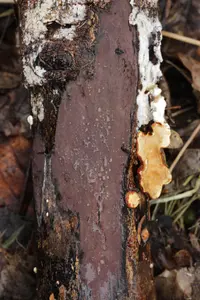
Hypoxylon petriniae is not a leafy plant but a wood-inhabiting fungus that forms crust-like patches on dead or declining branches, especially of hardwood trees. Its fruiting bodies create small, dark, cushion-like structures on bark surfaces.
This species occurs mainly in temperate forests, including parts of Europe and North America, where it plays a role in wood decay and nutrient recycling. It is not cultivated as an ornamental species, and attempts to care for Hypoxylon petriniae at home are uncommon and usually impractical.
In nature it favors moist, shaded conditions on already stressed or dead wood. Its growth depends more on the condition of the host wood than on typical garden care factors such as soil preparation or irrigation.

Care Difficulty
Moderate Care

Light Preference
Partial Shade

Water Requirements
Moderate Water

Temperature Preference
Warm Climate

Hardiness Zone
Unknown

Soil Texture
Loamy

Soil pH
Slightly acidic (6.5–7.0)

Soil Drainage
Well-drained

Fertilization
Minimal (feed rarely)
Scan your plant to receive care tips personalized for your specific plant
Available on iOS and Android
This wood-inhabiting fungus prefers stable, moderate light levels rather than intense direct sun.
This fungus depends on consistent substrate moisture rather than direct watering of fruiting bodies.
This species is adapted to temperate climates with cool to mild conditions throughout the year.
Humidity is not a meaningful care factor for Hypoxylon petriniae, which develops on wood rather than as a cultivated houseplant or garden specimen.
Soil preparation is generally irrelevant because Hypoxylon petriniae is a wood-inhabiting fungus rather than a plant grown in beds or pots.
This wood-decaying fungus is not suitable for container growing and is not maintained as a potted specimen.
This wood-decay fungus grows on host trees and does not need supplemental fertilizer in managed landscapes.
Pruning is not applied to Hypoxylon petriniae itself but to the living host tree it colonizes.
This fungus is not maintained as a potted specimen; management focuses on host trees rather than repotting.
Intentional propagation of this wood-inhabiting fungus is rarely practiced outside research or diagnostic contexts, so home propagation is not recommended.
Hypoxylon petriniae is naturally cold hardy; no specific winter protection is required for the fungus itself.

Plant Health Check
Not sure what's wrong with your plant? Check your plant's health inside the app.
This species is most frequently associated with dead or declining beech wood (Fagus species), showing a clear preference for smooth, pale bark where its dark crust-like fruiting bodies contrast strongly.
Its stromata form low, cushion-like crusts dotted with tiny, pimple-like mounds, each containing numerous perithecia, which are flask-shaped structures that release spores through minute openings.
The elongated, dark ascospores of this species have characteristic straight germ slits, a microscopic feature that mycologists use to distinguish it from closely related Hypoxylon species.

Hypoxylon petriniae was separated from the Hypoxylon rubiginosum complex based on detailed microscopic traits and chemical analyses of its pigment compounds, making it an example of how modern mycology uses both morphology and secondary metabolites to resolve cryptic species.
This species is a wood-decaying fungus found on dead or dying trees, not a typical ornamental plant. It is not considered a common poison source, but it is not regarded as edible and should not be consumed.
Keep your plants happy and healthy with plant identification, disease detection, and easy care guidance.