Shear After Bloom
Right after the main spring flowering flush, shear the plant back by about 1/3 to keep the mound dense, delay woodiness, and encourage a neater carpet of foliage for the rest of the year.

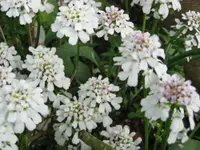
Evergreen candytuft, Iberis sempervirens, is a low, mat-forming perennial often used as an edging or rock garden plant. It forms dense cushions of narrow, dark green leaves that stay attractive year-round in mild climates.
In spring it produces abundant clusters of small white flowers that can cover the foliage and create a bright, uniform carpet. The plant naturally occurs in rocky, sunny slopes of southern Europe, which explains its preference for well-drained soil and moderate moisture.
Its compact growth habit, drought tolerance once established, and resistance to light frost make it relatively easy to maintain for most gardeners. Understanding these traits helps clarify how to care for Evergreen candytuft in typical home gardens.

Care Difficulty
Easy Care

Light Preference
Full Sun

Water Requirements
Low Water

Temperature Preference
Cold Hardy

Hardiness Zone
3–9

Soil Texture
Sandy, Loamy, Rocky

Soil pH
Slightly acidic (6.5–7.0), Slightly alkaline (7.0–7.5)

Soil Drainage
Well-drained

Fertilization
Minimal (feed rarely)
Scan your plant to receive care tips personalized for your specific plant
Available on iOS and Android
This sun-loving groundcover flowers best with strong light exposure in most climates.
This plant prefers slightly dry, well-drained conditions rather than frequent, heavy watering.
This hardy perennial tolerates a wide temperature range but performs best in cool to mild conditions.
Humidity is rarely a concern for Evergreen candytuft, which thrives in typical outdoor air conditions.
This species prefers mineral, free-draining soil and will decline in heavy, water-retentive substrates.
This plant is suitable for container growing, especially in sunny patios and rock-garden style pots.
This low-maintenance perennial benefits from modest feeding to support compact growth and flowering.
Pruning Iberis sempervirens keeps the plant dense, tidy, and free-flowering.
This species is usually grown in beds or rock gardens, so focus on careful transplanting rather than frequent repotting.
Iberis sempervirens is commonly propagated by cuttings and division to maintain desirable traits.
This evergreen perennial is generally cold hardy and often needs only minimal winter care in most temperate gardens.

Plant Health Check
Not sure what's wrong with your plant? Check your plant's health inside the app.
This species is not a typical short-lived bedding annual but a woody, low-growing evergreen subshrub that can persist for many years while keeping its foliage through winter in mild climates.
In its native range of southern Europe, this plant often grows on rocky slopes and limestone outcrops, where its roots anchor into crevices with very shallow, fast-draining soils.
Its dense clusters of white spring flowers provide one of the earlier nectar sources for bees and other pollinating insects when few other garden perennials are in full bloom.

The Royal Horticultural Society in the UK has granted this species the Award of Garden Merit, recognizing its long-term reliability, ornamental value, and stable performance under typical garden conditions.
This species is a true broadleaf evergreen in mild to moderately cold climates, keeping most foliage year-round. In very harsh winters, outer leaves may scorch or thin, but plants typically refoliate from protected inner growth in spring.
Keep your plants happy and healthy with plant identification, disease detection, and easy care guidance.