

Use fresh substrate
Prepare a clean, freshly pasteurized substrate such as a hardwood sawdust and straw mix before inoculation to reduce competition from other fungi and improve overall yield when growing Infundibulicybe squamulosa.

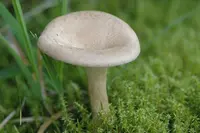
Infundibulicybe squamulosa is not a garden plant but a ground-dwelling mushroom species found in forests. It typically forms funnel-shaped caps with fine scales and pale to brownish tones, growing in soil or leaf litter.
This fungus is usually recorded in temperate woodland habitats, often among mixed or coniferous trees. It is not commonly cultivated, so anyone wanting to care for Infundibulicybe squamulosa will face challenges due to limited cultivation knowledge.
In nature it favors moist, cool, shaded conditions with organic-rich substrates. Its reliance on specific forest soils and microclimates makes it unsuitable for typical indoor or backyard growing setups.

Care Difficulty
Moderate Care

Light Preference
Partial Shade

Water Requirements
Moderate Water

Temperature Preference
Cool Climate

Hardiness Zone
Unknown

Soil Texture
Loamy, Organic-rich

Soil pH
Acidic (5.5–6.5)

Soil Drainage
Moist but well-drained

Fertilization
Minimal (feed rarely)
Scan your plant to receive care tips personalized for your specific plant
Available on iOS and Android
This forest-dwelling fungus prefers soft, filtered light rather than direct, open sun.
This species relies on consistently moist, not waterlogged, forest soil to form healthy fruiting bodies.
This fungus fruits best in cool to mild conditions typical of temperate woodland climates.
Humidity is not a primary factor for Infundibulicybe squamulosa, which copes well in typical outdoor ranges.
This fungus fruits best in loose, moist, well-drained, organic-rich soil that mimics a forest floor.
This species is not suitable for typical container growing, as it relies on complex soil and wood interactions in the ground.
This wild, saprophytic fungus usually obtains all needed nutrients from decaying organic matter and does not benefit from targeted fertilization in garden settings.
As a mushroom-forming fungus, Infundibulicybe squamulosa does not require horticultural pruning in the usual plant sense.
Transplanting focuses on moving colonized substrate or soil patches rather than treating this fungus like a potted plant.
Propagation of this fungus relies on spores and mycelium rather than conventional plant methods such as cuttings or division.
This outdoor fungus is generally cold hardy in its native range and needs no dedicated winter care.

Plant Health Check
Not sure what's wrong with your plant? Check your plant's health inside the app.
This species is recognized by its pale to ochre funnel-shaped cap covered with fine, darker scales, especially toward the center, which helps distinguish it from smoother-capped Infundibulicybe relatives.
It typically fruits on well-rotted leaf litter in mixed or coniferous forests, contributing to the breakdown of complex plant debris and recycling nutrients back into the soil.
Reports show a relatively restricted distribution compared with some congeners, often associated with specific forest types and soil conditions rather than appearing in a wide variety of habitats.
Identification of wild fungi is complex, and misidentification can be life‑threatening. This species is poorly documented in culinary literature, so it should be treated as non‑edible. Only consume mushrooms positively identified as edible by an experienced mycologist.
Keep your plants happy and healthy with plant identification, disease detection, and easy care guidance.

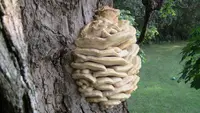
Northern Tooth
Climacodon septentrionalis
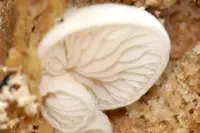
roundspored oysterling
Crepidotus cesatii
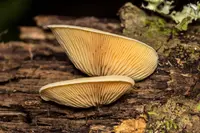
Saffron Crep
Crepidotus crocophyllus
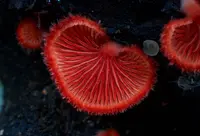
cinnabar oysterling
Crepidotus cinnabarinus
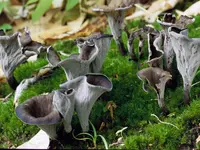
Eastern Black Trumpet
Craterellus fallax
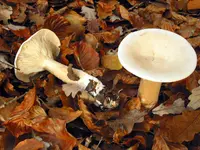
Trooping Funnel
Infundibulicybe geotropa
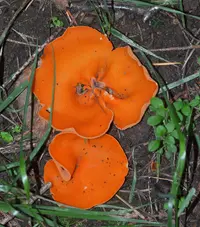
Orange peel fungus
Aleuria aurantia
Dacrymyces capitatus
Dacrymyces capitatus