Install discreet staking
Place a slim bamboo or fiberglass stake behind each clump before stems elongate in spring, then loosely tie flowering stems with soft garden tie so tall scapes do not snap in wind or heavy rain.

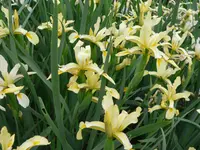
Turkish iris (Iris orientalis) is a clump-forming perennial grown for its tall, slender stems and elegant white flowers with yellow accents. It produces narrow, upright leaves that give a vertical, architectural look even when not in bloom.
This species is native to southeastern Europe and western Asia, where it grows in sunny, open habitats with reasonably moist but free-draining soil. It is generally considered a robust garden plant, provided it does not sit in waterlogged conditions.
Gardeners who learn how to care for Turkish Iris usually find it reliable, long-lived, and suitable for mixed borders or naturalistic plantings in temperate climates.

Care Difficulty
Moderate Care

Light Preference
Full Sun

Water Requirements
Moderate Water

Temperature Preference
Cold Hardy

Hardiness Zone
5–9

Soil Texture
Sandy, Loamy, Clay

Soil pH
Slightly acidic (6.5–7.0), Neutral (7.0)

Soil Drainage
Moist but well-drained

Fertilization
Minimal (feed rarely)
Scan your plant to receive care tips personalized for your specific plant
Available on iOS and Android
Iris orientalis needs bright, direct light for strong growth and reliable flowering.
This species prefers steady moisture but dislikes waterlogged soil.
This iris is a hardy perennial that tolerates cool winters and warm summers when temperature extremes are avoided.
Humidity has little impact on Iris orientalis, which thrives in typical outdoor conditions of 30–60% without special adjustment.
Iris orientalis prefers loose, well-drained mineral soil that stays evenly moist but never stagnant.
This species can grow successfully in containers when given a deep, stable setup that mimics open ground.
Iris orientalis benefits from modest feeding in spring and early summer to support flowering without creating lush, weak growth.
Pruning Iris orientalis is mainly about hygiene and maintaining a tidy clump, rather than reshaping the plant.
This species is usually grown in the ground, so focus on lifting and transplanting clumps rather than frequent container repotting.
Iris orientalis is most reliably multiplied by division of established clumps rather than by seed.
Established Iris orientalis is cold hardy in most temperate gardens and usually needs only light winter attention.

Plant Health Check
Not sure what's wrong with your plant? Check your plant's health inside the app.
This species occurs naturally in the eastern Mediterranean region, especially in western Turkey and nearby areas, where it grows in sunny, open habitats with well-drained, often calcareous soils.
Unlike many bearded irises, it has elegant white, slightly arching upper petals and narrow, drooping lower segments with a soft yellow signal, giving a more refined, lily-like look in bloom.
Its rhizomes slowly form dense clumps that can live for many years in the same spot, making it a long-lived structural plant in temperate gardens when basic Iris orientalis plant care needs are met.

Historically, this species has often been confused with and grown under the name Iris spuria or other related names in horticulture, so many older garden plants and references labeled as spuria iris are actually Iris orientalis.
Lack of flowers often results from insufficient sun, overly rich nitrogen fertilizer, or crowded, old clumps. Divide rhizomes every 3–4 years, avoid heavy feeding, and ensure the site is bright and well drained to restore flowering.
Keep your plants happy and healthy with plant identification, disease detection, and easy care guidance.