Log selection
Use freshly cut, disease-free hardwood logs with intact bark, as benzoin bracket establishes more reliably and fruits better on solid, uncompromised substrate than on decayed or punky wood.

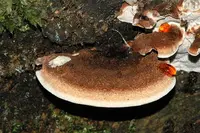
Benzoin bracket, Ischnoderma benzoinum, is a polypore fungus rather than a leafy houseplant. It forms thick, shelf-like brackets on dead or decaying conifer wood. The surface is usually dark brown with a velvety texture when young, becoming harder and more crusted as it ages. In nature it helps break down wood and recycle nutrients in cool, moist forests. For those who want to grow or care for Benzoin Bracket in controlled conditions, it requires consistently high humidity, stable moisture in a woody substrate, and good air circulation. It is not suited to typical pot culture and is best treated as a specialized cultivation project.

Care Difficulty
Moderate Care

Light Preference
Shade

Water Requirements
Keep Soil Moist

Temperature Preference
Cool Climate

Hardiness Zone
Unknown

Soil Texture
Organic-rich, Peaty, Loamy

Soil pH
Strongly acidic (4.5–5.5), Acidic (5.5–6.5)

Soil Drainage
Moist but well-drained

Fertilization
Minimal (feed rarely)
Scan your plant to receive care tips personalized for your specific plant
Available on iOS and Android
This bracket fungus prefers shaded forest conditions with limited direct sun exposure.
This wood-decay fungus relies on stable, evenly moist substrate rather than direct watering of the fruiting bodies.
This species is adapted to cool to mild temperate forests with noticeable seasonal variation.
This wood-decay fungus prefers consistently moist, cool air but adapts to a moderate range in cultivation.
Ischnoderma benzoinum grows best on substrates that mimic decaying wood rather than conventional potting soil.
This species can be grown in containers if the setup replicates a stable, moist wood-based substrate rather than standard potting conditions.
This wood-decay fungus usually needs no supplementary feeding when established on suitable host wood.
Ischnoderma benzoinum does not require true pruning, but small management steps keep colonies tidy and safe.
This fungus is typically grown on logs or woody substrates, so management focuses on repositioning or renewing the substrate rather than classic repotting.
Propagation of this bracket fungus is specialized and mainly carried out by experienced growers or researchers.
This wood-rotting species is naturally cold hardy across temperate climates and usually needs no special winter care outdoors.

Plant Health Check
Not sure what's wrong with your plant? Check your plant's health inside the app.
Fresh fruiting bodies release a noticeable sweet, resin-like odor that resembles benzoin resin, which is the origin of both the common name benzoin bracket and the species epithet benzoinum.
This species is a brown-rot fungus that specializes in decaying already weakened or dead conifer wood, breaking down cellulose and hemicellulose while leaving behind crumbly, brown lignin-rich residues.
Young brackets often show a velvety, dark brown surface with paler, concentrically zoned margins, and as they age the caps usually become smoother, tougher, and sometimes develop a cracked or slightly lumpy texture.

Molecular studies have shown that Ischnoderma benzoinum belongs to the order Polyporales but shares several microscopic traits with both polypores and stereoid fungi, making it a useful species for understanding evolutionary transitions between crust-like and bracket-forming wood decay fungi.
This wood-decay fungus colonizes dead or dying conifer wood and can gradually spread across logs or stumps, but it does not invade healthy trees or soil. In gardens, it is typically restrained by the amount of available dead wood.
Keep your plants happy and healthy with plant identification, disease detection, and easy care guidance.