Encourage Bushy Shape
Pinch back soft new shoot tips in late winter or early spring to promote denser branching and keep the shrub compact instead of leggy.

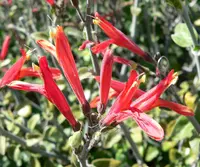
Beloperone, often sold under the name Justicia californica, is a shrubby, drought-tolerant plant valued for its tubular, hummingbird-attracting flowers. It typically forms a bushy mound with slender stems and narrow leaves, giving it a light, airy look in the landscape.
This species is native to arid regions of the southwestern United States and northern Mexico, where it thrives in hot, dry conditions and poor, rocky soils. In cultivation, it prefers full sun, fast-draining soil, and infrequent but deep watering, which makes it suitable for low-water gardens.
Because it is adapted to harsh climates and lean soils, many growers find it relatively easy to manage once established. Understanding how to care for beloperone mainly involves avoiding overwatering and providing strong light.

Care Difficulty
Easy Care

Light Preference
Full Sun

Water Requirements
Low Water

Temperature Preference
Warm Climate

Hardiness Zone
8–11

Soil Texture
Sandy, Loamy, Rocky

Soil pH
Slightly acidic (6.5–7.0), Slightly alkaline (7.0–7.5)

Soil Drainage
Well-drained

Fertilization
Minimal (feed rarely)
Scan your plant to receive care tips personalized for your specific plant
Available on iOS and Android
Justicia californica thrives in strong sun typical of arid and semi-arid landscapes.
Justicia californica is a drought-tolerant shrub that prefers deep, infrequent watering once established.
This desert-adapted shrub handles heat well but is sensitive to prolonged hard frost.
Justicia californica tolerates very dry air and usually does not need special humidity management.
Justicia californica prefers lean, fast-draining, sandy soil that never stays wet for long.
This species adapts well to container growing in sunny, dry locations.
Justicia californica is a low‑maintenance desert shrub that benefits from light feeding in poor soils but often manages without fertilizer in rich ground.
Pruning supports a compact shape and sustained flowering in Justicia californica without demanding intensive maintenance.
This desert shrub is more often transplanted in the landscape than repotted, as Justicia californica prefers stable conditions once established.
Justicia californica is commonly propagated from semi‑hardwood cuttings and sometimes from seed under warm, bright conditions.
Justicia californica is fairly cold hardy in arid climates and usually needs minimal winter care once established.

Plant Health Check
Not sure what's wrong with your plant? Check your plant's health inside the app.
This shrub’s long, tubular red flowers are shaped and timed to match the feeding behavior of desert hummingbirds, which are its primary pollinators in the Sonoran Desert.
In hot, dry conditions it often sheds most of its leaves and relies on its green stems for photosynthesis, an adaptation that reduces water loss while keeping energy production possible.
In its native desert habitat, peak flowering usually follows winter and early spring rains, showing a strong link between precipitation pulses and its reproductive cycle.

Genetic and field studies indicate that this species plays a key role as an early-season nectar source for migrating hummingbirds across parts of the Sonoran Desert, helping sustain their long-distance movements between wintering and breeding grounds.
Poor flowering often comes from insufficient light, excess nitrogen fertilizer, or old, unpruned wood. Provide strong light, use a balanced or low-nitrogen fertilizer, and prune lightly after flowering to stimulate new, bloom-producing shoots.
Keep your plants happy and healthy with plant identification, disease detection, and easy care guidance.