

Rotation for symmetry
Rotate the pot 1/4 turn every 2–3 weeks so new shoots receive even light, which keeps the plant compact and prevents it from leaning toward the brightest side.

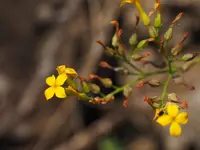
Kalanchoe ceratophylla is a succulent shrublet known for its deeply lobed, antler-like leaves and branching, upright stems. It typically stays compact, making it suitable for containers. Native to arid parts of Madagascar, it has evolved to store water in its fleshy tissues and tolerate dry air. This adaptation makes it relatively forgiving for beginners who may forget occasional waterings. The plant prefers bright light, fast-draining soil, and careful watering that lets the mix dry between soakings. Understanding how to care for Kalanchoe ceratophylla mainly involves avoiding overwatering and providing enough light to keep the stems sturdy and the foliage well-shaped.

Care Difficulty
Easy Care

Light Preference
Bright Indirect Light

Water Requirements
Low Water

Temperature Preference
Tropical / Frost Sensitive

Hardiness Zone
10–11

Soil Texture
Sandy, Loamy, Rocky

Soil pH
Acidic (5.5–6.5), Slightly acidic (6.5–7.0)

Soil Drainage
Well-drained

Fertilization
Minimal (feed rarely)
Scan your plant to receive care tips personalized for your specific plant
Available on iOS and Android
This sun-loving succulent prefers bright conditions with protection from harsh extremes.
This species stores water in its leaves and needs infrequent, careful watering.
This succulent favors warm, frost-free conditions with moderate heat.
This succulent handles indoor humidity well and rarely needs special humidity management.
Use a very free-draining, mineral-rich mix to prevent root rot in this succulent.
This species is very suitable for container growing due to its compact succulent habit.
This succulent needs modest feeding, focused on the active spring–summer growth period for balanced Kalanchoe ceratophylla care.
Pruning Kalanchoe ceratophylla helps keep a compact shape and maintain healthy, flowering growth.
Repotting supports healthy roots and stable growth in container-grown Kalanchoe ceratophylla.
Propagation of Kalanchoe ceratophylla is commonly done from stem or leaf cuttings under warm, bright conditions.
Winter care for Kalanchoe ceratophylla focuses on avoiding freezing temperatures and overly wet soil.

Plant Health Check
Not sure what's wrong with your plant? Check your plant's health inside the app.
This species is known for its deeply lobed, antler-like leaves with irregular, horn-shaped segments, a trait that helps distinguish it from many other kalanchoes with simpler leaf outlines.
It is native to dry, rocky habitats of Madagascar, where it grows in seasonally arid conditions with intense light and fast-draining, often shallow soils.
The leaf margins can produce small clonal plantlets, an asexual reproduction strategy that allows the plant to colonize nearby cracks and pockets of substrate efficiently, which is important when caring for Kalanchoe ceratophylla in cultivation.
Brown leaves usually result from underwatering, intense direct sun scorch, or old age of lower foliage. Check soil moisture, adjust light exposure, and remove dead or badly damaged leaves to reduce stress and prevent further decline.
Keep your plants happy and healthy with plant identification, disease detection, and easy care guidance.

Euphorbia pulvinata
Euphorbia aggregata
Soehrensia schickendantzii
Soehrensia schickendantzii
Haworthia bolusii
Haworthia bolusii
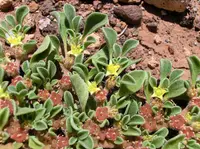
Purslane-leaved aizoon
Aizoon canariense
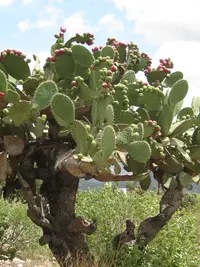
Opuntia streptacantha
Opuntia streptacantha
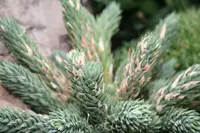
Blue Haworthia
Haworthiopsis glauca
Kleinia anteuphorbium
Kleinia anteuphorbium
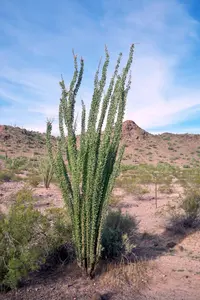
ocotillo
Fouquieria splendens