Controlled stem training
As stems elongate, loosely spiral them around a support or drape them over the pot rim to prevent kinking or breakage and to keep the plant compact and stable.

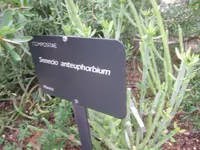
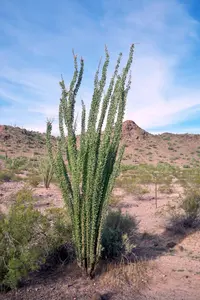
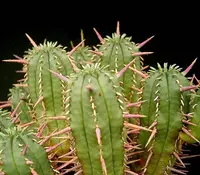
Kleinia anteuphorbium is a shrubby succulent from arid regions of northeast Africa and the Arabian Peninsula. It forms many upright, leafless, pencil-like stems with a gray-green surface. Small leaves appear only briefly on new growth, and flowers are modest, usually cream to yellow, on branched stalks. The overall look is architectural and somewhat cactus-like, although it is not a true cactus.
This species is adapted to high light, heat, and long dry periods, which makes it suitable for bright windowsills and xeric gardens in warm climates. Its drought tolerance and relatively slow growth make it manageable for beginners who want to learn how to care for Kleinia anteuphorbium without frequent watering demands.

Care Difficulty
Easy Care

Light Preference
Full Sun

Water Requirements
Low Water

Temperature Preference
Tropical / Frost Sensitive

Hardiness Zone
10–11

Soil Texture
Sandy, Loamy, Rocky

Soil pH
Slightly acidic (6.5–7.0), Neutral (7.0)

Soil Drainage
Well-drained

Fertilization
Minimal (feed rarely)
Scan your plant to receive care tips personalized for your specific plant
Available on iOS and Android
This drought-tolerant succulent prefers bright, direct light similar to arid, open habitats.
This species stores water in its succulent stems and prefers infrequent, deep watering.
This succulent thrives in warm, dry conditions and is sensitive to frost.
This drought-adapted succulent tolerates typical indoor humidity and does not need extra moisture in the air.
This species needs a very fast-draining, mineral-rich mix to prevent root and stem rot.
This species is well suited to container culture due to its shrubby, succulent growth habit.
This drought-adapted succulent needs modest feeding, with more focus on light and drainage than heavy nutrition for healthy Kleinia anteuphorbium growth.
This species benefits from light, targeted pruning to maintain shape and plant health.
Container-grown plants need only infrequent repotting, as the root system is relatively compact and tolerant of being slightly root-bound.
This succulent is commonly propagated from stem cuttings, which root well under warm, dry-leaning conditions.
This plant is frost sensitive and needs protection from freezing temperatures, especially in container culture.

Plant Health Check
Not sure what's wrong with your plant? Check your plant's health inside the app.
This species develops many jointed, cylindrical, blue-green stems that can become woody at the base, forming a small, shrub-like structure instead of a single upright stem typical of many succulents.
It produces small, narrow leaves near the stem tips during active growth, but these leaves are usually short-lived and drop as the plant enters a more drought-tolerant, leafless phase.
This plant is native to arid and semi-arid regions of northeastern Africa and the Arabian Peninsula, where it grows on rocky slopes and dry hillsides exposed to intense sunlight and minimal rainfall.
Slow growth usually comes from low light, cool temperatures, cramped roots, or too-frequent watering that keeps the soil constantly moist. Adjusting light, pot size, and watering rhythm typically improves vigor over several months of new growth.
Keep your plants happy and healthy with plant identification, disease detection, and easy care guidance.