


Mountain laurel Identification (Kalmia latifolia)

To recognize Mountain laurel, look for an evergreen shrub or small tree with thick, leathery, elliptic leaves set alternately along the stems, usually 2 to 5 inches (5 to 13 cm) long.

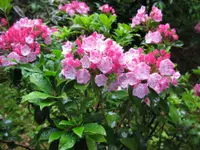
Its flowers form dense terminal clusters, and each bloom has a distinct shallow cup or saucer shape with five fused lobes.

Kalmia latifolia Identification

Check Your Plant with Botan

Upload a clear image to check whether your plant ID is correct.

Clear images work best. Avoid photos taken too close or too far away

Check the shrub’s leaves, branching, and flower shape first.

  • Broadleaf evergreen shrub, usually dense and many-branched, often about 5-15 feet (1.5-4.6 m) tall.
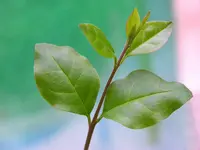
  • Leaves are simple, leathery, and mostly oval to elliptic, about 2-5 inches (5-13 cm) long, with smooth edges.
  • Leaves are arranged alternately along the stems, though they can appear clustered near branch tips.
  • Flower buds and open flowers sit in rounded clusters at the ends of branches.
  • Each flower is cup- to saucer-shaped with 5 fused lobes and a regular, geometric look.

If flowers are present, the terminal clusters and 5-lobed cups are especially useful clues.

Mountain laurel shows clear visual shifts from compact leafy growth to showy flowering and fruiting.

  • Young plant: Forms a dense, many-stemmed shrub with slender twigs and smaller evergreen leaves, often about 2-4 inches (5-10 cm) long, spaced along short side branches.
  • Mature plant: Develops a broader, layered framework with thicker, woody stems and a rounded outline; older specimens often show gnarled branching and a more open interior.
  • Flowering stage: Branch tips carry tight clusters of bowl-shaped buds that open into broad, saucer-like flowers, making the plant look capped with grouped blooms above the foliage.
  • Fruiting stage: After flowering, the clusters become upright, dry, rounded capsules held above the leaves, replacing the showy flower display with persistent, plainly structured seed heads.

Mountain laurel has several named selections with flower colors or foliage patterns that are easy to recognize.

  • 'Olympic Fire': New leaves emerge bright red to bronze-red before maturing green, a clear foliage contrast from the typical uniformly green leaves.
  • 'Peppermint': Flowers are pale pink to white with a bold red band around the corolla, unlike the usual solid pink flowers.
  • 'Carousel': Flowers are white with strong maroon-red striping and banding, giving a pinwheel effect not seen in the typical form.
  • 'Minuet': This dwarf cultivar usually stays about 2 to 3 feet tall and wide (0.6 to 0.9 m), with white flowers marked by a distinct red band.

Mountain laurel stays evergreen, so the leathery leaves remain visible year-round and help with recognition even in winter. The clearest seasonal clue comes in late spring to early summer, when dense clusters of cup-shaped flowers open at branch tips. After bloom, small dry seed capsules develop and can persist for a time.

A few broadleaf evergreens are regularly mistaken for Kalmia latifolia.

great laurel(Rhododendron maximum)

Often confused because both are dense evergreen shrubs with clustered pink-to-white flowers. Rhododendron maximum has longer leaves, often 4-8 inches (10-20 cm), and funnel-shaped blooms, not the cup-like, angular flowers of Kalmia.

Japanese andromeda(Pieris japonica)

Similar as an evergreen shrub with leathery leaves and pale flower clusters. Pieris japonica bears many small urn-shaped flowers in drooping chains, while Kalmia has broader clustered flowers and leaves usually arranged more distinctly in whorls near stem tips.

Kalmia latifolia is native to the eastern United States, from southern Maine south through the Appalachian region to northern Florida, and west to parts of Indiana, Kentucky, Louisiana, and Mississippi. It is most often found in acidic woodlands, forest edges, mountain slopes, and streamside thickets, especially in the Appalachians. Seeing it in eastern upland woods or rocky slopes helps separate it from similar broadleaf evergreens that are planted outside this range.

  • Poisonous if eaten: All parts of Kalmia latifolia, especially the leaves, flowers, nectar, and stems, are toxic if ingested by humans and pets. The plant contains grayanotoxins, which can affect the heart and nervous system.
  • Risk from honey: Honey made from mountain laurel nectar can also contain grayanotoxins and is harmful if ingested by humans.

Scan. Check. Confirm.

Use Botan to identify or verify a plant from a photo, which helps avoid mix-ups with similar species.

FAQ

The most reliable feature is the flower: shallow cup-shaped blooms with 10 tiny pockets that hold the stamens. For Mountain laurel identification, pair that with thick, evergreen, elliptic leaves arranged alternately on woody stems.

Everything About Mountain laurel

More Plant Identification Guides

Scan Your Plant. Get the Details.

Identify a plant from a photo with Botan, then review its profile, care information, and common problems.

Botan app identifying a plant from a photo
Frozen vs Fresh Vegetable Nutrients: Which Option Is Healthier?

6 min read · 8 Sept 2026

Frozen vs Fresh Vegetable Nutrients: Which Option Is Healthier?

Frozen and fresh vegetables are nutritionally comparable: frozen produce often retains vitamins just as well as fresh and may sometimes contain more. Here’s how blanching and storage affect nutrients—and when to choose each.

Plant Recommendations
Frozen vs Fresh Vegetable Nutrients: Which Option Is Healthier?
How Often to Water Fruit Trees

7 min read · 11 Aug 2026

How Often to Water Fruit Trees

Irrigation needs change as roots establish and weather shifts. This guide gives practical starting intervals, explains how soil and tree type change them, and shows how to recognize both excess moisture and drought stress.

Plant Care
How Often to Water Fruit Trees
How to Repot a Plant: A Step-by-Step Guide

7 min read · 28 May 2026

How to Repot a Plant: A Step-by-Step Guide

In spring, many plants need repotting—an essential part of care. To avoid stress, consider the plant’s type and size. This article offers a step-by-step guide for repotting indoors or outdoors and shows how to check plant health and get care tips using the Botan App.

Plant Care
How to Repot a Plant: A Step-by-Step Guide