Staggered Deadheading
Cut individual spent stems back to the next strong bud every week during peak bloom instead of shearing the whole plant at once, which keeps flowers coming while preserving a natural shape.

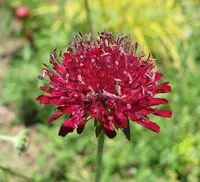
Macedonian scabious, Knautia macedonica, is a clump-forming perennial grown mainly for its long season of small, pincushion-like crimson flowers. It typically produces slender, branching stems above a basal mound of divided, slightly rough foliage, giving a light, airy look in mixed borders or meadow-style plantings.
This species is native to the Balkans and surrounding regions, where it grows in open, sunny, often rocky places. It adapts well to garden conditions, and many gardeners find it relatively easy if given full sun, moderately fertile, well-drained soil, and regular but not excessive moisture.
Once established, it is fairly resilient and continues blooming with minimal effort, which makes it straightforward to care for Macedonian scabious in many temperate gardens.

Care Difficulty
Easy Care

Light Preference
Full Sun

Water Requirements
Moderate Water

Temperature Preference
Cold Hardy

Hardiness Zone
5–9

Soil Texture
Sandy, Loamy, Rocky

Soil pH
Acidic (5.5–6.5), Slightly acidic (6.5–7.0)

Soil Drainage
Well-drained

Fertilization
Minimal (feed rarely)
Scan your plant to receive care tips personalized for your specific plant
Available on iOS and Android
This sun-loving perennial flowers best with strong light and open exposure.
This plant prefers evenly moist but not saturated soil, especially during establishment.
This hardy perennial manages a broad temperature range once established in the garden.
Humidity is rarely a concern for this species and it thrives in typical outdoor air conditions.
Knautia macedonica prefers lean, well-drained ground that mimics its natural meadow and hillside habitats.
This species can grow in containers if drainage and root space are carefully managed.
This perennial prefers lean soil and only light supplemental feeding for best flowering and sturdy growth.
Pruning helps Knautia macedonica stay compact and extend its flowering season.
This species is usually grown in the ground and dislikes frequent disturbance once established.
Knautia macedonica is commonly propagated from seed and by careful division of mature clumps.
This perennial is generally cold hardy in temperate climates and needs minimal winter attention once established.

Plant Health Check
Not sure what's wrong with your plant? Check your plant's health inside the app.
This species produces domed crimson flower heads made of many tiny florets on long wiry stems, giving a pin-cushion appearance that stays attractive even as older blooms fade beside new ones.
In suitable conditions it can flower repeatedly from early summer into early fall, because each stem forms successive buds rather than opening all florets at once.
In its native Balkan range it is typically found in sunny, well-drained meadows and rocky grasslands, which explains its strong performance in low-fertility, dry garden soils.

This species is notably attractive to butterflies and other pollinating insects, often acting as a prolonged nectar source in mixed meadows because its many small tubular florets open over an extended period rather than all at once.
Lack of flowers usually comes from too much shade, overly rich or wet soil, or plants becoming old and woody. Divide clumps every few years and deadhead spent blooms to extend flowering and maintain strong performance.
Keep your plants happy and healthy with plant identification, disease detection, and easy care guidance.