Encourage Deep Rooting
In the first growing season, water less frequently but more deeply to encourage roots to follow moisture downward, which improves drought resilience on dry, rocky sites.

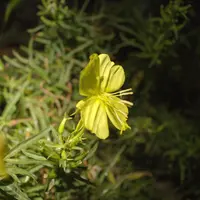
Shale barren evening primrose, Oenothera argillicola, is a small, short-lived perennial or biennial wildflower adapted to very dry, rocky slopes. It forms low rosettes of narrow leaves and sends up slender stems with pale yellow, night-opening flowers that attract moths and other pollinators.
This species is native to shale barrens and similar open habitats in parts of the eastern United States, where soils are thin, poor, and fast-draining. It is generally challenging outside its natural range, since it dislikes rich, moist, or heavily shaded conditions.
Gardeners who want to learn how to care for shale barren evening primrose should focus on replicating its native conditions: full sun, excellent drainage, and lean, gritty soil with minimal disturbance.

Care Difficulty
Moderate Care

Light Preference
Full Sun

Water Requirements
Low Water

Temperature Preference
Cold Hardy

Hardiness Zone
5–7

Soil Texture
Sandy, Loamy, Rocky

Soil pH
Slightly acidic (6.5–7.0), Neutral (7.0)

Soil Drainage
Well-drained

Fertilization
Minimal (feed rarely)
Scan your plant to receive care tips personalized for your specific plant
Available on iOS and Android
This species thrives in open, bright sites that mimic its native shale barrens.
This plant is adapted to dry, fast-draining habitats and is sensitive to excess moisture.
This species is adapted to continental climates with cold winters and hot, dry summers.
Humidity is not a major factor for Oenothera argillicola, which prefers dry, open conditions.
Soil for Oenothera argillicola must be very free-draining and low in organic matter to mimic its native shale habitats.
This species can be grown in containers, but only if drainage and dryness are carefully controlled.
This species is adapted to nutrient-poor shale soils, so shale barren evening primrose needs only minimal fertilization in cultivation.
Pruning Oenothera argillicola is simple and mainly supports tidy growth and strong flowering.
This species is usually grown in-ground, so focus on careful transplanting rather than frequent repotting.
Propagation of this evening primrose relies mainly on seed, which establishes well in suitable, gritty soils.
This hardy perennial usually needs little special winter care in typical temperate climates.

Plant Health Check
Not sure what's wrong with your plant? Check your plant's health inside the app.
This species is naturally restricted to shale barrens and steep shale slopes of the central Appalachian region, where few other flowering plants can tolerate the thin, unstable substrates.
Its pale yellow flowers typically open in the evening and are short-lived, a trait that aligns flowering time with nocturnal and crepuscular pollinators such as moths.
Populations often occur in scattered, localized colonies along road cuts and exposed shale outcrops, reflecting both habitat fragmentation and its specialization for disturbed shale substrates.
This species is highly attractive to night-flying moths and also visited by native bees. The pale yellow, evening-opening flowers provide nectar and pollen, supporting local pollinator populations in dry, open habitats and rock gardens.
Keep your plants happy and healthy with plant identification, disease detection, and easy care guidance.