

Host tree selection
Establish the fungus only near compatible ectomycorrhizal trees such as beech, oak, or spruce, and avoid planting it close to heavily fertilized lawns, which suppress the necessary root–fungus partnership.

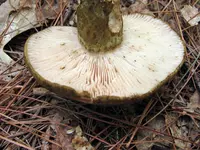
The dark-spotted milkcap, Lactarius atroviridis, is a mycorrhizal mushroom that forms symbiotic partnerships with tree roots, especially in conifer and mixed forests. It is not a typical houseplant but may interest advanced growers or foragers.
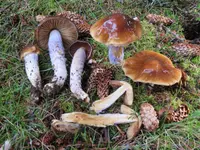
Caps are usually dark green to olive with scattered darker spots, and the gills exude a milky latex when damaged. This fungus fruits from soil rather than decaying wood and often appears in groups.
It naturally occurs in parts of Europe, where it helps trees absorb water and nutrients. Those wanting to care for dark-spotted milkcap need to understand its reliance on suitable host trees, undisturbed soil, and consistently moist but not waterlogged conditions.

Care Difficulty
Hard Care

Light Preference
Partial Shade

Water Requirements
Keep Soil Moist

Temperature Preference
Cool Climate

Hardiness Zone
Unknown

Soil Texture
Loamy, Organic-rich

Soil pH
Acidic (5.5–6.5)

Soil Drainage
Moist but well-drained

Fertilization
Minimal (feed rarely)
Scan your plant to receive care tips personalized for your specific plant
Available on iOS and Android
This ectomycorrhizal fungus prefers stable, filtered woodland light rather than direct open sun.
This mycorrhizal mushroom depends on consistently moist, not waterlogged, soil around its host tree roots.
This woodland fungus thrives in cool to mild conditions and is sensitive to both hard frost and extreme heat.
This mycorrhizal mushroom needs consistently moist, humid forest-like air to fruit well.
This ectomycorrhizal fungus relies on suitable forest soil rather than a standard potting medium.
This forest mushroom is not well-suited to typical container growing, since it depends on living tree roots in natural soil.
This ectomycorrhizal fungus relies mainly on its tree host and natural soil nutrients, so fertilization is usually unnecessary.
Lactarius atroviridis does not require pruning in the usual horticultural sense, since it is a wild mycorrhizal mushroom rather than a garden plant.
This species is not suited to conventional repotting, as it lives in symbiosis with tree roots in soil rather than as an independent potted plant.
Reproducing Lactarius atroviridis under garden or indoor conditions is difficult because it depends on a specific ectomycorrhizal relationship with host trees.
In natural settings this fungus is cold hardy and typically needs no targeted winter care from gardeners.

Plant Health Check
Not sure what's wrong with your plant? Check your plant's health inside the app.
When cut or damaged, its white latex rapidly stains dark green to almost black on the gills and flesh, a key diagnostic trait that separates it from many other milkcaps.
This species forms ectomycorrhizal partnerships with spruce, especially Picea abies, and is most often recorded in montane to subalpine conifer forests rather than lowland woodlands.
Mature caps often show a dull green to olive tinge on a darker background, combined with dark-spotted gills, giving the mushroom a characteristic appearance used by field mycologists when identifying and growing dark-spotted milkcap in culture trials.
This mushroom is generally considered inedible or of low culinary value and is not recommended for consumption. Identification of wild fungi is difficult, and misidentification can be dangerous, so avoid eating specimens unless verified by a qualified mycologist.
Keep your plants happy and healthy with plant identification, disease detection, and easy care guidance.

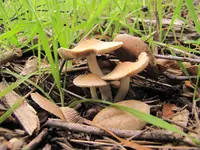
Coprinopsis uliginicola
Coprinopsis uliginicola
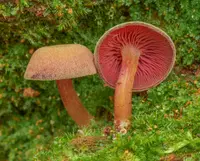
Purple-edged Lute
Callistosporium purpureomarginatum
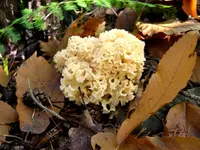
Cauliflower Fungus
Sparassis crispa
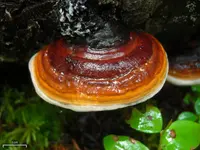
Red-banded polypores
Fomitopsis pinicola
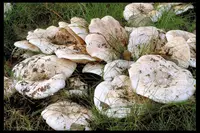
Blushing Milkcap
Lactarius controversus
Cyathicula cyathoidea
Cyathicula cyathoidea
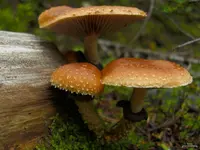
Leratiomyces squamosus
Leratiomyces squamosus
Cortinarius seidliae
Cortinarius seidliae