

Use clean substrate
Prepare hardwood chips or a woodchip–compost mix that has been aged and leached by rain for several months to reduce excess nutrients and salt that can suppress fruiting.

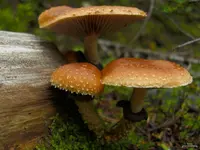
Leratiomyces squamosus is a saprophytic fungus, not a leafy houseplant. It forms medium-sized, often scaly caps on stout stems, usually in clusters. The fruiting bodies appear on rich, disturbed ground such as garden beds, composted areas, or woodchip mulch. It is most often seen in temperate regions after rain, especially in urban and suburban landscapes. This species can be unpredictable and short-lived, which makes it challenging to grow intentionally at home. Those who want to care for Leratiomyces squamosus should know it relies on decaying organic matter, steady moisture, and mild temperatures rather than typical houseplant-style care.

Care Difficulty
Moderate Care

Light Preference
Partial Shade

Water Requirements
Regular Water

Temperature Preference
Cool Climate

Hardiness Zone
Unknown

Soil Texture
Loamy, Silty, Organic-rich

Soil pH
Acidic (5.5–6.5), Slightly acidic (6.5–7.0)

Soil Drainage
Moist but well-drained

Fertilization
Minimal (feed rarely)
Scan your plant to receive care tips personalized for your specific plant
Available on iOS and Android
This wood-inhabiting fungus prefers cool, shaded to semi-shaded forest or garden edges rather than strong open sun.
Moist, well-drained woody or organic substrate is critical for sustained fruiting of this fungus.
This species fruits best in cool to mild conditions and is sensitive to both hard frost and intense heat.
This wood-rotting fungus grows best in moist, sheltered conditions rather than very dry air.
This species fruits on nutrient-rich, organic substrates rather than conventional garden soil.
This fungus can be grown in containers if the pot is treated as a controlled substrate bed rather than standard potted soil.
This wood-decaying fungus occurs naturally on nutrient-rich wood chips and rarely benefits from intentional fertilization.
Leratiomyces squamosus does not need horticultural pruning, as fruiting bodies are temporary and arise from buried mycelium.
Cultivation in containers is uncommon; management focuses on where the fungus is allowed to fruit in beds or mulched areas.
Practical propagation of this wild saprophytic fungus is limited and not handled like a typical ornamental plant.
Outdoor colonies are generally hardy in temperate climates and need no special winter care beyond stable substrate conditions.

Plant Health Check
Not sure what's wrong with your plant? Check your plant's health inside the app.
This species is strongly associated with woodchip mulch and other woody landscaping debris, where it often fruits in large clusters after rain in urban parks, playgrounds, and garden beds.
The cap is typically reddish-brown to chestnut with coarse, darker scales, especially toward the center, which helps distinguish it from many smooth-capped brown lawn mushrooms.
It contains toxic compounds that can cause gastrointestinal distress, and its brown gills and ringed stem mean it is easily confused with some edible agarics, so it must never be collected for food.
This fungus is not recommended for consumption. Identification within this group is difficult, and similar species may be toxic or cause gastrointestinal upset. For safety, treat it as inedible and do not harvest or eat it.
Keep your plants happy and healthy with plant identification, disease detection, and easy care guidance.

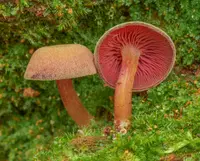
Purple-edged Lute
Callistosporium purpureomarginatum
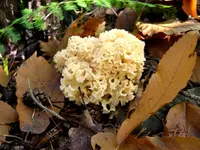
Cauliflower Fungus
Sparassis crispa
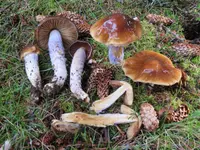
Cortinarius seidliae
Cortinarius seidliae
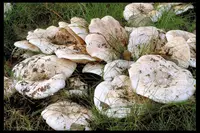
Blushing Milkcap
Lactarius controversus
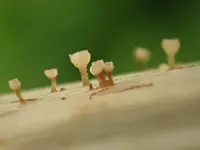
Cyathicula cyathoidea
Cyathicula cyathoidea
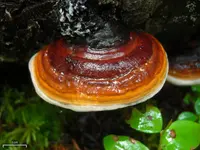
Red-banded polypores
Fomitopsis pinicola
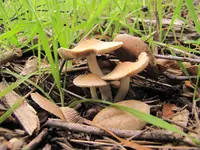
Coprinopsis uliginicola
Coprinopsis uliginicola
Velvet Bolete
Suillus variegatus