Host tree pairing
Plant the fungus near compatible host trees such as pine on free-draining, acidic soil and avoid mixing in lime or wood ash, since a stable, slightly acidic environment supports reliable mycorrhiza formation.

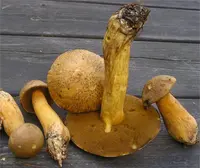
Velvet bolete, Suillus variegatus, is a mycorrhizal mushroom that forms a close partnership with the roots of pine trees. It appears as low, stocky fruiting bodies emerging from soil or moss in coniferous forests.
The cap surface is dry, velvety, and yellow‑brown to olive‑brown, with a sponge-like pore layer instead of gills underneath. It typically grows in groups on acidic, sandy soils.
This species is native to and widespread across northern and temperate Europe and is associated mainly with Scots pine and related species. It can be challenging to cultivate because it depends on a living pine host, so most people do not attempt to care for Velvet Bolete at home.
In nature it favors cool conditions, consistent moisture, and well-drained, slightly acidic soil around suitable host trees.

Care Difficulty
Hard Care

Light Preference
Partial Shade

Water Requirements
Regular Water

Temperature Preference
Cool Climate

Hardiness Zone
3–7

Soil Texture
Sandy, Loamy, Organic-rich

Soil pH
Strongly acidic (4.5–5.5), Acidic (5.5–6.5)

Soil Drainage
Moist but well-drained

Fertilization
Minimal (feed rarely)
Scan your plant to receive care tips personalized for your specific plant
Available on iOS and Android
This ectomycorrhizal fungus prefers bright woodland conditions with limited direct sun.
This fungus needs consistently moist, not waterlogged, soil around its tree partners.
This species is adapted to cool to mild temperate climates with distinct seasons.
Suillus variegatus develops best in moderately moist, well-aerated conditions outdoors, so indoor humidity control is rarely critical.
Suillus variegatus relies on specific soil conditions that support both the fungus and its tree partners.
This species is not suitable for typical container growing because it depends on mycorrhizal association with living conifer roots in the ground.
This ectomycorrhizal fungus relies mostly on its tree host, so Velvet Bolete needs little or no additional fertilizer.
Suillus variegatus does not require conventional pruning, since only short-lived fruiting bodies appear above ground.
Transplanting focuses on the tree and soil where this mycorrhizal fungus lives, not on moving the mushroom itself.
Propagation of Suillus variegatus is specialized and not usually attempted in typical home settings.
This species is naturally cold hardy in temperate climates and generally needs no special winter care.

Plant Health Check
Not sure what's wrong with your plant? Check your plant's health inside the app.
This species forms ectomycorrhizal associations almost exclusively with two-needle pines such as Scots pine, meaning its fine fungal threads wrap around the tree roots and help them absorb water and minerals in nutrient-poor, sandy soils.
Unlike many boletes with sticky or slimy caps, this species has a characteristically dry, velvety cap surface even in damp weather, which is a key field trait used by mycologists to separate it from similar Suillus species.
The spore-bearing surface under the cap is composed of small, angular pores that often become mottled or spotted as the mushroom ages, giving rise to the common name velvet bolete and helping distinguish it from boletes with larger, round pores.

Suillus variegatus is an important early colonizer of disturbed, sandy conifer sites in northern Europe, often appearing soon after pine planting and helping stabilize young forest ecosystems by improving tree nutrient uptake long before a full forest soil community has developed.
This species is considered edible but of modest culinary quality. The cap can become slimy when wet and the texture soft. Always cook thoroughly, avoid old or insect‑ridden specimens, and never eat wild fungi without confident identification.
Keep your plants happy and healthy with plant identification, disease detection, and easy care guidance.