Host tree selection
Establish the fungus with compatible host trees such as pine, spruce, or fir, and avoid planting it near heavily fertilized lawns where high phosphorus can suppress mycorrhizal formation.

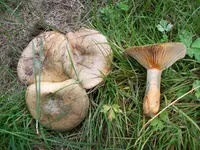
Carrot milkcap, Lactarius quieticolor, is a wild ectomycorrhizal mushroom that forms a symbiotic relationship with trees, especially conifers. It is not a houseplant but a forest-dwelling fungus. Caps are usually orange to carrot-colored, often with concentric zones, and exude orange latex when cut. It typically appears in mossy or moist woodland floors. This species depends on living tree roots, so it cannot be grown in standard pots or garden beds. For anyone exploring how to care for carrot milkcap, the key point is that it needs a suitable forest-like habitat, partner trees, and undisturbed soil to establish and fruit.

Care Difficulty
Hard Care

Light Preference
Partial Shade

Water Requirements
Keep Soil Moist

Temperature Preference
Cool Climate

Hardiness Zone
Unknown

Soil Texture
Loamy, Silty, Organic-rich

Soil pH
Strongly acidic (4.5–5.5), Acidic (5.5–6.5)

Soil Drainage
Moist but well-drained

Fertilization
Minimal (feed rarely)
Scan your plant to receive care tips personalized for your specific plant
Available on iOS and Android
This ectomycorrhizal fungus relies on forest light conditions rather than direct garden-style sun exposure.
Moist, well-drained forest soil is more important than direct watering of the fungal organism itself.
This species is adapted to cool to mild forest climates with distinct seasonal shifts.
This ectomycorrhizal fungus forms best fruiting bodies in consistently moist, not saturated, air conditions near soil level.
Lactarius quieticolor requires a specific outdoor soil environment rather than a standard cultivated bed.
This species is not suitable for long-term container growing because it depends on ectomycorrhizal partnership with tree roots in living soil.
This mycorrhizal fungus lives in partnership with host tree roots and usually does not require additional fertilizer in natural or woodland-style plantings.
Lactarius quieticolor does not need conventional pruning because the visible part is a short-lived mushroom, not a woody plant.
This species is not suited to typical container culture, so focus on careful site preparation and minimal disturbance of its tree partners rather than routine repotting.
Propagation of Lactarius quieticolor is specialized and mainly handled by professional mycologists or inoculated-tree nurseries, not typical home growers.
This woodland fungus is naturally cold hardy in its native range and normally needs no special winter care when established with suitable host trees.

Plant Health Check
Not sure what's wrong with your plant? Check your plant's health inside the app.
When the fruiting body is cut or damaged, it exudes a bright orange milk that slowly turns wine-red on exposure to air, a key field character separating it from similar Lactarius species.
This species forms ectomycorrhizal associations with conifers, especially spruces and pines, exchanging mineral nutrients from the soil for sugars from the host tree and helping the roots explore a larger soil volume.
Lactarius quieticolor is primarily found in cool to cold, boreal and subalpine regions of Europe and North America, fruiting in late summer to autumn when soil temperatures are relatively low.

Molecular studies have shown that Lactarius quieticolor belongs to a closely related group of orange-latex Lactarius species, and careful DNA sequencing is often needed to separate it reliably from its near look-alikes despite their obvious color differences in the field.
This mushroom is considered edible and is eaten in some regions, usually cooked rather than raw to improve texture and flavor. Always confirm identification with an expert, because similar orange milkcaps and other fungi can be toxic.
Keep your plants happy and healthy with plant identification, disease detection, and easy care guidance.