Host tree selection
Establish the fungus only near suitable host trees such as spruce or fir, since this species forms obligate mycorrhiza and will not persist in lawns or isolated beds without compatible roots.

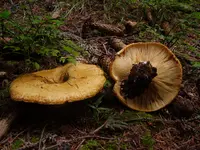
Lactarius scrobiculatus, commonly called spotted milkcap, is a mycorrhizal mushroom that forms symbiotic associations with conifer trees, especially spruce and fir. It is not a houseplant or ornamental species, but a wild forest fungus.
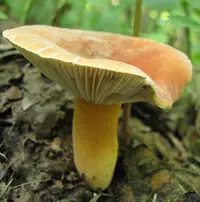
The cap is typically yellow to golden with darker spots and concentric zones, and it exudes a milky latex when damaged. It usually appears in mossy, moist soils in cool, temperate forests across parts of Europe and North America.
Spotted milkcap depends on living tree partners, so it is difficult to cultivate deliberately, even outdoors. For anyone wanting to understand how to care for spotted milkcap, it is usually best viewed and studied in its natural woodland habitat rather than grown at home.

Care Difficulty
Hard Care

Light Preference
Partial Shade

Water Requirements
Regular Water

Temperature Preference
Cool Climate

Hardiness Zone
3–7

Soil Texture
Loamy, Silty, Organic-rich

Soil pH
Strongly acidic (4.5–5.5), Acidic (5.5–6.5)

Soil Drainage
Moist but well-drained

Fertilization
Minimal (feed rarely)
Scan your plant to receive care tips personalized for your specific plant
Available on iOS and Android
This ectomycorrhizal fungus prefers cool, forest light rather than open, direct sun.
Lactarius scrobiculatus depends on steady soil moisture around its host tree roots, not surface wetness alone.
This species prefers cool to mild conditions typical of temperate coniferous or mixed forests.
Humidity is not a meaningful cultivation factor for Lactarius scrobiculatus, which fruits in natural outdoor forest conditions rather than controlled indoor environments.
This ectomycorrhizal fungus depends on specific forest soil conditions rather than standard garden substrates.
This species is not suitable for container growing because it requires a stable ectomycorrhizal partnership with host tree roots in undisturbed forest soil.
This wild ectomycorrhizal fungus forms a nutrient-sharing partnership with host trees and generally needs no added fertilizer in natural soil.
Lactarius scrobiculatus does not require pruning, as its visible fruiting bodies are temporary and the main organism lives as a hidden mycelial network in the soil.
Transplanting focuses on supporting the tree and soil where this fungus naturally associates, since the organism itself is not suited to typical pot culture.
Propagation of Lactarius scrobiculatus is specialized and rarely attempted by typical home growers, as it depends on complex tree–fungus interactions.
This species is naturally cold hardy in its native temperate forests and needs no special winter care beyond maintaining a stable woodland-like environment.

Plant Health Check
Not sure what's wrong with your plant? Check your plant's health inside the app.
The species is named for its stem covered in conspicuous, darker, pit-like depressions (scrobiculae), which are important for reliable field identification within the Lactarius genus.
When damaged, the gills and flesh exude a yellow, often slowly browning latex that tastes strongly acrid and can cause mouth irritation in humans, which is one reason it is generally considered inedible or at best conditionally edible in many field guides.
This fungus forms ectomycorrhizal associations mainly with spruce and sometimes other conifers, exchanging mineral nutrients and water from the soil for carbohydrates from its host trees, and is typically found in moist, acidic coniferous forests of northern and montane regions.

In some Eastern European and Russian traditions, the mushroom is salted or parboiled to reduce its acrid compounds and then eaten as a pickled delicacy, although many modern field guides still classify it as inedible due to its harsh taste and potential for gastrointestinal upset.
This fungus is generally considered inedible and is sometimes reported as mildly toxic or strongly irritating to the digestive system. It should not be collected for food, especially since it can be confused with other, more toxic milkcaps.
Keep your plants happy and healthy with plant identification, disease detection, and easy care guidance.