

Encourage Mycorrhizal Partners
Plant host trees such as pine, spruce, or oak and avoid disturbing their roots, since this fungus relies on mycorrhizal association with living tree roots to form productive fruiting patches.

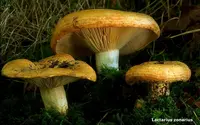
The ringed milk-cap, Lactarius zonarius, is a mycorrhizal mushroom that forms symbiotic partnerships with tree roots, especially in conifer and mixed woodlands. It is not a houseplant and cannot complete its life cycle in a regular pot.
Its caps are typically pale to ochre with distinct concentric rings, and they exude a milky latex when cut or damaged. In nature it appears in temperate regions, often on forest floors with leaf litter or moss.
This species depends on specific tree partners and undisturbed soil, which makes it difficult to cultivate deliberately. General guides on how to care for Ringed milk-cap focus more on conserving suitable woodland habitat than on conventional gardening methods.

Care Difficulty
Hard Care

Light Preference
Partial Shade

Water Requirements
Regular Water

Temperature Preference
Cool Climate

Hardiness Zone
Unknown

Soil Texture
Loamy, Silty, Organic-rich

Soil pH
Acidic (5.5–6.5)

Soil Drainage
Moist but well-drained

Fertilization
Minimal (feed rarely)
Scan your plant to receive care tips personalized for your specific plant
Available on iOS and Android
This ectomycorrhizal fungus prefers dappled woodland light rather than open, exposed sun.
This forest mushroom depends on evenly moist, well-drained soil rather than direct watering of the fruiting bodies.
This species fruits best in mild to cool conditions typical of temperate woodlands.
Humidity is not a primary factor for Lactarius zonarius, which grows naturally in outdoor forest conditions rather than controlled indoor environments.
This ectomycorrhizal fungus relies on host tree roots, so soil preparation focuses on supporting that partnership rather than the fungus alone.
This species is not suitable for container growing because its life cycle depends on extensive root associations with trees in undisturbed soil.
Lactarius zonarius is a mycorrhizal fungus associated with host tree roots and usually does not need intentional fertilization in garden or forest settings.
Lactarius zonarius does not require pruning in the usual horticultural sense, since the visible part is a short-lived mushroom rather than a persistent plant structure.
Transplanting Lactarius zonarius is rarely successful because this fungus depends on a stable mycorrhizal relationship with its host tree roots.
Caring for Ringed milk-cap does not usually involve intentional propagation, since this fungus reproduces naturally via spores and complex root associations.
Lactarius zonarius is naturally cold hardy in its native range and normally needs no special winter care in outdoor woodland or garden settings.

Plant Health Check
Not sure what's wrong with your plant? Check your plant's health inside the app.
The cap surface typically shows concentric zones of paler and darker orange to yellow tones, which is reflected in the epithet zonarius meaning zoned or banded.
When cut or damaged, the gills exude a white latex that tastes strongly acrid or peppery, a key macroscopic feature used by mycologists to separate it from similar-looking Lactarius species.
This species often fruits in calcareous, or lime-rich, soils, especially in broadleaf woodlands, which helps distinguish its habitat niche from related milk-cap fungi that favor more acidic substrates.

Lactarius zonarius forms ectomycorrhizal associations with trees, meaning its underground fungal threads closely wrap around fine roots and exchange mineral nutrients and water for sugars, contributing significantly to forest nutrient cycling where it occurs.
This mushroom is generally considered inedible or of poor culinary value. Some related milk-cap species cause gastrointestinal upset. For safety, do not eat wild specimens unless confirmed by a qualified local mycologist and regional field guide.
Keep your plants happy and healthy with plant identification, disease detection, and easy care guidance.

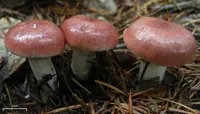
Rosy Slime Spike
Gomphidius subroseus
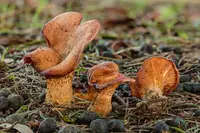
tawny funnel cap
Paralepista flaccida

Hymenotorrendiella eucalypti
Hymenotorrendiella eucalypti
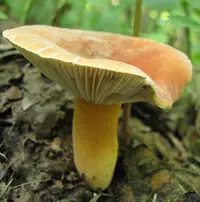
Lactifluus hygrophoroides
Lactifluus hygrophoroides
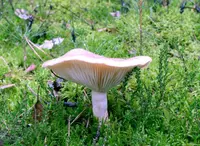
tacked milkcap
Lactarius trivialis
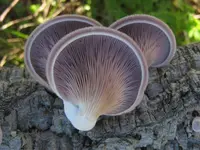
Hairy Oyster Mushroom
Panus neostrigosus
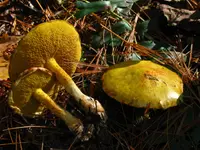
Chicken Fat Mushroom
Suillus americanus
Flammulaster limulatus
Flammulaster limulatus