Select host wood
Use freshly cut, disease-free eucalypt or other suitable hardwood logs, 10–25 cm in diameter, as substrate and avoid resinous softwoods that slow colonization and can inhibit mycelium growth.

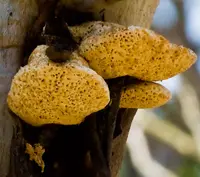
White punk, Laetiporus portentosus, is a perennial bracket fungus rather than a leafy plant. It forms thick, hoof-shaped shelves on living or dead trees, often eucalypts. The fruiting bodies are usually pale cream to whitish and corky, with a firm, spongy texture that becomes tougher as it ages.
This species is native to Australia, New Zealand, and parts of South America, where it acts as a wood-decaying organism. It is not commonly grown in home gardens, and successful cultivation can be challenging because it requires suitable host wood and stable outdoor conditions. For those exploring how to care for white punk, the fungus generally prefers cool, moist, shaded environments and naturally colonizes well-weathered wood.

Care Difficulty
Moderate Care

Light Preference
Partial Shade

Water Requirements
Moderate Water

Temperature Preference
Warm Climate

Hardiness Zone
Unknown

Soil Texture
Loamy, Organic-rich

Soil pH
Slightly acidic (6.5–7.0)

Soil Drainage
Moist but well-drained

Fertilization
Minimal (feed rarely)
Scan your plant to receive care tips personalized for your specific plant
Available on iOS and Android
Laetiporus portentosus develops best when its fruiting surface receives bright, indirect light rather than harsh, direct sun.
This wood-decay fungus relies on consistent trunk or log moisture rather than traditional soil watering.
This species prefers cool to mild conditions and slows growth in temperature extremes.
This wood-decaying fungus tolerates a wide humidity range but grows best in consistently moist air.
This species does not use standard potting soil but instead colonizes woody substrates that mimic decaying trees.
This fungus is only moderately suitable for container growing and performs best when the container closely mimics a stable log environment.
This fungus grows on host trees and usually does not need feeding in natural or landscape settings.
Pruning is not a standard practice for Laetiporus portentosus, since it forms fruiting bodies on host trees rather than growing as a managed ornamental plant.
Transplanting applies only when this wood-decay fungus is intentionally cultured on logs or substrate blocks rather than grown in soil.
Propagation of this bracket fungus is specialized and usually done only by experienced growers or researchers, not home gardeners.
Outdoor colonies of this cold-tolerant decay fungus generally need no specific winter care in temperate climates, as the mycelium remains protected inside wood.

Plant Health Check
Not sure what's wrong with your plant? Check your plant's health inside the app.
Indigenous groups in Australia, New Zealand, and Patagonia traditionally harvested this bracket fungus as a reliable tinder, taking advantage of its dry, fibrous, slow‑smoldering flesh to transport fire between camps.
This species is strongly associated with Nothofagus (southern beech) forests in the Southern Hemisphere, where it grows mainly on living or recently dead trunks and branches, contributing to the decay of heartwood.
Studies on fungi used for traditional fire‑carrying show that the inner tissue of this species maintains a relatively stable pH, which supports a long‑lasting ember suitable for repeated ignition of dry plant material.

Charred slices of this fungus have been documented archaeologically in southern South America as evidence that past hunter‑gatherer groups carried slow‑burning pieces with them, allowing them to maintain fire over long journeys rather than relighting it from scratch each day.
This species is not considered a food mushroom. Old records mention traditional uses, but texture is very tough and culinary value is poor. For safety, it is better treated as inedible and left in nature.
Keep your plants happy and healthy with plant identification, disease detection, and easy care guidance.