Karoo rose Care (Lapidaria margaretae)

Also known as: Karoo rose
Karoo rose

About Karoo rose

Karoo rose, Lapidaria margaretae, is a miniature succulent from the dry, rocky regions of South Africa and Namibia. It forms tight clusters of thick, paired leaves that resemble small, angular stones. In season, it produces daisy-like yellow flowers that rise above the leaf pairs. Growth is slow and compact, which makes it suitable for small pots and bright indoor windowsills. This species is adapted to intense sun, sharp drainage, and long dry periods, so overwatering is the main challenge. Once its seasonal rhythm and watering needs are understood, it is relatively straightforward to care for Karoo rose.

Main Plant Requirements

Care Difficulty

Hard Care

Light Preference

Full Sun

Water Requirements

Low Water

Temperature Preference

Tropical / Frost Sensitive

Hardiness Zone

10–11

Soil Texture

Sandy, Rocky, Loamy

Soil pH

Slightly acidic (6.5–7.0), Neutral (7.0)

Soil Drainage

Well-drained

Fertilization

Minimal (feed rarely)

Get Personalized Care Plan

Scan your plant to receive care tips personalized for your specific plant

Available on iOS and Android

How to Care for the Karoo rose

This compact South African succulent needs bright, gentle sun that mimics open, high‑desert light.

  • Provide 4–6 hours of morning sun with bright, filtered light the rest of the day; in very hot regions, shield from direct sun after 11 a.m.
  • Tolerates light, shifting afternoon shade, but in deep shade Karoo rose stretches, loses its compact shape, and leaf color turns dull green.
  • In summer, acclimate gradually to stronger sun to avoid leaf scorch; in winter, move to the brightest spot available to compensate for shorter days.

Watering must stay conservative for this slow-growing desert species to avoid root rot.

  • Let the top 3–5 cm of soil dry completely before watering; in cool, low-light periods allow almost the whole root zone to dry.
  • During active growth in spring and early fall, water thoroughly but infrequently, then drain fully so no water stands around the roots of Lapidaria margaretae.
  • Reduce or stop watering in the coldest months; wrinkling and slight leaf softness suggest it is time for a light drink, while split, mushy leaves indicate overwatering.

This species prefers warm, dry air with distinct cool periods but cannot handle hard frost.

  • Aim for 65–80°F (18–27°C) during active growth; short periods up to 90°F (32°C) are tolerated if shade and airflow are good.
  • Protect from frost; growth slows below 50°F (10°C), and tissue damage occurs near 32°F (0°C), especially in wet soil.
  • Provide a cool, bright rest period around 50–60°F (10–16°C) in winter to support compact growth and seasonal flowering behavior while keeping it dry.

This succulent prefers dry indoor air with low humidity demands.

  • Aim for 20–40% humidity, similar to a dry, heated room, as higher moisture around leaves increases rot risk.
  • Karoo rose tolerates very dry air, but keep air moving gently to prevent stagnant, damp pockets near the crown.
  • Watch for soft, translucent leaves or sudden splitting as signs of excess humidity combined with overwatering rather than dryness.
  • If ambient humidity regularly exceeds 50%, space plants apart and use a small fan instead of trays or humidifiers.

Lapidaria margaretae needs a very fast-draining, mineral-heavy substrate to prevent root rot.

  • Use a gritty mix such as 70–80% inorganic materials (pumice, coarse sand, small gravel) and 20–30% low-organic cactus mix.
  • Ensure the soil feels loose and crumbly, not sticky, so water passes through within seconds, leaving air pockets around the roots.
  • Keep pH slightly acidic to neutral (6.0–7.0), which most commercial cactus mixes already provide without adjustment.
  • Avoid peat-heavy, compact, or moisture-retentive substrates; amend them heavily with pumice or coarse grit to improve aeration and drainage.

This species is very suitable for container growing due to its compact, shallow root system.

  • Choose a wide, shallow pot to match the shallow roots and keep the crown slightly elevated above the soil line.
  • Use unglazed terracotta when possible, as it speeds evaporation and keeps the mix from staying wet too long.
  • Add a top dressing of fine gravel to reduce surface moisture against the leaves and stabilize the plant in the pot.

Lapidaria margaretae grows slowly and needs only light, careful feeding to avoid root damage.

  • Use a very dilute balanced liquid fertilizer (around 1/4 strength, low NPK such as 2-2-2) formulated for cacti or succulents.
  • Feed once in mid to late spring and again in midsummer during active growth, never more often than monthly.
  • Skip fertilizer in fall and winter dormancy, and always water with plain water once between feedings to prevent salt buildup.
  • Karoo rose grown in very lean, gritty soil often performs well with minimal feeding rather than rich compost.

Lapidaria margaretae needs almost no structural pruning, only occasional cleaning to maintain health and appearance.

  • Best timing is during dry, warm weather in the active season, when wounds dry quickly.
  • Use fine, clean tweezers or scissors to remove dead, shriveled leaves and any rotting tissue at the base.
  • Limit pruning to visibly damaged or diseased parts; do not cut healthy leaf pairs, which store water and energy.
  • Gentle, minimal trimming helps reduce rot risk and keeps the compact rosette form intact without stimulating weak growth.

This species prefers stability and infrequent disturbance, so repot only when clear signs show the plant has outgrown its container.

  • Check for roots circling the pot, pushing plants upward, or water running straight through as indicators repotting is needed.
  • Plan to move Lapidaria margaretae to a slightly larger pot every 3–4 years, ideally in late spring or early summer.
  • Use a shallow container with multiple drainage holes and a very gritty, fast-draining cactus mix to reduce root rot risk.
  • Handle the rootball gently, keep old soil around the roots, avoid breaking fleshy roots, and withhold water for 3–5 days after repotting.

Propagation of Lapidaria margaretae is possible but slow, usually done by seed or careful division of clumps.

  • Sow fresh seeds in late spring on the surface of a sterile, gritty mix, then lightly press in without burying deeply.
  • Provide bright, indirect light, gentle airflow, and stable warmth around 70–77°F to support germination and seedling growth.
  • Keep the medium just barely moist with fine misting or bottom watering, never wet, to limit damping-off disease.
  • For divisions, separate natural offsets only, allow wounds to callus for several days, then plant in dry mix and introduce moisture gradually.

This desert succulent is not frost hardy and needs controlled, dry, cool conditions in winter, especially in cold climates.

  • Move containers indoors before temperatures drop below 40°F, placing them in the brightest possible window.
  • Aim for a cool, dry rest at 45–55°F with plenty of light to maintain compact growth and avoid etiolation.
  • Water very sparingly, just enough to prevent severe shriveling, and do not use fertilizer in winter.
  • Ensure excellent air circulation and keep leaves completely dry to limit fungal problems in low light and cool temperatures.

Care Tips

Strategic pot placement

Place the pot so that the rosette edges sit at or just above the soil line and keep leaves clear of the container rim to reduce trapped moisture and rot at the leaf bases.

Controlled winter rest

From late fall to late winter, keep the plant in a bright, cool spot and withhold water almost completely to encourage compact growth and proper flower bud formation.

Use top-dressing gravel

Apply a thin layer (0.5–1 cm) of mineral grit or small stones on the soil surface to keep leaf bases dry, limit algae and moss, and stabilize the plant during growth.

Gentle rotation routine

Rotate the pot by 90° every 2–3 weeks during active growth so light hits all sides evenly, which helps maintain a flat, symmetrical rosette instead of lopsided stretching.

Preventive airflow management

Position the plant where it receives gentle, consistent air movement but not cold drafts, which helps dry the crown quickly after watering and lowers the risk of fungal issues when growing Karoo rose.

Common Pests and Diseases

Mealybugs

This pest hides in leaf joints and along the fissures of the thick leaves, sucking sap and causing yellowing, distortion, and weak new growth.

Solution

Isolate the plant, then dab visible insects with cotton swabs dipped in 70% isopropyl alcohol and repeat weekly until no new pests appear; increase light and air movement and avoid excess humidity, which favors infestations. For larger outbreaks, use a ready-to-use insecticidal soap or neem oil spray, applied carefully to all crevices and repeated according to label directions.

Root mealybugs

These insects live in the potting mix and on roots, causing slow decline, poor growth, and sudden collapse despite seemingly healthy leaves above the soil.

Solution

Remove the plant from the pot, discard all old soil, and rinse roots thoroughly under lukewarm water, then inspect and remove any white cottony clusters. Repot into fresh, fast-draining mineral mix and, if needed, treat the root zone with a systemic insecticide labeled for succulent use, monitoring closely for renewed decline as part of Lapidaria margaretae care.

Spider mites

These insects thrive in hot, very dry indoor air, causing fine stippling, dull or rough leaf surfaces, and sometimes delicate webbing between the leaf pairs.

Solution

Rinse the plant gently but thoroughly with lukewarm water to remove mites, taking care not to damage the leaves, then improve humidity slightly around the plant while keeping the soil dry. Follow with targeted applications of insecticidal soap or neem oil to all leaf surfaces and repeat every 5–7 days until symptoms and webbing stop.

Fungal leaf spots

This disease appears as small, sunken, dark or translucent spots on the upper leaf surface, often after prolonged moisture on the foliage or overcrowded conditions.

Solution

Remove any affected leaves if possible and improve spacing, airflow, and watering hygiene by keeping water off the foliage and only watering the soil in the morning. Allow the mix to dry well between waterings and, if spotting continues, use a low-toxicity fungicide labeled for succulents according to the instructions, while reducing overall humidity.

Soft bacterial rot

Symptoms include rapidly softening, translucent, and foul-smelling leaves, usually starting at a wound or where water has sat in the central fissure for too long.

Solution

Immediately cut away all affected tissue with a sterile blade, allowing only firm, healthy tissue to remain, and dust cuts lightly with sulfur powder or a dry fungicidal product. Improve cultural conditions by watering sparingly, keeping water out of the leaf fissure, maximizing light and airflow, and discarding the plant if rot has reached the crown and cannot be fully removed.

Interesting Facts

Stone mimic rosette

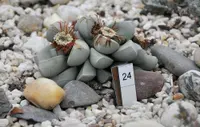
This species naturally grows almost level with the ground, with its thick opposite leaf pairs forming a low rosette that closely matches the surrounding gravel in color and shape, a classic example of stone mimicry used to avoid herbivores.

Single autumn bloom

Mature plants usually produce one large yellow flower in autumn, emerging from the center of the leaf pairs and opening in bright light, which conserves energy and water in its extremely arid native habitat.

Hyper-arid habitat specialist

It is native to the Nama Karoo and southern Namib regions of South Africa and Namibia, where it experiences very low rainfall, intense sun, and large temperature swings, and is often found in quartz-rich or calcareous gravel that reflects light and reduces heat load.

Botan icon

Did you know?

This species is considered one of the rarest mesembs in cultivation and in the wild, with a very limited natural range and highly localized populations that are vulnerable to habitat disturbance and illegal collection.

FAQs about Karoo rose

Lack of flowers is usually linked to insufficient light, cool temperatures during the growing season, or stress from recent repotting or division. Keeping conditions stable and bright often restores normal flowering in the next active season.

Grow Healthy Plants with Botan Care

Keep your plants happy and healthy with plant identification, disease detection, and easy care guidance.

Botan plant care app — identify plants on mobile

Explore More Plants