Cream nut Care (Lecythis pisonis)

Cream nut

About Cream nut

Cream nut, Lecythis pisonis, is a large evergreen tree from the rainforests of Brazil and neighboring regions. It belongs to the same family as the Brazil nut and forms a tall, straight trunk with a broad, rounded crown.

The tree produces hard, woody pods containing edible seeds, which give it its common name. Its size and slow growth make it suitable mainly for spacious gardens in frost-free climates rather than small home landscapes.

Lecythis pisonis prefers warm temperatures, consistent moisture, and well-drained, slightly acidic soil. These specific climate and space needs mean it is not an easy species to grow outside its native-type conditions, so learning how to care for Cream nut is important before planting.

Main Plant Requirements

Care Difficulty

Hard Care

Light Preference

Full Sun

Water Requirements

Regular Water

Temperature Preference

Tropical / Frost Sensitive

Hardiness Zone

11–12

Soil Texture

Loamy, Sandy, Organic-rich

Soil pH

Acidic (5.5–6.5), Slightly acidic (6.5–7.0)

Soil Drainage

Moist but well-drained

Fertilization

Minimal (feed rarely)

Get Personalized Care Plan

Scan your plant to receive care tips personalized for your specific plant

Available on iOS and Android

How to Care for the Cream nut

This large South American tree prefers strong light in warm climates and needs full sun for best flowering and fruiting.

  • Provide 6–8 hours of direct sun daily once established; young Cream nut trees benefit from bright morning sun with light afternoon shade in hot regions.
  • Allow partial shade (3–4 hours direct sun) in very hot inland areas to reduce leaf scorch and stress during peak summer.
  • Watch for sparse growth and small leaves as signs of too little light, and for yellow, scorched leaf edges as signs of excessive intense afternoon sun exposure.

This species prefers evenly moist, well-drained soil and reacts poorly to both drought and prolonged saturation.

  • For in-ground Lecythis pisonis, water deeply when the top 3–5 cm of soil feels dry, aiming for slow soaking that reaches at least 20–30 cm depth.
  • Increase watering during hot, dry months and reduce frequency in cooler or rainy seasons, always checking soil moisture before each irrigation.
  • Yellowing, soft leaves and persistent wet soil indicate overwatering, while dull, curling, or browning leaf edges suggest the root zone has been too dry for several days.

This tropical tree favors warm, stable temperatures and is not suited to cold or frosty climates.

  • Optimal growth occurs at 70–86°F (21–30°C), with the best development in humid, lowland tropical conditions.
  • Avoid exposure below 50°F (10°C); brief dips to 45°F (7°C) may be tolerated, but any frost can damage foliage and young shoots.
  • Mature trees handle short hot spells up to 95°F (35°C) if soil moisture is maintained; provide mulch and wind protection during temperature extremes or dry seasonal winds.

This species prefers moderately humid air but usually adapts to typical home levels.

  • Aim for 50–70% humidity to support healthy foliage and steady growth in Cream nut.
  • Expect leaf edge browning or curling and slower growth under very dry air below about 40%.
  • Increase humidity with a nearby humidifier or grouped plants rather than misting, which adds little lasting moisture.

Lecythis pisonis grows best in deep, loose, well-drained, organic-rich soil.

  • Use a loamy mix made from roughly 50% peat or coco coir, 25% compost, and 25% coarse sand or perlite.
  • Ensure rapid drainage so water does not stand around the roots, which are prone to rot in stagnant, saturated conditions.
  • Keep pH slightly acidic to neutral, around 6.0–7.0, to support nutrient availability and root activity.
  • Improve aeration for container or compact sites by blending in chunky bark or extra perlite instead of fine, dense materials.

This species can be grown in containers when young or kept somewhat compact.

  • Choose a tall, heavy container that resists tipping, as the developing tree becomes top-heavy over time.
  • Provide a deep pot to accommodate the strong taproot and avoid shallow, wide containers that restrict root descent.
  • Use a pot material with moderate moisture retention, such as thick-walled plastic or glazed clay, to reduce rapid drying in warm climates.

Lecythis pisonis benefits from moderate, balanced feeding when grown in cultivation, especially in containers.

  • Use a balanced slow-release fertilizer (for example, 10-10-10) or well-rotted compost mixed into the topsoil at the start of the growing season.
  • Apply granular or slow-release fertilizer every 3–4 months during spring and summer for young or container-grown Cream nut trees.
  • Dilute any liquid feed to 1/2 strength to avoid root burn, and water before and after application to distribute nutrients evenly.
  • Reduce or stop fertilization in fall and winter when growth slows, especially in cooler or lower-light conditions.

Lecythis pisonis needs only light, corrective pruning to maintain a stable crown structure and safe framework.

  • Carry out pruning in late winter or very early spring before active growth starts, avoiding heavy cuts in midsummer.
  • Remove dead, diseased, crossing, or storm-damaged branches first to improve airflow and reduce disease risk.
  • Thin congested inner branches sparingly to let more light into the canopy and encourage balanced structural growth.
  • Use clean, sharp bypass pruners or a pruning saw, making smooth cuts just outside the branch collar without leaving stubs.

This large tree is usually transplanted from nursery containers to the ground while still young to reduce long-term stress.

  • Look for circling roots at drainage holes or slow, stalled top growth as signs that a container-grown Lecythis pisonis is pot-bound.
  • Plan transplanting for late spring or early summer, once soil is warm and the risk of cold snaps has passed.
  • Move young trees every 2–3 years into slightly larger containers or into a permanent ground position, disturbing roots as little as possible.
  • Water deeply before and after transplanting, keep the root ball shaded for a few days, and maintain even moisture until new growth resumes.

Lecythis pisonis is mainly propagated from fresh seeds, as vegetative methods are less reliable for home growers.

  • Collect ripe seeds and sow them as soon as possible, since viability declines quickly in storage.
  • Sow seeds in a deep, well-drained, slightly acidic mix and keep at 70–80°F with steady, light moisture.
  • Provide bright, indirect light and good air movement to limit fungal problems during germination and early seedling growth.
  • Transplant seedlings carefully once roots hold the mix together, avoiding root damage and waterlogging.

This tropical tree is frost-sensitive and needs dedicated winter care in regions with cool or freezing conditions.

  • In ground, grow only in frost-free or very mild climates; young trees are especially vulnerable to temperatures near 32°F.
  • Apply a 5–8 cm mulch layer around the root zone in fall, keeping it away from the trunk to moderate soil temperature.
  • Move container plants indoors or into a heated greenhouse before nights drop below 50°F, giving bright light and reduced watering.
  • Shelter outdoor specimens from cold winds using fences, buildings, or temporary windbreak fabric to reduce tissue damage.

Care Tips

Deep root training

During the first 2–3 years, water less often but in high volume to encourage deep root development, which improves drought resilience and anchorage as the tree matures.

Wind and stake management

In exposed sites, use 2–3 low, flexible stakes set outside the root zone and soft tree ties, then remove them after 1–2 years once the trunk has thickened and the root system is stable.

Mycorrhizal support

When planting into the ground, incorporate a mycorrhizal inoculant around the root ball to improve nutrient and water uptake, especially in sandy or nutrient-poor soils.

Mulch for root health

Maintain a 5–8 cm layer of organic mulch over the root zone, keeping it 5–10 cm away from the trunk, to stabilize soil temperature, reduce compaction, and gradually improve soil structure for growing Cream nut.

Controlled canopy shaping

In the first 3–5 years, selectively remove competing leaders and crossing branches at the collar to build a single strong central leader and well-spaced scaffold branches that can safely support future nut production.

Common Pests and Diseases

Brazilian nut borer

This pest is a caterpillar of a moth that bores into developing nuts and seeds, reducing yield and damaging the edible kernels. Symptoms include small entry holes in fruits and premature fruit drop.

Solution

Collect and destroy infested and fallen fruits to break the life cycle, and prune to reduce dense, shaded clusters where moths tend to lay eggs. In larger orchards, pheromone traps and targeted applications of Bacillus thuringiensis (Bt) on young fruit sets can help control caterpillars while preserving beneficial insects.

Fruit piercing bugs

These insects are large sap-sucking bugs that pierce the outer shell of developing fruits, causing localized dark spots, sap exudation, and secondary rot around feeding sites.

Solution

Hand-pick and remove visible bugs in small plantings and use fine-mesh netting or bagging of clusters of young fruits where practical. Maintain orchard sanitation by removing damaged fruits, and encourage natural predators by avoiding broad-spectrum insecticides that disrupt beneficial insects.

Leaf miners

These insects are larvae that feed between the upper and lower surfaces of leaves, creating pale, winding tunnels and reducing photosynthesis. Symptoms include distorted new leaves and scattered serpentine trails on the foliage.

Solution

Remove and discard leaves heavily affected by mines to physically remove larvae before they mature. For ongoing problems, use yellow sticky traps to monitor adult flies and apply neem oil or horticultural oil on young flushes to deter egg-laying, while keeping the canopy well-ventilated to support healthy regrowth.

Anthracnose

This disease is a fungal infection that causes dark, sunken lesions on young leaves, twigs, and sometimes developing fruits, often following warm, humid weather. Symptoms include leaf blight, dieback of tender shoots, and spotting on fruits that can crack or dry out.

Solution

Prune and discard infected twigs and leaves, and thin the canopy to improve airflow and reduce leaf wetness duration. In humid regions or during rainy seasons, apply a preventive copper-based or other labeled fungicide to new growth and young fruits while avoiding overhead irrigation that keeps foliage wet for long periods.

Sooty mold

This disease is a superficial black fungal growth that develops on honeydew secreted by sap-sucking insects such as scale insects, aphids, and mealybugs on leaves and young stems. Symptoms include blackened leaf surfaces and reduced photosynthesis, often making foliage appear dirty or soot-covered.

Solution

Focus on eliminating the honeydew-producing insects by washing foliage with a strong but gentle stream of water and treating infestations with insecticidal soap or horticultural oil. Once the insect population is reduced, gently wipe or rinse affected leaves to remove remaining mold, and maintain good Lecythis pisonis care by providing adequate light and balanced nutrition to support new, clean growth.

Interesting Facts

Amazon nut producer

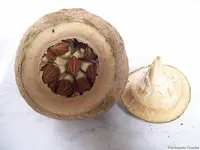
This tree produces large, woody capsules that contain edible seeds often called cream nuts or sapucaia nuts, traditionally harvested and eaten in parts of Amazonia.

Explosive seed release

When the woody fruit dries and the lid pops off, the seeds are released in a drop-like fashion, an example of ballistic dispersal that helps spread them around the parent tree.

Pollinated by large bees

The complex flower structure is adapted for pollination by strong bees that can manipulate the stamens to access nectar, ensuring effective cross-pollination.

Botan icon

Did you know?

The extremely hard, urn-shaped fruit capsules of this species can persist on the forest floor for long periods and are sometimes used locally as natural containers or ornaments due to their durability and distinctive shape.

FAQs about Cream nut

Growth is slow to moderate. Young trees add roughly 20–40 cm per year under warm, humid, frost‑free conditions. In cultivation they often reach 8–15 m, smaller than forest specimens, which can grow much taller.

Grow Healthy Plants with Botan Care

Keep your plants happy and healthy with plant identification, disease detection, and easy care guidance.

Botan plant care app — identify plants on mobile

Explore More Plants