Early staking support
Install sturdy stakes or a light wire cage when plants are 20–30 cm tall to prevent wind damage and toppling as they reach full height and develop heavy flower whorls.

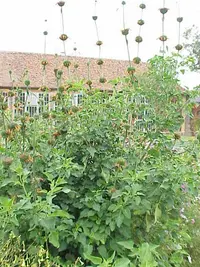
Lion's ear, Leonotis nepetifolia, is a fast-growing, sun-loving annual or short-lived perennial best known for its tall stems and bright orange, tufted flower whorls. It often reaches impressive height in a single season, forming an upright, architectural shape that stands out in mixed borders.
This species is native to tropical regions of Africa and has naturalized in many warm areas worldwide, often along roadsides and open fields. It is generally easy to grow where summers are warm, as it tolerates poor soils and brief dry spells once established.
For gardeners learning how to care for lion's ear, it prefers full sun, well-drained soil, and moderate moisture without waterlogging.

Care Difficulty
Easy Care

Light Preference
Full Sun

Water Requirements
Moderate Water

Temperature Preference
Tropical / Frost Sensitive

Hardiness Zone
9–11

Soil Texture
Sandy, Loamy, Organic-rich

Soil pH
Slightly acidic (6.5–7.0), Neutral (7.0)

Soil Drainage
Well-drained

Fertilization
Minimal (feed rarely)
Scan your plant to receive care tips personalized for your specific plant
Available on iOS and Android
This fast-growing annual thrives in strong light and produces best flowering in full sun.
This species prefers evenly moist but fast-draining soil and resents prolonged saturation.
This warm-season plant grows best in consistently mild to hot conditions without frost exposure.
This species handles a wide humidity range and usually does not need special humidity management.
This species prefers moderately fertile, well-drained, slightly sandy soil that dries between waterings.
This species grows reasonably well in containers if the pot is large, stable, and drains freely.
Leonotis nepetifolia grows well in average soil but benefits from light feeding in poor or very sandy sites.
Pruning supports compact growth and abundant flowering in Leonotis nepetifolia.
This fast-growing species is usually grown in-ground, with transplanting more common than repotting.
Leonotis nepetifolia plant care often includes propagation from seed, as the species is generous and fast-growing.
This warm-climate annual or tender perennial has low frost tolerance and usually dies back in freezing winters.

Plant Health Check
Not sure what's wrong with your plant? Check your plant's health inside the app.
This species produces distinctive spherical clusters of tubular orange flowers arranged in stacked whorls up the stem, an efficient structure for presenting nectar to pollinators such as sunbirds in its native range.
Unlike many shrubby lion’s ear relatives, this species is typically an annual that can reach 2–3 m in a single growing season in warm climates, then dies back after setting large quantities of seed.
Native to tropical Africa, this plant has become naturalized across many tropical and subtropical regions, including parts of the Americas and Asia, often thriving in disturbed sites like roadsides and field margins.

Genetic and morphological studies place this species in the mint family (Lamiaceae), and like its relatives it has square stems and opposite leaves, traits that help botanists quickly identify it in the field even when it is not in flower.
Lack of blooms usually comes from insufficient light, too much nitrogen fertilizer, or plants that are still immature. Ensure full sun, avoid high-nitrogen feeds, and allow enough time from seedling stage for flowering to begin.
Keep your plants happy and healthy with plant identification, disease detection, and easy care guidance.