Moisture monitoring
Use a simple soil moisture meter or your fingers to confirm the substrate stays consistently moist but never waterlogged, as brief drying cycles can quickly halt fruiting of this fungus.

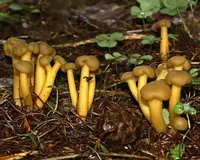
Jelly baby, Leotia lubrica, is a small, gelatinous fungus rather than a typical leafy houseplant. It forms clusters of olive to yellow, club-shaped heads on thin stems, giving a rubbery, toy-like look.
This species is usually found on damp forest floors, often among moss, leaf litter, or decaying wood in temperate regions. It relies on consistently moist, shaded habitats, so it is not easy to maintain indoors or in containers.
Most growers observe it in nature rather than actively cultivating it, though some experiment with how to care for Jelly Baby in controlled woodland-style beds with rich, decaying organic matter.

Care Difficulty
Hard Care

Light Preference
Partial Shade

Water Requirements
Keep Soil Moist

Temperature Preference
Cool Climate

Hardiness Zone
Unknown

Soil Texture
Loamy, Silty, Organic-rich

Soil pH
Acidic (5.5–6.5)

Soil Drainage
Moist but well-drained

Fertilization
Minimal (feed rarely)
Scan your plant to receive care tips personalized for your specific plant
Available on iOS and Android
This woodland fungus prefers low, filtered light rather than direct sun exposure.
This species thrives in consistently moist, not waterlogged, woodland substrates.
This fungus is adapted to cool, moist forest conditions and avoids temperature extremes.
This fungus prefers consistently moist, humid air similar to shaded forest conditions.
This species fruits best in consistently moist, soft, organic-rich ground rather than conventional potting substrates.
This species is generally unsuitable for long-term container growing because it relies on complex soil and microbial relationships found in natural woodland.
Leotia lubrica is a wild mycorrhizal fungus that should not be fertilized in cultivation or natural habitats.
Leotia lubrica does not require pruning, as individual fruiting bodies are short-lived and arise seasonally from underground structures.
Transplanting this jelly fungus is generally unsuccessful, as it depends on specific soil fungi and host roots in situ.
Propagation of Leotia lubrica is highly specialized and not practical for home growers, so it is usually left to natural spore dispersal and professional laboratories.
This species is cold hardy in its native range and normally needs no specific winter care in the ground or forest litter.

Plant Health Check
Not sure what's wrong with your plant? Check your plant's health inside the app.
This fungus forms gelatinous, rubbery fruiting bodies with a smooth, often brain-like cap and a paler, narrow stalk, a texture uncommon among many cup fungi relatives.
Leotia lubrica is considered ectomycorrhizal, forming symbiotic associations with tree roots in mixed and coniferous forests, where it helps trees access soil nutrients while receiving carbohydrates in return.
It typically appears on mossy, wet soil or decaying plant material in late summer to autumn, reflecting its preference for consistently damp, shaded microhabitats in temperate regions.

Molecular studies have shown that Leotia lubrica and its close relatives occupy an unusual position within the Leotiomycetes, with their odd jelly-headed form representing a specialized evolutionary offshoot from more typical cup-shaped ancestors.
This fungus is generally regarded as inedible. It is small, rubbery, and offers little culinary value. Some sources list it as edible but not recommended, so foragers usually leave it in place and avoid consumption.
Keep your plants happy and healthy with plant identification, disease detection, and easy care guidance.