Support trailing stems
Install a sturdy hook or wall-mounted bracket and gently guide new stems along a trellis or wire grid so the long, flexible growth is supported and does not kink or snap at the base.

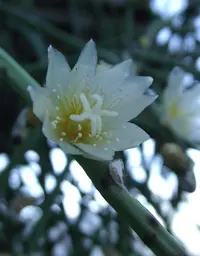
Lepismium lumbricoides is an epiphytic jungle cactus that naturally grows on trees and rocks in tropical forests of South America. Its long, narrow, often twisting stems hang or trail, giving it a distinctive, cascading look.
The plant produces small, pale flowers along the stem edges, sometimes followed by decorative berries. It is generally considered easy to grow because it tolerates typical indoor temperatures and moderate care mistakes.
This species prefers bright, filtered light, loose, well-draining soil, and regular but light watering. For many growers, learning how to care for Lepismium lumbricoides starts with understanding that it behaves more like a tropical forest epiphyte than a desert cactus.

Care Difficulty
Moderate Care

Light Preference
Bright Indirect Light

Water Requirements
Moderate Water

Temperature Preference
Tropical / Frost Sensitive

Hardiness Zone
11–12

Soil Texture
Sandy, Loamy, Organic-rich

Soil pH
Acidic (5.5–6.5), Slightly acidic (6.5–7.0)

Soil Drainage
Well-drained

Fertilization
Light (every 4–6 weeks)
Scan your plant to receive care tips personalized for your specific plant
Available on iOS and Android
This epiphytic cactus prefers bright, filtered light similar to dappled forest shade.
This species prefers slightly moist, fast-draining conditions rather than prolonged drought.
Stable, mild temperatures support steady growth and flowering for Lepismium lumbricoides.
This epiphytic cactus prefers moderate humidity and dislikes very dry indoor air.
Use a loose, fast-draining mix that mimics airy, organic-rich forest debris.
This species is well suited to container growing, including hanging baskets.
Light feeding supports healthy, segmented growth for Lepismium lumbricoides without causing weak, soft tissue.
Thoughtful pruning keeps Lepismium lumbricoides tidy and encourages branching without stressing the plant.
Repotting focuses on refreshing the loose, airy mix and managing root space for this epiphytic cactus.
Stem cuttings are the most practical way of growing Lepismium lumbricoides for home growers.
Cool-season care aims to prevent cold damage and excess moisture problems in Lepismium lumbricoides.

Plant Health Check
Not sure what's wrong with your plant? Check your plant's health inside the app.
This species naturally grows as an epiphyte on trees in the Atlantic rainforest of Brazil, Paraguay, and Argentina, anchoring to bark rather than rooting in deep soil.
Its long, slender stems are made of many cylindrical segments that can branch repeatedly and hang down several feet, which explains the species name lumbricoides, meaning wormlike.
It produces small, funnel-shaped white to pale pink flowers along the sides of its stems, often opening in the evening and releasing a light fragrance that attracts nocturnal pollinators.

In its native range, this cactus often forms dense pendant curtains on tree branches, creating miniature shaded microhabitats where mosses, lichens, and small invertebrates can live among its hanging stems.
Lack of flowering usually comes from insufficient light, no cool rest in winter, or too much nitrogen fertilizer. Provide bright but indirect light, slightly cooler, drier winter conditions, and a low-nitrogen cactus fertilizer to encourage buds.
Keep your plants happy and healthy with plant identification, disease detection, and easy care guidance.