Spore Print Monitoring
Use regular white and dark paper spore prints from mature caps to confirm identity and avoid confusing this species with toxic white Amanita or Chlorophyllum mushrooms when growing White Dapperling near look-alikes.

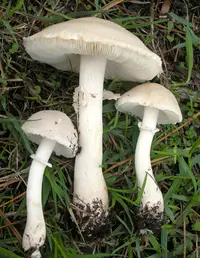
White dapperling (Leucoagaricus leucothites) is a small to medium mushroom-forming fungus, not a true houseplant, often found in lawns, garden beds, and grassy parks. It typically has a smooth white to cream cap, free gills, and a slender stem with a fragile ring. In nature it occurs widely in temperate regions, especially in nutrient-rich, disturbed soils. It often appears in small clusters or scattered groups after rain. This species can be confused with white toxic mushrooms, which makes identification critical before any handling or use. For those studying how to care for White Dapperling in cultivated settings, stable moisture, organic-rich soil, and moderate light are usually preferred.

Care Difficulty
Moderate Care

Light Preference
Partial Shade

Water Requirements
Keep Soil Moist

Temperature Preference
Cool Climate

Hardiness Zone
Unknown

Soil Texture
Loamy, Organic-rich

Soil pH
Slightly acidic (6.5–7.0), Neutral (7.0)

Soil Drainage
Moist but well-drained

Fertilization
Minimal (feed rarely)
Scan your plant to receive care tips personalized for your specific plant
Available on iOS and Android
This saprobic mushroom prefers gentle, indirect light rather than full, exposed sun.
This fungus depends on consistently moist, but not waterlogged, soil to fruit well.
This species fruits best in mild, stable temperatures with moderate humidity.
Humidity is rarely a limiting factor for Leucoagaricus leucothites in garden or lawn settings.
Leucoagaricus leucothites fruits best in loose, organic-rich substrate with steady moisture and rapid drainage.
This species is not well-suited to container growing, as it prefers natural soil and lawn-type environments.
This woodland fungus generally needs no fertilization when growing in soil rich in organic matter.
Pruning is not part of normal management for Leucoagaricus leucothites, as it is a free-growing mushroom rather than a landscape plant.
Transplanting is rarely practical, as this fungus establishes in soil or mulch and does not adapt well to container culture.
Propagation of Leucoagaricus leucothites is usually left to natural spore spread rather than controlled methods.
This species is naturally cold hardy in temperate climates and typically requires no special winter care.

Plant Health Check
Not sure what's wrong with your plant? Check your plant's health inside the app.
This white mushroom is frequently confused with deadly white Amanita species in lawns and pastures, which is why many mycologists advise against eating it even though it is not classified as a deadly species itself.
It often appears in nutrient-enriched lawns, gardens, and disturbed soils, where it helps decompose organic matter and recycle nitrogen into the upper soil layer.
Originally described from Europe, this species is now found across many temperate and subtropical regions worldwide, commonly appearing in urban and suburban grassy areas after rain.

Molecular studies have shown that this species has sometimes been misapplied to outwardly similar white lawn mushrooms, leading to taxonomic revisions and re-identification of herbarium collections as DNA-based methods become more common.
This species is often confused with deadly white Amanita mushrooms, which makes any attempted consumption very risky. Identification is difficult even for experts. For safety, it should always be treated as inedible and left untouched.
Keep your plants happy and healthy with plant identification, disease detection, and easy care guidance.