Select suitable logs
Use fresh, healthy hardwood logs 10–20 cm in diameter cut within the last 2–4 weeks, and avoid conifers or heavily decayed wood, which reduce colonization success and fruiting quality.

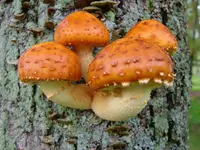
Golden pholiota, Pholiota aurivella, is a wood-decaying mushroom rather than a typical leafy houseplant. It forms clustered, golden-yellow caps with sticky, often scaly surfaces on dead or weakened hardwoods. Stems are sturdy and pale, usually growing in tiered groups that stand out against dark bark.
This species occurs mainly in temperate forests of North America and Europe, appearing in late summer to fall. It is not commonly cultivated, and accurate identification is essential because similar mushrooms can be harmful. Those who wish to care for Golden Pholiota need consistently moist, cool, shaded conditions and access to the right woody substrate.

Care Difficulty
Moderate Care

Light Preference
Partial Shade

Water Requirements
Keep Soil Moist

Temperature Preference
Cool Climate

Hardiness Zone
Unknown

Soil Texture
Loamy, Organic-rich

Soil pH
Acidic (5.5–6.5)

Soil Drainage
Moist but well-drained

Fertilization
Minimal (feed rarely)
Scan your plant to receive care tips personalized for your specific plant
Available on iOS and Android
This wood-inhabiting mushroom prefers cool, shaded forest-like light conditions for reliable fruiting.
This species needs evenly moist, but not waterlogged, wood to support healthy mycelium and fruiting.
This fungus prefers cool to mild conditions, with distinct seasonal temperature patterns for colonization and fruiting.
This fungus prefers moderately moist, humid air around its fruiting site but usually does not need precise humidity control outdoors.
Pholiota aurivella fruits best on moist, organic-rich substrates that stay aerated and never waterlogged.
This species can be grown in containers or grow-bags when moisture and airflow are carefully managed.
Pholiota aurivella is usually grown on nutrient-rich wood or substrates and needs only modest additional feeding.
Pruning Pholiota aurivella is minimal and focuses on hygiene rather than shaping.
Pholiota aurivella is usually grown on logs or specialized substrates, so transplanting focuses on moving colonized material rather than traditional repotting.
Propagation of Pholiota aurivella relies on managing mycelium and spores rather than typical plant methods.
Outdoor Pholiota aurivella on hardy logs tolerates cool conditions but benefits from basic winter moisture and substrate protection.

Plant Health Check
Not sure what's wrong with your plant? Check your plant's health inside the app.
The cap surface is covered in thick, gelatinous slime when fresh, holding coarse yellow to brown scales that give the mushroom its golden, speckled appearance. As it dries, the slime layer shrinks and the cap looks more matte but the embedded scales remain visible.
This species typically fruits in overlapping clusters on the trunks and large branches of living or recently dead hardwood trees, especially willows and maples. It often appears around wounds or decayed sections where the wood is already weakened by other fungi.
Fruiting bodies commonly appear in late summer to late autumn, often persisting through cool, wet weather that favors spore production and dispersal. Heavy autumn rains can trigger large clustered flushes on the same host tree year after year.

The bright yellow to golden pigments in this species, especially in the cap scales and flesh, are stable enough that older field mycology guides often used its vivid coloration as a reference example for teaching beginners how to distinguish strongly pigmented from weakly pigmented gilled mushrooms in the genus Pholiota.
This mushroom is considered inedible by many sources due to its slimy cap, bitter taste, and possible gastrointestinal upset. Identification errors with toxic look-alikes are common, so it is safest to avoid eating it altogether.
Keep your plants happy and healthy with plant identification, disease detection, and easy care guidance.