Use Burned Wood
Incorporate a thin layer of well‑aged, cooled hardwood ash and small charred wood chips into the top 2–3 cm of the bed to mimic post‑fire conditions that stimulate morel fruiting.

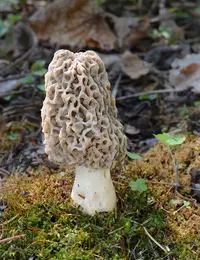
The white morel, Morchella americana, is a spring-fruiting fungus valued for its edible, honeycomb-like caps and hollow stems. It is not a leafy plant but a soil-dwelling mushroom that appears seasonally.
It typically grows in woodland areas, especially near hardwood trees, and often appears after disturbance such as fire or soil disruption. In cultivation, it is considered challenging because it needs very specific soil conditions, temperature shifts, and seasonal moisture patterns.
For those who want to learn how to care for white morel, it helps to understand local climate and natural fruiting patterns. It prefers cool spring temperatures, moist but well-drained soil, and dappled light similar to an open forest floor.

Care Difficulty
Hard Care

Light Preference
Partial Shade

Water Requirements
Keep Soil Moist

Temperature Preference
Cool Climate

Hardiness Zone
3–8

Soil Texture
Loamy, Silty, Organic-rich

Soil pH
Slightly acidic (6.5–7.0), Neutral (7.0)

Soil Drainage
Moist but well-drained

Fertilization
Minimal (feed rarely)
Scan your plant to receive care tips personalized for your specific plant
Available on iOS and Android
Morchella americana fruiting bodies develop best in cool, forest-like light rather than open, direct sun.
Morchella americana requires consistently moist but not waterlogged soil, especially during the fruiting period.
This species fruits best in cool spring conditions and is sensitive to both hard frost and intense heat.
Morchella americana needs consistently high humidity to form healthy fruiting bodies and avoid drying out.
Morchella americana thrives in loose, organically enriched, well-drained substrate rather than dense, compact mineral soil.
This species is challenging but can be attempted in containers under carefully controlled outdoor conditions.
Morchella americana relies mainly on its mycorrhizal partnership with trees, so added fertilizer is usually minimal or unnecessary.
Morchella americana is a mushroom-forming fungus and does not require true pruning, only occasional cleanup.
Transplanting Morchella americana focuses on moving colonized substrate or soil patches rather than handling a typical rootball.
Propagation of Morchella americana is challenging and usually attempted by experienced growers rather than casual gardeners.
Outdoor Morchella americana colonies are generally cold hardy in much of North America and need only light winter management.

Plant Health Check
Not sure what's wrong with your plant? Check your plant's health inside the app.
Morchella americana is a yellow morel species native to North America that was separated from the European Morchella esculenta based on DNA studies, so older North American field guides often mislabel it under the European name.
This species often fruits abundantly after soil disturbance such as logging, flooding, or old cultivation, suggesting that it is adapted to take advantage of temporarily altered forest-floor conditions.
M. americana appears to function both as a saprotroph, decomposing organic matter, and as a weak symbiont with tree roots in some contexts, indicating a flexible ecology that helps it exploit different forest habitats.

Genetic research shows that Morchella americana belongs to the so‑called Esculenta clade of yellow morels, and within this group it is one of the more widely distributed species in eastern North America, occurring from the Great Lakes region through the Appalachians and into parts of eastern Canada.
This fungus grows quickly once conditions suit it. Fruiting bodies often appear within days after warm spring rains, provided a well‑established underground mycelium and suitable host trees are present. Colonization from spawn usually needs 1–2 years before reliable harvests.
Keep your plants happy and healthy with plant identification, disease detection, and easy care guidance.