Host tree pairing
Establish beds near established ash, tulip poplar, or hardwoods with a history of morels, since these fungi often associate with specific tree roots and fruit more reliably where compatible hosts are present.

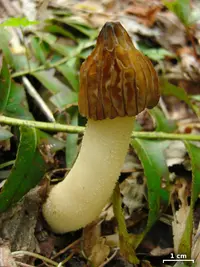
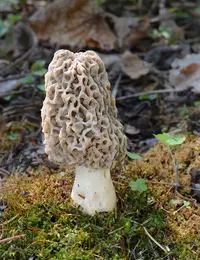
Half-free morel is a spring-fruiting fungus, not a true plant, valued by foragers for its distinctive honeycomb cap and culinary use when properly cooked. Morchella punctipes typically has a tall, hollow stem with a conical cap that is attached about halfway down, giving the “half-free” appearance.
It naturally occurs in hardwood forests of eastern North America, often near ash, elm, and other deciduous trees, sometimes in leaf litter or along forest edges. This species is challenging to cultivate reliably at home, so most people do not try to care for Half-free Morel and instead harvest it from wild populations.
In nature, it favors cool spring conditions, moist but well-drained soils rich in organic matter, and dappled woodland light.

Care Difficulty
Hard Care

Light Preference
Partial Shade

Water Requirements
Keep Soil Moist

Temperature Preference
Cool Climate

Hardiness Zone
4–8

Soil Texture
Loamy, Silty, Organic-rich

Soil pH
Acidic (5.5–6.5), Slightly acidic (6.5–7.0)

Soil Drainage
Moist but well-drained

Fertilization
Minimal (feed rarely)
Scan your plant to receive care tips personalized for your specific plant
Available on iOS and Android
This woodland fungus prefers cool, filtered light rather than direct, intense sun.
This species needs consistently moist but not waterlogged soil in its leaf-litter habitat.
This fungus fruits best in cool to mild spring temperatures with gradual warming.
Morchella punctipes requires sustained high humidity to fruit reliably in cultivation.
Morchella punctipes thrives in loose, organic-rich, well-drained soil that mimics a moist forest floor.
This species is generally unsuitable for long-term container growing beyond experimental or short trial setups.
Morchella punctipes usually fruits well in nutrient-rich woodland soil and needs only modest supplemental feeding in cultivation.
Pruning is not relevant for Morchella punctipes, as it is a fungus and has no stems or foliage to shape.
This fungus is rarely grown in containers; transplanting Morchella punctipes focuses on moving colonized substrate or spawn rather than roots.
Propagation of Morchella punctipes is specialized and usually done by experienced growers rather than casual gardeners.
Half-free Morel is cold hardy in much of its native range and generally needs no special winter care outdoors.

Plant Health Check
Not sure what's wrong with your plant? Check your plant's health inside the app.
This species is one of the first morels to appear in eastern North American forests, often fruiting in late winter to very early spring when few other macrofungi are visible.
Unlike many morels, its cap is attached to the stem only near the top, leaving the lower half free, which creates a noticeable skirt-like gap that helps distinguish it from related species.
It shows a strong ecological association with moist floodplain and bottomland hardwood forests, especially near ash, elm, and tulip poplar, reflecting a preference for nutrient-rich, periodically disturbed soils.

Molecular studies have placed this species in a distinct lineage within the so-called half-free morels, and its name punctipes refers to the fine, punctate (dotted) surface texture of the stem, a microscopic feature mycologists use to separate it from visually similar relatives.
This species is considered edible and is collected as a wild mushroom when correctly identified and thoroughly cooked. Raw specimens may cause digestive upset. Accurate identification is essential because some false morels and other look-alikes are toxic.
Keep your plants happy and healthy with plant identification, disease detection, and easy care guidance.