Deep-root establishment
During the first growing season, give one slow, deep watering per week in dry periods rather than frequent light waterings to encourage the taproot to grow straight and deep for long-term drought tolerance.

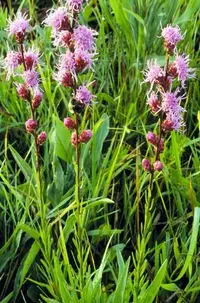
Tall blazing star, Liatris aspera, is a clumping perennial wildflower in the aster family, known for its upright, bottlebrush flower spikes. It forms narrow stems lined with grassy leaves and topped with rose-purple flower clusters that open from the top downward, attracting bees and butterflies.
This species is native to prairies and open habitats in central and eastern North America, where it thrives in sunny, well-drained, often dry soils. It adapts well to low-fertility ground and once established is quite drought tolerant, which makes it easier to care for tall blazing star in typical garden conditions.

Care Difficulty
Easy Care

Light Preference
Full Sun

Water Requirements
Low Water

Temperature Preference
Cold Hardy

Hardiness Zone
3–8

Soil Texture
Sandy, Loamy, Rocky

Soil pH
Acidic (5.5–6.5), Slightly acidic (6.5–7.0)

Soil Drainage
Well-drained

Fertilization
Minimal (feed rarely)
Scan your plant to receive care tips personalized for your specific plant
Available on iOS and Android
This sun-loving prairie perennial needs strong light to flower well and stay upright.
This species prefers dry to moderately moist soil and is more tolerant of drought than excess water.
This hardy prairie plant tolerates a wide temperature range but grows best in warm summers and cold winters.
Humidity is rarely a concern for this prairie perennial and it thrives in typical outdoor air.
This species prefers lean, well-drained soil that mimics dry prairie conditions.
This species can be grown in containers if the pot is deep and drains very freely.
Liatris aspera grows best in lean soil and usually needs only modest fertilization in garden settings.
Pruning Liatris aspera is simple and focuses on grooming rather than reshaping the plant.
Transplanting is more relevant for this deep-rooted prairie perennial than frequent repotting in containers.
Liatris aspera plant care includes straightforward propagation by both seed and division.
This species is cold hardy in most temperate climates and usually needs minimal winter care in the ground.

Plant Health Check
Not sure what's wrong with your plant? Check your plant's health inside the app.
The flower heads of this species are unusually rounded and button-like, with tufted purple florets emerging in a tight cluster rather than in the more elongated spikes seen in other blazing stars.
This plant is strongly associated with dry prairies, gravelly glades, and sandy uplands in central North America, tolerating very low soil fertility and seasonal drought where many other forbs struggle to persist.
It blooms relatively late in the season, often from late summer into early fall, providing an important nectar source for migrating monarch butterflies, skipper butterflies, and a range of native bees when many prairie plants have finished flowering.

Liatris aspera produces starchy underground corms that allow it to survive prairie fires and resprout from below the soil surface, a key adaptation for persisting in frequently burned tallgrass prairie ecosystems.
Lack of flowers usually comes from insufficient sun, soil that stays too wet, or plants that are still immature. Overfertilizing with high-nitrogen products can also reduce flowering. Ensure full sun, well-drained soil, and avoid rich, heavy feeding.
Keep your plants happy and healthy with plant identification, disease detection, and easy care guidance.