Sturdy stem support
Install low, unobtrusive ring supports or individual stakes when shoots are 10–15 cm tall so stems grow through them naturally and avoid kinking or snapping under flower weight or wind later in the season.

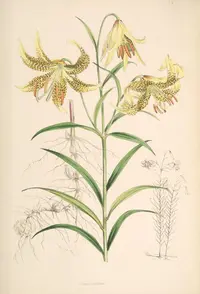
Leichtlin's lily, Lilium leichtlinii, is a bulb-forming perennial lily valued for its elegant, nodding, turk's-cap flowers and upright, leafy stems. It develops from underground bulbs that return each year, forming clumps over time.
This species is native to Japan, where it grows in open woodlands, meadows, and light mountain slopes. Its flowers often have recurved petals with spotting, giving a refined, intricate look suited to mixed borders or naturalistic plantings.
Gardeners usually find it moderately easy to grow if its basic needs are met. It prefers bright light with some protection from intense midday sun, consistent moisture, and well-drained, fertile soil. Learning how to care for Leichtlin's Lily mainly involves providing stable moisture and avoiding waterlogged conditions around the bulbs.

Care Difficulty
Moderate Care

Light Preference
Full Sun

Water Requirements
Moderate Water

Temperature Preference
Cold Hardy

Hardiness Zone
4–8

Soil Texture
Loamy, Sandy, Organic-rich

Soil pH
Acidic (5.5–6.5), Slightly acidic (6.5–7.0)

Soil Drainage
Moist but well-drained

Fertilization
Light (every 4–6 weeks)
Scan your plant to receive care tips personalized for your specific plant
Available on iOS and Android
This lily prefers bright, open conditions with protection from the harshest sun in hotter climates.
This bulb prefers evenly moist but never waterlogged soil throughout its active growing season.
This species is fairly cold hardy but grows best in moderate, temperate conditions.
This species is flexible about humidity and usually copes well with typical home or garden conditions.
Soil for Lilium leichtlinii should be loose, moisture-retentive yet free-draining, with a slightly acidic to neutral reaction.
This lily is suitable for container growing when bulbs receive enough depth and stable, well-drained conditions.
This species benefits from moderate feeding during active growth but does not need heavy fertilization.
Lilium leichtlinii needs only light, well-timed pruning to maintain health and flowering.
This lily is usually grown in garden beds, so transplanting bulbs correctly matters more than frequent repotting.
Lilium leichtlinii is commonly propagated by bulb division and sometimes by seed for larger plantings.
Established plants are fairly cold hardy, but thoughtful winter care supports long-term bulb health.

Plant Health Check
Not sure what's wrong with your plant? Check your plant's health inside the app.
This species occurs naturally as two main subspecies: subsp. leichtlinii with orange flowers and subsp. maximowiczii with deeper orange to reddish flowers, which differ in distribution and subtle floral morphology.
Its tepals (petal-like structures) are strongly reflexed backward and densely covered with dark spots, a floral form that visually guides pollinating insects toward the nectar and reproductive structures.
The species is native to Japan, where it typically grows in light woodland, forest margins, and grassy slopes, adapting to cool to mild climates with distinct seasonal changes.

Lilium leichtlinii was introduced into European horticulture in the 19th century and became a foundational parent in many modern Asiatic hybrid lilies, contributing its distinctive recurved, spotted flowers and vigorous growth to contemporary garden cultivars.
The flowers are rich in nectar and pollen and strongly attract bees, bumblebees, and butterflies. Planting several bulbs together increases visual impact and makes the clump more noticeable to pollinators in mixed garden borders.
Keep your plants happy and healthy with plant identification, disease detection, and easy care guidance.