Stake Tall Stems
Install discreet bamboo stakes or a low wire grid in late spring before stems reach full height so the tall, nodding flower stalks stay upright and are less likely to lodge or snap in wind or heavy rain.


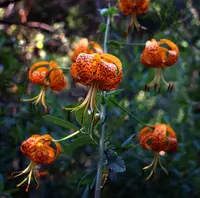
Michigan lily, Lilium michiganense, is a native North American perennial lily found in moist meadows, prairies, and open woodlands. It grows from a bulb and returns each year. Tall stems carry whorled leaves and several nodding, orange to reddish-orange flowers with dark spots and strongly recurved petals, giving a delicate, turk’s-cap look. The plant often forms loose colonies where conditions stay consistently moist.
This species prefers cool roots, evenly moist but well-drained soil, and light ranging from full sun in cooler climates to light shade in warmer areas. Its need for stable moisture and undisturbed soil makes it moderately challenging for beginners who want to learn how to care for Michigan lily.

Care Difficulty
Moderate Care

Light Preference
Partial Sun

Water Requirements
Keep Soil Moist

Temperature Preference
Cold Hardy

Hardiness Zone
3–8

Soil Texture
Loamy, Silty, Organic-rich

Soil pH
Acidic (5.5–6.5), Slightly acidic (6.5–7.0)

Soil Drainage
Moist but well-drained

Fertilization
Minimal (feed rarely)
Scan your plant to receive care tips personalized for your specific plant
Available on iOS and Android
This woodland lily thrives in bright conditions that mimic open, moist meadows or light woodland edges.
This species prefers consistently moist but not waterlogged soil, similar to a wet meadow or stream edge.
This hardy North American lily is adapted to cool to warm temperate climates with cold winters and mild to warm summers.
This species prefers moderate, stable humidity and is somewhat tolerant of typical indoor air.
Lilium michiganense grows best in deep, moist, well-aerated soil that never stays waterlogged.
This species can be grown in containers if the pot is deep, stable, and drains quickly.
This native lily benefits from light, targeted feeding during its active growth but does not need heavy fertilization.
Pruning needs for Lilium michiganense are minimal and focus on hygiene rather than shaping.
This species is usually grown in the ground, so focus on careful site transplanting rather than frequent repotting.
Lilium michiganense is most often propagated by seed or careful division of established clumps.
This cold-hardy lily typically survives normal winters in its range with minimal intervention.

Plant Health Check
Not sure what's wrong with your plant? Check your plant's health inside the app.
The reflexed petals of this species curve strongly backward, forming a turk’s-cap shape that exposes the anthers and makes pollen easily accessible to large pollinating insects.
In much of its range, Lilium michiganense is pollinated primarily by large swallowtail butterflies, especially the giant swallowtail, which can reach nectar in the deep, narrow floral tube.
Unlike many garden lilies, this species naturally occurs in wet meadows, moist prairies, and along stream edges in the Great Lakes region, where its bulbs tolerate consistently damp, organic-rich soils.

Lilium michiganense has declined enough across parts of its native Great Lakes range that it is listed as threatened or endangered in several U.S. states, mainly due to habitat loss and alteration of its wetland and wet prairie ecosystems.
Lack of flowering often comes from too little light, crowded or undivided bulbs, or nutrient-poor soil. Bulbs also need a natural cold period. Avoid heavy cutting of foliage, since leaves must recharge the bulb for next year’s blooms.
Keep your plants happy and healthy with plant identification, disease detection, and easy care guidance.