Douglas' meadowfoam Care (Limnanthes douglasii)

Also known as: Poached Egg Plant, Poached Egg Flower, meadow foam
Douglas' meadowfoam

About Douglas' meadowfoam

Douglas' meadowfoam (Limnanthes douglasii) is a low, spreading annual wildflower native to moist meadows and vernal pools in western North America, especially California and Oregon. It forms dense, soft green mats with finely divided leaves and produces many small, white to yellow, cup-shaped flowers that create a foamy look across the ground.

The plant grows quickly from seed, completes its life cycle in one season, and often self-sows where conditions stay cool and moist in spring. Gardeners who learn how to care for Douglas' meadowfoam will find it relatively easy in climates with mild, wet winters and well-drained but consistently moist soil.

Main Plant Requirements

Care Difficulty

Easy Care

Light Preference

Full Sun

Water Requirements

Regular Water

Temperature Preference

Cool Climate

Hardiness Zone

5–10

Soil Texture

Loamy, Silty, Organic-rich

Soil pH

Slightly acidic (6.5–7.0), Neutral (7.0)

Soil Drainage

Moist but well-drained

Fertilization

Minimal (feed rarely)

Get Personalized Care Plan

Scan your plant to receive care tips personalized for your specific plant

Available on iOS and Android

How to Care for the Douglas' meadowfoam

This annual prefers bright, cool conditions with moderate direct exposure each day.

  • Provide 4–6 hours of direct morning sun with light afternoon shade, especially in warmer regions, to support compact growth and abundant flowering in Douglas' meadowfoam.
  • Allow light or dappled shade during the hottest midday period to reduce leaf scorch and drying of the shallow root zone.
  • In spring and early summer, ensure plants are not shaded by taller vegetation; in low-light sites, expect fewer flowers and more leggy, weak stems.

This species naturally grows in moist to seasonally wet soils and is sensitive to drying out.

  • Keep soil consistently moist so the top 1–2 cm never fully dries; in the ground, use touch-testing rather than a fixed schedule, especially during variable spring weather.
  • Use soil with good structure and drainage so water does not pool for more than a few hours; persistent puddling increases risk of rot in Limnanthes douglasii.
  • Watch foliage for cues: wilting or dull, drooping leaves indicate drought stress, while yellowing, soft stems and a sour smell suggest overwatering or poor drainage.

This cool-season annual grows best in mild, frost-free conditions.

  • Aim for daytime temperatures of 55–70°F (13–21°C) and cooler nights; growth and flowering are strongest in this range.
  • Tolerates brief light frost down to about 28°F (-2°C), but repeated hard freezes below this can damage or kill plants, especially young seedlings.
  • In hot weather above 80°F (27°C), flowering declines and plants may decline early, so in warm climates sow for cool-season display and provide afternoon shade to reduce heat stress.

This species prefers moderately moist air but usually adapts well to typical outdoor humidity levels.

  • Target 40–60% humidity, which is common in many temperate outdoor climates where Douglas' meadowfoam is often grown.
  • Plants tolerate brief drier air, but prolonged arid conditions can cause leaf edge browning and faster soil drying.
  • In very dry, hot weather, group containers close together and use a shallow water tray nearby (not under the pot) to slightly raise ambient humidity.

Limnanthes douglasii grows best in consistently moist, well-structured soil that stays aerated yet never stagnant.

  • Use a loamy mix with high organic matter, such as garden loam blended with compost, to hold moisture evenly.
  • Ensure slow but steady drainage; in containers, combine 2 parts loam, 1 part compost, and 1 part coarse sand or fine grit.
  • Aim for slightly acidic to neutral pH around 6.0–7.0, avoiding strongly alkaline or saline conditions that restrict nutrient uptake.
  • Prevent compaction by avoiding heavy clay alone and periodically loosening the top layer so roots receive enough oxygen.

This species is suitable for shallow, wide containers that can stay evenly moist without waterlogging.

  • Choose a broad, low pot to match its spreading habit and reduce the risk of edges drying out faster than the center.
  • Use a heavier material like ceramic when growing Douglas' meadowfoam outdoors so wind does not tip over lightweight plastic pots.
  • Raise the container slightly on feet or bricks so drainage holes clear quickly after rain, preventing standing water around the base.

This annual wildflower needs only light nutrition, especially in reasonably fertile garden soil.

  • Use a thin layer of garden compost or well-rotted organic matter before sowing or planting to enrich poor soils.
  • If needed, apply a balanced liquid fertilizer (e.g., 10-10-10) at 1/4–1/2 strength once a month during active spring growth.
  • Avoid feeding during summer decline or winter dormancy, as Douglas' meadowfoam completes its life cycle as conditions warm.
  • Do not use high-nitrogen lawn fertilizers, which encourage weak, floppy foliage rather than dense flowering stands.

Light pruning helps maintain tidy growth and prolonged bloom in Limnanthes douglasii.

  • In late spring through early summer, deadhead spent flowers with scissors to encourage continued blooming and reduce self-seeding.
  • Remove yellowing, damaged, or diseased stems at the base to improve air flow and limit fungal issues.
  • Shear back straggly or lodging patches by 2–3 cm to neaten edges and promote compact regrowth where conditions remain cool.
  • Use clean, sharp scissors or small snips and disinfect blades if disease is present to reduce transmission between plants.

This species is most often grown as a direct-sown annual, so transplanting is minimal and repotting is uncommon.

  • Transplant seedlings outdoors in spring when they have 2–3 true leaves and the risk of hard frost has passed.
  • Handle roots gently; disturb the root ball as little as possible to limit shock and maintain steady growth.
  • Choose a site with moist, well-drained soil and full sun to light shade, spacing plants 10–15 cm apart for good coverage.
  • Container-grown plants are usually seasonal; replace each year rather than repotting unless roots are severely circling the pot.

This plant is most commonly propagated from seed, which provides reliable and abundant new plants.

  • Sow fresh seeds of Limnanthes douglasii in early spring outdoors where they are to flower, or in trays kept cool and bright.
  • Press seeds into moist, well-drained soil without burying deeply; a light covering of fine soil or vermiculite is sufficient.
  • Maintain even moisture and cool temperatures (50–60°F) to support germination within 1–3 weeks.
  • Allow some plants to set seed and dry on the plant so they can self-sow naturally for future displays.

As a cool-season annual, this species usually completes its life cycle before severe winter weather in most regions.

  • In mild-winter climates, autumn-sown plants may overwinter; use a light mulch (2–3 cm) to buffer soil temperature and moisture.
  • Young fall seedlings tolerate light frosts but may be damaged by prolonged freezes below about 25°F, especially in exposed sites.
  • Container-grown plants in colder areas can be moved to a cold frame or unheated garage to avoid hard freezes that damage roots.

Care Tips

Succession Sowing

Sow small batches of seed every 2–3 weeks in early spring so flowering is staggered, which keeps the display going longer and maintains healthier, younger plants in the patch.

Use As Living Mulch

Interplant meadowfoam between taller, slower-establishing crops or ornamentals to act as a low, dense groundcover that suppresses weeds and protects the soil surface from crusting.

Encourage Self‑Seeding

After peak bloom, leave some spent flowers and seed heads on the plants so seed can mature and drop, then lightly rake the soil surface to help them settle for natural reseeding next season when growing Douglas' meadowfoam.

Moisture Zoning

Plant in the slightly lower or shallowest parts of a bed or border so water naturally collects there, which helps maintain the consistently moist conditions this species prefers without frequent irrigation.

Support Beneficial Insects

Combine meadowfoam with other early-blooming natives in small clusters rather than single plants to create a concentrated nectar and pollen source that attracts pollinators and predatory insects which can help keep pests in balance.

Common Pests and Diseases

Aphids

This pest commonly colonizes tender shoots and flower stems, sucking sap and causing distorted growth and sticky honeydew on Douglas' meadowfoam.

Solution

Rinse plants with a firm stream of water to dislodge colonies, then spot-treat remaining insects with insecticidal soap or a light horticultural oil, making sure to coat stems and the undersides of leaves. Encourage natural predators such as lady beetles by avoiding broad-spectrum insecticides and maintaining diverse flowering plants nearby.

Powdery mildew

This disease appears as white, powdery patches on leaves and stems, which can cause yellowing and reduced flowering in dense meadowfoam plantings.

Solution

Improve air circulation by thinning crowded patches and avoid overhead watering late in the day so foliage dries quickly. If needed, apply a sulfur or potassium bicarbonate-based fungicide at the first sign of symptoms and remove heavily affected plant material to limit spread.

Fungal crown rot

This disease develops in poorly drained or waterlogged soils, where the crown darkens, softens, and plants collapse despite adequate moisture.

Solution

Improve drainage by amending soil with coarse material, avoid standing water, and keep irrigation light and even, especially on heavy soils. Remove and discard affected plants and avoid replanting Douglas' meadowfoam in the same saturated spot for at least one season.

Slugs and snails

These insects (mollusks) chew irregular holes in young leaves and flowers, often leaving slime trails around meadowfoam patches in cool, damp conditions.

Solution

Hand-pick at dusk or early morning, use iron phosphate bait around plant edges, and reduce hiding places such as thick mulch or debris. Copper tape barriers or coarse grit around small plantings can further limit access to the foliage.

Interesting Facts

Oil-rich seed producer

The seeds of this species yield meadowfoam seed oil, a highly stable oil with long-chain fatty acids that make it valuable in cosmetic formulations as a plant-based alternative to some synthetic emollients.

Distinct cup-shaped flowers

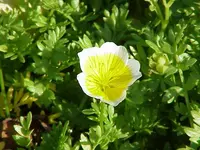
Its white flowers with bright yellow centers form a shallow cup, which efficiently presents both nectar and pollen to small bees and syrphid flies that act as pollinators.

Native to Pacific lowlands

This annual naturally occurs in moist meadows and seasonal wetlands of lowland California and southwestern Oregon, where it is adapted to cool, wet winters and dry summers typical of Mediterranean-type climates.

Botan icon

Did you know?

This species was named in honor of the Scottish botanist David Douglas, who collected it in western North America in the early 19th century and helped introduce many Pacific Northwest plants to European science and horticulture.

FAQs about Douglas' meadowfoam

This species forms low, spreading mats but is not usually aggressive. It self-seeds readily in moist, open soil, so patches may expand each year. Unwanted seedlings are easy to pull or lightly hoe out.

Grow Healthy Plants with Botan Care

Keep your plants happy and healthy with plant identification, disease detection, and easy care guidance.


Botan plant care app — identify plants on mobile

Explore More Plants