Cool root zone
Mulch around the plants with a 2–3 cm layer of fine bark or leaf mold to keep roots cool and moist without burying the creeping stems or flowers.

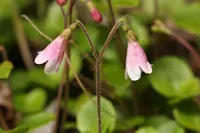
Twinflower, Linnaea borealis, is a low-growing, evergreen woodland plant native to cool forests of the Northern Hemisphere. It forms creeping mats of fine stems and small, rounded leaves close to the ground. In season, it produces pairs of nodding, pale pink, bell-shaped flowers with a light fragrance, carried on delicate arching stalks. This subtle habit makes it most suitable as a groundcover in shaded, naturalistic plantings. The species prefers cool summers, consistent moisture, and acidic, humus-rich soil, which can make it somewhat challenging in warmer or drier gardens. Those who care for Twinflower successfully usually provide dappled shade, steady moisture, and protection from heat and foot traffic.

Care Difficulty
Hard Care

Light Preference
Partial Shade

Water Requirements
Keep Soil Moist

Temperature Preference
Cold Hardy

Hardiness Zone
2–6

Soil Texture
Loamy, Peaty, Organic-rich

Soil pH
Strongly acidic (4.5–5.5), Acidic (5.5–6.5)

Soil Drainage
Moist but well-drained

Fertilization
Minimal (feed rarely)
Scan your plant to receive care tips personalized for your specific plant
Available on iOS and Android
Linnaea borealis prefers cool, bright woodland conditions with gentle, filtered light rather than strong direct sun.
This creeping woodland plant needs consistently moist, cool soil without waterlogging over its shallow roots.
This species is a true cool-climate plant that grows best in consistently cool to mild temperatures.
This woodland groundcover prefers moderately moist air but usually adapts to typical indoor humidity if soil moisture is stable.
This species prefers loose, cool, humus-rich soil that mimics a conifer forest floor.
This species can be grown in containers, but it performs best in wide, shallow pots that allow its creeping stems to spread.
Linnaea borealis is adapted to low‑nutrient soils and usually needs little to no fertilizer in garden settings.
Pruning Linnaea borealis is light and mainly hygienic, aimed at keeping the mat of stems healthy and flowering well.
Transplanting Twinflower needs care, as its fine roots and stolons dislike disturbance and drying.
Propagation of Linnaea borealis is most reliable by division or layering, as seed germination is slow and variable.
Linnaea borealis is very cold hardy and usually needs minimal winter care in garden conditions.

Plant Health Check
Not sure what's wrong with your plant? Check your plant's health inside the app.
This species forms extensive mats across the boreal and subarctic zones of North America, Europe, and Asia, where it is strongly associated with cool, moist coniferous forests and old-growth woodland microhabitats.
Linnaea borealis has a genetic self-incompatibility system, meaning a plant’s own pollen usually cannot fertilize its flowers, so it depends on cross-pollination by insects such as small bees and flies to set viable seed.
The low, trailing stems can root at many nodes and spread slowly but persistently, creating large clonal patches in the forest understory that may remain in the same location for many decades under stable conditions.

The twinflower was the personal favorite plant of the Swedish botanist Carl Linnaeus, and it was named Linnaea borealis in his honor by his contemporaries, making it one of the few wild species directly commemorating the founder of modern biological nomenclature.
This species grows slowly, often taking several years to form a dense mat. In suitable woodland conditions, it may reach near-mature spread in 3–5 years, with further gradual thickening rather than dramatic size increases.
Keep your plants happy and healthy with plant identification, disease detection, and easy care guidance.