Timed sowing waves
Sow small batches 7–10 days apart rather than all at once to stagger flowering and seed production, which makes harvesting and monitoring plant health more manageable.

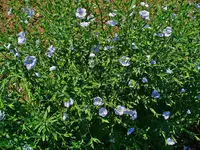
Common flax, Linum usitatissimum, is an annual flowering plant grown for its fibers, seeds, and ornamental value. It forms upright, slender stems with narrow leaves and delicate blue flowers.
In nature, it is associated with regions of the Mediterranean and Western Asia, but it is now widely cultivated in temperate climates. It grows relatively quickly and is considered moderately easy to manage if given full sun and well-drained soil.
Plants tend to have a tidy, vertical habit, so they suit mixed borders and informal meadows. Basic knowledge of how to care for common flax helps maintain healthy growth and consistent flowering.

Care Difficulty
Moderate Care

Light Preference
Full Sun

Water Requirements
Moderate Water

Temperature Preference
Cool Climate

Hardiness Zone
5–9

Soil Texture
Sandy, Loamy, Silty

Soil pH
Acidic (5.5–6.5), Slightly acidic (6.5–7.0)

Soil Drainage
Well-drained

Fertilization
Light (every 4–6 weeks)
Scan your plant to receive care tips personalized for your specific plant
Available on iOS and Android
This species performs best in open, bright field conditions with consistent direct sun.
This plant prefers evenly moist but not saturated soil, especially during early growth and flowering.
This cool-season annual grows best in mild conditions without temperature extremes.
Humidity is not a critical factor for Linum usitatissimum in typical home or outdoor conditions.
Linum usitatissimum prefers light, well-drained mineral soils that never stay waterlogged.
This species can be grown in containers if the pot and medium are chosen to support its fine, fibrous roots and upright stems.
Linum usitatissimum benefits from modest feeding to support flowering and seed production.
Linum usitatissimum needs only light pruning to keep plants tidy and encourage flowering.
This species is usually grown as an annual in beds, so focus on careful transplanting rather than long-term repotting.
Linum usitatissimum is most commonly propagated from seed for uniform, vigorous stands.
Common flax is usually grown as a cool-season annual and needs minimal winter care once its lifecycle ends.

Plant Health Check
Not sure what's wrong with your plant? Check your plant's health inside the app.
This species has been cultivated for its strong bast fibers for several thousand years, with archaeological evidence of flax textiles from Neolithic sites in Europe and the Near East.
The seeds, commonly called flaxseed or linseed, are unusually rich in the omega‑3 fatty acid alpha‑linolenic acid, which is stored mainly in the seed oil.
The plant typically bears delicate, short‑lived blue flowers that often self‑pollinate, a trait that supports reliable seed set in agricultural fields.

Charred flax fibers and seeds have been found in archaeological layers at sites such as Çatalhöyük in present‑day Turkey, showing that humans were processing and using this plant at least 8,000–9,000 years ago, making it one of the earliest domesticated fiber crops.
Poor flowering usually comes from too much shade, excess nitrogen fertilizer, or dry soil during bud formation. Ensure full sun, moderate fertility, and steady moisture. Older, exhausted annual plantings also bloom less toward the end of the season.
Keep your plants happy and healthy with plant identification, disease detection, and easy care guidance.