


Stabilize top-heavy plants
As mature stems elongate and offset, place the pot in a slightly heavier cachepot or add a top layer of coarse gravel to keep the plant stable and prevent the root ball from rocking loose.

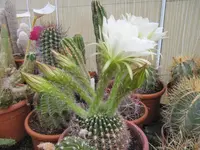
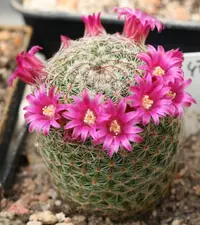
Lobivia mamillosa is a small, clustering cactus from high-altitude regions of Bolivia and northern Argentina. It forms rounded stems covered with distinct ribs and short spines. In season it produces relatively large, funnel-shaped flowers, often in bright pink or red, that create a strong contrast against the compact body. The plant grows slowly and stays modest in size, which makes it suitable for window sills and small indoor collections. This species is considered fairly easy to handle if given strong light, very well-draining mineral soil, and careful watering. Understanding how to care for Lobivia mamillosa mostly revolves around avoiding excess moisture and providing enough sun.

Care Difficulty
Easy Care

Light Preference
Full Sun

Water Requirements
Low Water

Temperature Preference
Warm Climate

Hardiness Zone
9–11

Soil Texture
Sandy, Loamy, Rocky

Soil pH
Slightly acidic (6.5–7.0), Neutral (7.0)

Soil Drainage
Well-drained

Fertilization
Minimal (feed rarely)
Scan your plant to receive care tips personalized for your specific plant
Available on iOS and Android
This small cactus needs strong light but benefits from some protection during the hottest hours.
This species prefers thorough but infrequent watering that mimics brief desert rains.
This cactus prefers warm conditions with a cool, dry rest period.
This cactus handles dry indoor air well, so humidity is rarely a concern.
Use a very fast-draining, mineral-rich mix to prevent root rot.
This species is well suited to container growing.
This small cactus has modest nutrient needs but responds well to light feeding during active growth.
Pruning needs are minimal and mainly focus on cleanliness and safety for this compact cactus.
This cactus grows slowly and prefers infrequent repotting in a stable, gritty medium.
New plants are most often produced from offsets, with seeds as a slower alternative.
Cool, dry winter conditions are important for healthy rest and reliable flowering in the next season.

Plant Health Check
Not sure what's wrong with your plant? Check your plant's health inside the app.
This species is native to high Andean regions of Bolivia, where it grows on rocky slopes and outcrops exposed to strong sunlight and large day–night temperature swings.
It produces relatively large, funnel-shaped pink to magenta flowers that open mainly at night or in the early morning, an adaptation that aligns flowering with the activity of its natural moth and nocturnal insect pollinators.
Instead of a smooth ribbed surface, the stem is divided into rounded, nipple-like projections (tubercles), which increase surface area for photosynthesis while helping manage water storage and expansion without cracking the epidermis.
This cactus usually blooms in late spring to summer, producing funnel-shaped flowers in shades of pink, red, or orange. Blooms open during the day, often in flushes, and may repeat under good conditions.
Keep your plants happy and healthy with plant identification, disease detection, and easy care guidance.

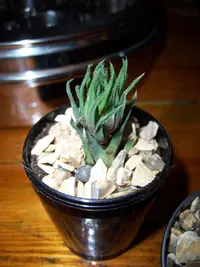
Haworthia angustifolia
Haworthia angustifolia
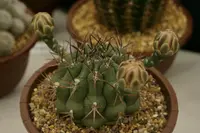
Gymnocalycium schickendantzii
Gymnocalycium schickendantzii
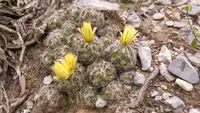
Coryphantha neglecta
Coryphantha neglecta
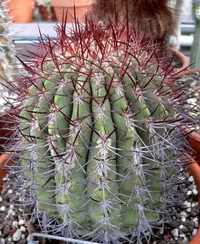
Denmoza rhodacantha
Denmoza rhodacantha
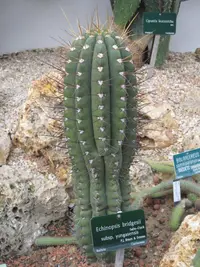
Lobivia bridgesii
Lobivia bridgesii
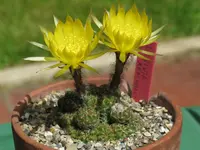
Lobivia arachnacantha
Lobivia arachnacantha
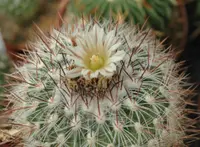
Brain Cactus
Stenocactus multicostatus
Thumb Cactus
Mammillaria matudae