
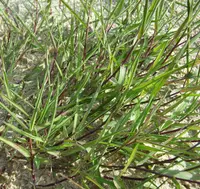
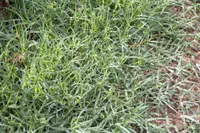


perennial ryegrass Identification (Lolium perenne)

To recognize perennial ryegrass, look for a bunch-forming grass with narrow, flat leaf blades and a flowering spike that holds the spikelets edge-on to the stem, alternating in two rows.

Leaves are glossy on the underside, and the stems are upright, usually reaching 1 to 3 feet (30 to 90 cm) tall.

Lolium perenne Identification

Check Your Plant ID

Not sure about your plant ID? Upload a photo and check it with Botan.

Clear images work best. Avoid photos taken too close or too far away

Check a few plain structural traits before relying on fine details.

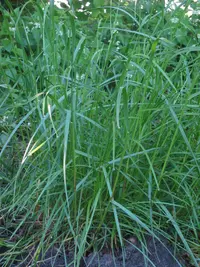
  • Grows as a dense tufted grass, usually about 1 to 2 feet (30 to 60 cm) tall.
  • Leaf blades are narrow, flat, and often 2 to 8 inches (5 to 20 cm) long, with a shiny underside.
  • Leaves attach alternately along the stem, and the leaf tips are pointed.
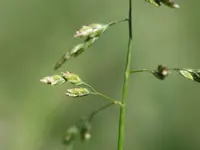
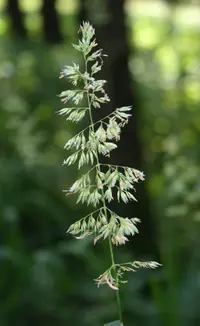
  • The flower head is a slim spike, with small spikelets set edge-on in two neat rows along the central stem.

The two-rowed spike is one of the quickest visual checks for Lolium perenne.

Lolium perenne shows useful visual shifts from seedling tufts to flowering stems and seed heads.

  • Seedling: The first leaves are narrow and soft, emerging in a small basal tuft with a folded appearance and no upright flowering stems.
  • Young plant: It forms a denser clump of glossy, narrow blades, still low to the ground, with overlapping leaf sheaths at the base.
  • Mature plant: Vegetative clumps stay tufted and upright, while fertile shoots rise above the leaves, often reaching 1-2 feet (30-60 cm) tall.
  • Flowering stage: The stem carries a slender, flattened spike with alternating spikelets attached edgewise along the central axis, unlike the purely leafy nonflowering clump.

Lolium perenne is most distinctive when flowering, usually from late spring into summer. The seedheads rise above the leaves as narrow, upright spikes with small spikelets attached edge-on directly along the stem. In mild climates it often stays green through winter, so there is usually no leaf drop or bare-stem stage to use for identification.

Several turf grasses are often mistaken for perennial ryegrass.

Italian ryegrass(Lolium multiflorum)

Often confused because both are glossy, bunch-forming ryegrasses. Italian ryegrass usually has awns, the bristle-like tips on the florets, while Lolium perenne is typically awnless or nearly so.

Tall fescue(Schedonorus arundinaceus)

Confusion happens in lawns and pastures because both form clumps with narrow green blades. Tall fescue has broader, coarser leaves and a ridged upper blade surface; ryegrass leaves are usually shinier and finer.

Annual bluegrass(Poa annua)

Can resemble young ryegrass in mowed turf. Annual bluegrass is lighter green and has boat-shaped leaf tips, while ryegrass has more pointed tips and a stronger leaf sheen.

Lolium perenne is native across much of Europe, North Africa, and temperate Asia. It is characteristic of lowland grasslands, meadows, pastures, roadsides, and other disturbed grassy places. Habitat can help narrow identification because this species is especially common in managed lawns, grazed fields, and compacted roadside turf in temperate regions. Finding it in regularly mown or trampled grassland supports an identification of perennial ryegrass rather than a less disturbance-tolerant wild grass.

Not Sure About the ID?

Botan can check a photo to help identify the plant or confirm your match before you spend more time on it.

FAQ

Flowers are arranged in a narrow spike. Small spikelets sit edge-on directly against the central stem, alternating along it. Each spikelet usually has several florets, a useful detail for identifying perennial ryegrass.

More Plant Identification Guides

Know What Plant You Have

Use Botan to identify a plant from a photo, then get species-specific care information, common problems, and safety notes.

Botan app identifying a plant from a photo
Banana Peel Water for Plants: 5 Things to Know Before Trying It

5 min read · 9 Jul 2026

Banana Peel Water for Plants: 5 Things to Know Before Trying It

Banana water can provide potassium and some nutrients that may support plant growth, but it is not a universal fix. Use it carefully and only when the plant actually shows signs of nutrient deficiency rather than as a routine treatment.

Plant Care
Banana Peel Water for Plants: 5 Things to Know Before Trying It
13 Best Front Yard Trees for Every Home and Yard

12 min read · 7 Aug 2026

13 Best Front Yard Trees for Every Home and Yard

A front yard tree can stay for decades. Therefore, choosing one deserves serious consideration. Here are 13 trees that have proven themselves, sorted by their purpose. You'll also find five species to avoid and basic planting information.

Plant Recommendations
13 Best Front Yard Trees for Every Home and Yard
How to Bottom Water Plants: Complete Guide

6 min read · 13 Jul 2026

How to Bottom Water Plants: Complete Guide

Bottom watering helps soil absorb moisture evenly and keeps foliage dry, reducing the risk of missed dry spots or root problems. Place the pot in a tray of water for a short time, then let it drain well.

Plant Care
How to Bottom Water Plants: Complete Guide