

kleingrass Identification (Panicum coloratum)

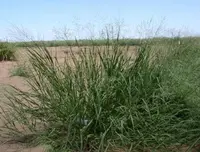
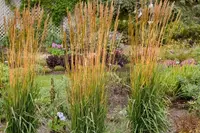
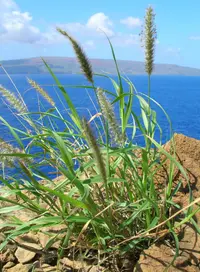
Recognize kleingrass by its upright bunching habit, narrow flat leaves that arise alternately along smooth stems, and a large open flower panicle held above the foliage.

Mature clumps form dense tufts, with leaves often 8 to 20 inches (20 to 50 cm) long and airy branched seedheads extending well beyond the leaf blades.

Panicum coloratum Identification

Identify a Plant by Photo

Take a photo and use Botan to confirm your plant identification.

Clear images work best. Avoid photos taken too close or too far away

  • 1 free identification
  • No sign-up
  • 30,000+ plants in database

Use these quick checks to assess Panicum coloratum by sight.

  • It forms dense bunches of upright stems rather than a creeping mat.
  • Leaves are long, narrow, and arching, often about 6-20 inches (15-50 cm) long.
  • The flowering head is an open, airy panicle with many fine, spreading branches above the leaves.
  • Seed heads are broad and slightly nodding, giving the top a loose, cloudlike outline.

Check the overall clumping habit and open panicle together for the most useful field cue.

Panicum coloratum shows useful visual shifts from early tufted growth to seed-bearing maturity.

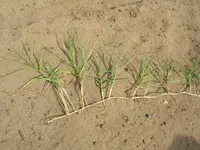
  • Young plant: Early plants form a small basal tuft of narrow, arching leaves, with few stems and a compact outline compared with later open clumps.
  • Mature plant: Established clumps stand about 2-4 feet (0.6-1.2 m) tall, with many leafy stems rising from the base and a broader, fountain-like habit.
  • Flowering stage: At flowering, stems carry open, airy panicles above the leaves, adding a branched upper outline that is absent in strictly vegetative plants.
  • Fruiting stage: After flowering, the panicles hold many small seeds, shifting from a finer flower texture to a denser, grain-bearing head.

In warm months, Panicum coloratum is easiest to recognize when the flowering stems rise above the leafy clump, carrying open, airy seedheads. After frost or in the dry season, the plant often turns straw-colored and remains as a coarse tuft of dry leaves and stems, making the clumping grass form more obvious.

These grasses are the most realistic field look-alikes.

switchgrass(Panicum virgatum)

It can resemble Panicum coloratum in overall clump shape and open panicles. Switchgrass is usually more upright, with narrower leaves, and its seedheads are airier and often broader than the denser, more contracted panicles of kleingrass.

guineagrass(Megathyrsus maximus)

Both are robust warm-season bunchgrasses with broad leaves and open flower clusters. Guineagrass usually has wider, longer leaves and a looser, more spreading panicle, while kleingrass tends to form a tighter tuft with a more compact seedhead.

Panicum coloratum is native to tropical and southern Africa. In the wild it is found mainly in grassland and savanna, often on seasonally moist flats, along drainage lines, and in other open sites rather than shaded woodland. That setting helps with identification because this species is most consistent with open African grassland plants, especially where moisture varies through the season. Habitat can help separate it from grasses more typical of forests, deserts, or permanently wet marshes.

Does Your Plant Match?

Use Botan to compare a photo and help identify or confirm the plant before you label it.

FAQ

Flowering heads are usually visible in the warm growing season, most often from summer into fall. For how to identify kleingrass, look for an open, airy seedhead held above the leafy stems.

More Plant Identification Guides

Know What Plant You Have

Identify it from a photo with Botan, then review plant details, care information, and common problems for that species.

Botan app identifying a plant from a photo
How Long Can Flowers Go Without Water? Everything You Need to Know

6 min read · 10 Jul 2026

How Long Can Flowers Go Without Water? Everything You Need to Know

Flowers can survive without water anywhere from 1-2 hours to several months, depending on the plant type, species, and growing conditions. Some strong-looking flowers are drought-sensitive, while delicate-looking plants may tolerate long dry periods surprisingly well.

Plant Care
How Long Can Flowers Go Without Water? Everything You Need to Know
What Plants Don't Like Epsom Salt?

11 min read · 29 Jul 2026

What Plants Don't Like Epsom Salt?

Learn which plants can be seriously damaged by Epsom salt and which will thrive on it. We’ll explain when and how to use it properly, provide tips for indoor & outdoor plants — read on and enjoy a healthy garden.

Plant Care
What Plants Don't Like Epsom Salt?
How to Mulch in the Fall and When to Wait Until Spring

5 min read · 12 Nov 2026

How to Mulch in the Fall and When to Wait Until Spring

In the fall, mulch gives the roots of trees and shrubs insulation and more stable conditions through winter. In the spring, it mainly suppresses weeds and keeps moisture in the soil during the growing season.

Beginner Guides
How to Mulch in the Fall and When to Wait Until Spring