
Kikuyu Grass Identification (Cenchrus clandestinus)

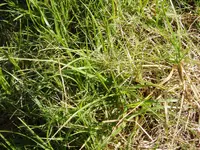
Recognize Kikuyu Grass by its dense, creeping mat of thick stolons and rhizomes, upright flowering stems, and flat, narrow leaf blades usually about 1/8 to 1/4 inch (3 to 6 mm) wide.

The flower heads are mostly hidden in the upper leaf sheaths, with only short clusters of spikelets showing at the stem tips.

Cenchrus clandestinus Identification

Is This Kikuyu Grass?

Use a clear photo to confirm what plant you have.

Clear images work best. Avoid photos taken too close or too far away

Check the turf’s spreading habit and the leaf details first.

  • Forms a dense mat with long above-ground runners and short underground rhizomes, creating a creeping carpet rather than upright clumps.
  • Leaf blades are narrow, flat, and bright to medium green, usually about 1–6 inches (2.5–15 cm) long.
  • Leaves arise alternately along the runners, with each blade tapering to a fine point.
  • Flowering stems carry short, partly hidden spike clusters tucked among the upper leaf sheaths rather than held well above the foliage.

Look closely at the runners and the partly concealed flower spikes, since that combination is especially useful.

Cenchrus clandestinus shows clear visual shifts from creeping juvenile growth to flowering turf.

  • Juvenile plant: Early growth stays low and spreading, with soft narrow blades and obvious runners rooting at nodes, forming a sparse mat rather than a dense turf surface.
  • Mature plant: Established plants form a dense, coarse lawn-like carpet with many stolons and rhizomes; leaf blades are broader and commonly 4-12 inches (10-30 cm) long.
  • Flowering stage: Short flowering stems rise slightly above the leaves, carrying narrow, partly hidden spike-like heads tucked among the upper leaf sheaths, unlike the purely vegetative mat.

In warm seasons, Kikuyu Grass may show short flowering stems hidden among the leaves, with pale, threadlike stigmas briefly visible. Those small, partly concealed flower clusters can help confirm the species. In cooler periods or after frost, patches often look straw-colored or brown from dormancy, then return to dense green growth when warmth resumes.

A few warm-season lawn grasses are regularly mistaken for Kikuyu grass.

bermudagrass(Cynodon dactylon)

Both spread fast and form dense turf. Bermudagrass usually has finer, narrower leaves and a less coarse look. Its seedheads are finger-like spikes, while Kikuyu grass has mostly hidden flower spikes tucked among the upper leaves.

St. Augustinegrass(Stenotaphrum secundatum)

Both are stolon-forming lawn grasses with broad blades. St. Augustinegrass has much thicker, flatter stolons and broader leaf blades, often around 1/5-2/5 inch (5-10 mm) wide. Kikuyu grass is usually narrower-bladed and more tufted.

Cenchrus clandestinus is native to the highlands of East Africa, especially Kenya, and is associated with montane and upland grasslands. That setting helps with identification because it is a grass of cooler tropical highlands rather than deserts, wetlands, or forest understories. Records commonly place it at moderate to high elevations, often around 4,900-9,800 feet (1,500-3,000 m).

Check Your Plant ID

Use Botan to identify or confirm the plant from a photo, which helps avoid mix-ups with similar-looking grasses.

FAQ

The quickest clue is its aggressive creeping habit. This plant spreads by thick above-ground runners and underground rhizomes, forming a dense mat. Leaves are bright green, flat, and often softly hairy at the base during Kikuyu Grass identification.

More Plant Identification Guides

Identify Your Plant and Learn More

Snap a photo with Botan to identify it, then get species-specific care information, plant details, and common problems.

Botan app identifying a plant from a photo
How to Group Plants in Landscaping: A Practical Layout Guide

8 min read · 31 Aug 2026

How to Group Plants in Landscaping: A Practical Layout Guide

Good plant grouping can mean the difference between a well-planned garden and one that looks sloppy. This guide explores layers, spacing, cluster shapes, and the plants that thrive when you group them.

Plant Care
How to Group Plants in Landscaping: A Practical Layout Guide
Is Sugar Water Good for Plants?

4 min read · 14 Sept 2026

Is Sugar Water Good for Plants?

Sugar water may sound like an easy boost, but most rooted plants do not need extra sucrose. This guide explains how green tissues produce carbohydrates, when a sweetened solution can be useful, and why too much can cause problems.

Plant Care
Is Sugar Water Good for Plants?
What Plants Don't Like Epsom Salt?

11 min read · 29 Jul 2026

What Plants Don't Like Epsom Salt?

Learn which plants can be seriously damaged by Epsom salt and which will thrive on it. We’ll explain when and how to use it properly, provide tips for indoor & outdoor plants — read on and enjoy a healthy garden.

Plant Care
What Plants Don't Like Epsom Salt?