

nimblewill Identification (Muhlenbergia schreberi)

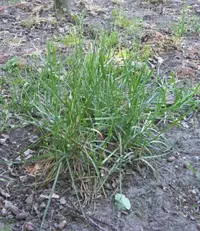
Recognize nimblewill by its loose, mat-forming habit with slender, branching stems that sprawl along the ground and root at the nodes. Leaves are narrow, flat, and alternate, usually under 2 inches (5 cm) long.

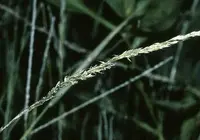
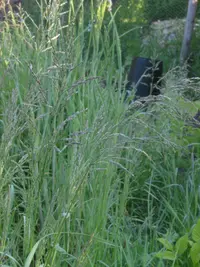
The flowering stems carry very open, delicate panicles, with tiny spikelets spaced along fine branches rather than packed into dense heads.

Muhlenbergia schreberi Identification

Scan to Confirm nimblewill

Check your plant ID by uploading a clear photo to Botan.

Clear images work best. Avoid photos taken too close or too far away

Check the plant’s loose, mat-forming habit and fine grass blades first.

  • Stems sprawl and branch along the ground, creating low, patchy mats rather than upright clumps.
  • Leaf blades are narrow and flat, usually about 1 to 3 inches (2.5 to 7.5 cm) long.
  • Leaves attach singly at stem joints, giving the stems a thin, wiry, lightly zigzag look.
  • Flowering stems carry very open, delicate panicles with many tiny spikelets set far apart.

A creeping, loosely branched lawn grass with airy seedheads points toward this species.

Muhlenbergia schreberi shows useful visual shifts from low vegetative mats to open flowering stems.

  • Juvenile plant: Early plants appear as small, loose patches with short, delicate blades and prostrate stems rooting at nodes, forming a thin mat rather than distinct upright clumps.
  • Mature plant: Established growth spreads into wider mats, with wiry branching stems and more widely spaced leaves; the plant stays low, usually under 1 foot (30 cm).
  • Flowering stage: At flowering, slender stems rise above the mat and carry narrow, airy panicles; this makes nimblewill look more open and uneven than vegetative plants.

In late summer into fall, nimblewill is easier to spot when its open, airy flower heads rise above the mat of leaves. The delicate seed heads give patches a soft, hazy look. After frost, the foliage turns straw tan and the lawn-like mats look thin and dormant, standing out from greener cool-season grasses.

A few warm-season lawn grasses can be mistaken for nimblewill.

bermudagrass(Cynodon dactylon)

Both can form thin, patchy mats in lawns. Bermudagrass usually has stiffer blades and obvious aboveground runners with leaves crowded at nodes. Muhlenbergia schreberi has finer, softer blades and a looser, more delicate mat.

Japanese stiltgrass(Microstegium vimineum)

Both can sprawl and root along stems. Japanese stiltgrass has broader leaves and a distinct pale, silvery stripe along the leaf midrib. Nimblewill leaves are narrower and lack that bold central stripe.

Muhlenbergia schreberi is native to eastern and central North America, from southern Canada through much of the eastern United States and into parts of Mexico and Central America. Range alone is broad, so habitat is the more useful clue. It is most often found in shaded to partly shaded woods, woodland edges, floodplain forests, streambanks, and other moist disturbed ground. Finding it in a forest understory or along a shaded path helps separate it from many lawn and open-prairie grasses.

Check Your Plant ID

Use Botan to compare a photo and help confirm the plant, so you can move forward with more confidence.

FAQ

Yes. Identifying nimblewill usually relies on its fine-textured, wiry mat-forming growth, creeping stems that root at the nodes, and short, narrow leaf blades. Flowering parts are small and often overlooked, so vegetative traits are often more useful.

More Plant Identification Guides

Identify Your Plant with Botan

Upload a photo to identify the plant, then see species-specific care information, safety notes, and common problems.

Botan app identifying a plant from a photo
Best Fertilizer for Grass in Summer: How to Choose the Right One

6 min read · 18 Aug 2026

Best Fertilizer for Grass in Summer: How to Choose the Right One

The right fertilizer in summer can make a lawn thrive. The wrong one can damage it. Here, you’ll learn the best NPK ratios by grass type, when and how to apply your formula, and how to recognize the signs of over- or under-fertilizing.

Plant Care
Best Fertilizer for Grass in Summer: How to Choose the Right One
Banana Peel Water for Plants: 5 Things to Know Before Trying It

5 min read · 9 Jul 2026

Banana Peel Water for Plants: 5 Things to Know Before Trying It

Banana water can provide potassium and some nutrients that may support plant growth, but it is not a universal fix. Use it carefully and only when the plant actually shows signs of nutrient deficiency rather than as a routine treatment.

Plant Care
Banana Peel Water for Plants: 5 Things to Know Before Trying It
20 Most Popular Fruits Around the World

7 min read · 22 Jul 2026

20 Most Popular Fruits Around the World

Curious which fruits the world actually eats the most? Here's the top-20 by production volume, an overview of what people choose in each region, and a few figures that defy common assumptions.

Plant Recommendations
20 Most Popular Fruits Around the World