
Kentucky bluegrass Identification (Poa pratensis)

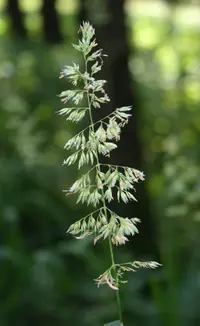
Recognize Kentucky bluegrass by its narrow, folded leaf blades with a distinct boat-shaped tip, plus creeping underground rhizomes that form a dense sod. Leaves arise mostly from the base, and the flowering stems carry open, branched panicles with many small, flattened spikelets.

This combination is a strong first pass for Poa pratensis.

Poa pratensis Identification

Is This Kentucky bluegrass?

Upload a plant photo and check the identification in seconds.

Clear images work best. Avoid photos taken too close or too far away

Check the grass blade tips, leaf shape, and the form of the seed head.

  • Leaf tips are boat-shaped, with the end folded like a tiny canoe.
  • Blades are narrow, usually about 1–3 mm wide, and mostly smooth with a soft texture.
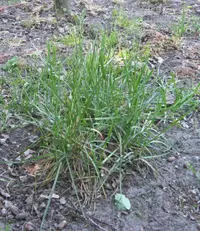
  • Leaves arise mainly from the base, forming a dense, low turf rather than obvious upright clumps.
  • Stems commonly reach about 1–2 feet (30–60 cm) tall when flowering.
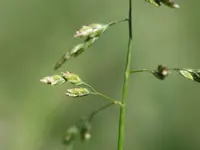
  • The seed head is an open, airy panicle with many small branched spikelets.

A combination of boat-shaped tips and an open branched seed head is especially useful to confirm the ID.

Poa pratensis shows useful visual shifts from seedling leaves to flowering turf-forming clumps.

  • Seedling: Seedlings show a few narrow, soft blades arising singly, with a fine texture and the characteristic boat-shaped leaf tip already visible.
  • Young plant: Young plants begin spreading by rhizomes, forming small connected patches rather than isolated shoots, with denser leaf clusters and short, nonshowy stems.
  • Mature plant: Mature Kentucky bluegrass forms a low, even sod, usually 1 to 2 feet (30 to 60 cm) tall only when stems elongate.
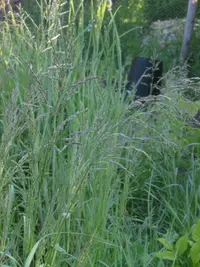
  • Flowering stage: Flowering stems rise above the leafy base and carry open, branched panicles with many small spikelets, giving the plant a lighter, airy outline.

In spring to early summer, Poa pratensis often becomes easier to recognize when its open, branched flower clusters rise above the turf. These airy panicles can give patches a light, hazy look for a short period. In hot, dry summer weather, leaves may fade from blue-green to dull green or tan as the grass goes partly dormant, so lawns can look thinner and less vivid until cooler conditions return.

Several lawn grasses are regularly mistaken for Kentucky bluegrass.

annual bluegrass(Poa annua)

Both have boat-shaped leaf tips. P. annua stays lower, forms lighter yellow-green patches, and often shows open seedheads at very short mowing heights.

rough bluegrass(Poa trivialis)

Also a Poa with boat-shaped tips and fine texture. It is usually brighter green, softer, and often has creeping aboveground stolons rather than firmer turf.

perennial ryegrass(Lolium perenne)

Can resemble it in mowed lawns. Ryegrass leaves are shinier underneath with pointed, not boat-shaped, tips, and the plant grows in bunches without rhizomes.

Poa pratensis is native across much of Europe, temperate Asia, and North Africa. It naturally occurs in meadows, pastures, open woodland edges, and other cool-temperate grasslands. This range matters because a bluegrass found in long-settled lawns and pasture regions often points toward this species. Habitat also helps separate it from grasses tied to wetlands, deep shade, or hot arid sites. It is especially associated with fertile, disturbed grassland and lowland to montane settings in temperate regions.

Does Your Plant Match?

Use Botan to compare a photo and help identify or confirm the plant before you label it or look up next steps.

FAQ

It is a spreading cool-season grass. The species forms a sod by underground rhizomes, which are horizontal stems below the soil, rather than staying in tight bunches like many similar lawn grasses.

More Plant Identification Guides

Find Out What Plant It Is

Use Botan to identify a plant from a photo, then see plant details, care information, and common problems.

Botan app identifying a plant from a photo
Best Fertilizer for Grass in Summer: How to Choose the Right One

6 min read · 18 Aug 2026

Best Fertilizer for Grass in Summer: How to Choose the Right One

The right fertilizer in summer can make a lawn thrive. The wrong one can damage it. Here, you’ll learn the best NPK ratios by grass type, when and how to apply your formula, and how to recognize the signs of over- or under-fertilizing.

Plant Care
Best Fertilizer for Grass in Summer: How to Choose the Right One
Top 15 Plants That Don’t Need Sunlight

8 min read · 17 Sept 2026

Top 15 Plants That Don’t Need Sunlight

Some plants thrive in dim rooms, shaded corners, and places with indirect light. In this guide, you’ll explore the top 15 species best suited to low-light conditions and how to care for them.

Plant Recommendations
Top 15 Plants That Don’t Need Sunlight
20 Most Popular Fruits Around the World

7 min read · 22 Jul 2026

20 Most Popular Fruits Around the World

Curious which fruits the world actually eats the most? Here's the top-20 by production volume, an overview of what people choose in each region, and a few figures that defy common assumptions.

Plant Recommendations
20 Most Popular Fruits Around the World