

Indiangrass Identification (Sorghastrum nutans)

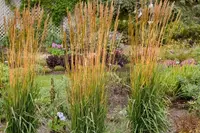
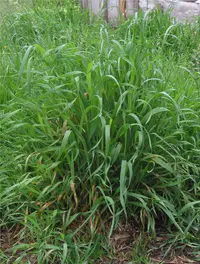
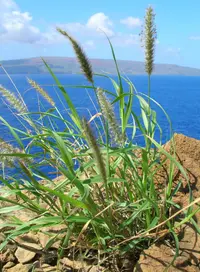
Recognize Indiangrass by its upright bunching habit, narrow blue-green leaves along tall stems, and a dense, plume-like flowering head held above the foliage. Mature plants typically stand 3 to 7 feet (0.9 to 2.1 m) tall.

A small, twisted, claw-like appendage where each leaf blade meets the stem is another strong field mark.

Sorghastrum nutans Identification

Check Your Plant with Botan

Use a clear photo to confirm what plant you have.

Clear images work best. Avoid photos taken too close or too far away

  • 1 free identification
  • No sign-up
  • 30,000+ plants in database

Check the tall, upright form and the seed head shape first.

  • Clumps usually stand 3 to 7 feet (0.9 to 2.1 m) tall, with straight, unbranched stems below the flower head.
  • Leaves are long and narrow, often 12 to 24 inches (30 to 60 cm) long, arching outward from the stems.
  • At the leaf base, a small, pointed membranous ligule shows above a tuft of soft hairs.
  • The flower head is a narrow, open plume with fine branches, often bronze to golden in color.

A visible hairy leaf base and airy bronze plume are especially useful for spotting Sorghastrum nutans.

Indiangrass shows clear visual shifts from narrow juvenile tufts to tall flowering clumps.

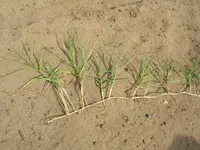
  • Juvenile plant: Early growth appears as a low basal tuft of narrow, upright leaves, with no tall stems and a tighter, less arching outline than older plants.
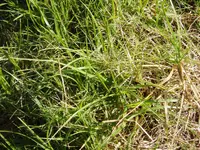
  • Mature plant: The clump becomes taller and broader, typically 3-7 feet (0.9-2.1 m), with many long blades and erect culms rising above the basal leaves.
  • Flowering stage: At flowering, stems carry narrow, plume-like flower clusters with a distinct golden cast, making the plant look more open and vertically accentuated than before bloom.

In spring, Sorghastrum nutans sends up fresh blue-green leaves from the base, forming upright clumps. By late summer into fall, tall stems carry open, golden-bronze flower clusters that stand above the foliage. In fall, the leaves often turn yellow to orange, and the dried seed heads can remain visible into winter.

A few prairie grasses are often mistaken for Indiangrass.

big bluestem(Andropogon gerardii)

Both are tall, warm-season bunchgrasses with bronze seed heads. Big bluestem usually has a three-part seed head shaped like a turkey foot, not the open, plume-like cluster of Sorghastrum nutans.

switchgrass(Panicum virgatum)

It can match the height and upright habit. Switchgrass has a finer, more airy flower panicle and lacks the distinct golden-brown awns, the bristle-like extensions on the florets, seen on Sorghastrum nutans.

Johnsongrass(Sorghum halepense)

The leaf blades and overall stature can seem similar at a glance. Johnsongrass has broader leaves and a looser, often purplish panicle rather than the denser golden plume.

Sorghastrum nutans is native to much of eastern, central, and southern North America, including much of the United States and parts of southern Canada and northern Mexico. It is most often found in prairies, open meadows, glades, savannas, and roadsides, usually in full sun. Seeing it in native grassland or other open, non-wooded habitat is a useful clue, especially in the Great Plains, Midwest, and eastern prairie regions.

Not Sure About the ID?

Use Botan to compare a photo and help confirm the plant before you label it or make planting decisions.

FAQ

The most reliable mark is the ligule, a small leaf-collar structure. In this species it is conspicuous, pointed, and often about 1/8 to 1/4 inch (3-6 mm) long.

More Plant Identification Guides

Know Your Plant Better

Identify it from a photo with Botan, then review plant details, care information, and common problems for that species.

Botan app identifying a plant from a photo
How to Group Plants in Landscaping: A Practical Layout Guide

8 min read · 31 Aug 2026

How to Group Plants in Landscaping: A Practical Layout Guide

Good plant grouping can mean the difference between a well-planned garden and one that looks sloppy. This guide explores layers, spacing, cluster shapes, and the plants that thrive when you group them.

Plant Care
How to Group Plants in Landscaping: A Practical Layout Guide
How to Mist Plants – Proper Technique and Common Mistakes

7 min read · 30 Jul 2026

How to Mist Plants – Proper Technique and Common Mistakes

Find out when misting works well and when to avoid it. Here, you’ll find detailed information about compatible and incompatible species, tips on how often to mist plants and do it correctly, and some great alternatives for raising humidity.

Beginner Guides
How to Mist Plants – Proper Technique and Common Mistakes
12 Best Landscaping Trees for Your Garden

8 min read · 6 Oct 2026

12 Best Landscaping Trees for Your Garden

Choosing the landscape tree depends on what your garden needs most. These 12 options include compact flowering specimens, colorful deciduous trees, shade varieties, and evergreens suitable for screening and year-round structure.

Plant Recommendations
12 Best Landscaping Trees for Your Garden