

Amur honeysuckle Identification (Lonicera maackii)

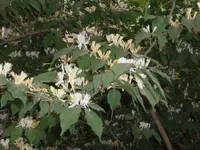
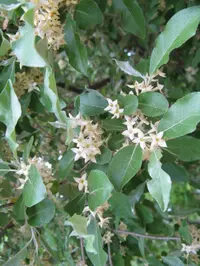
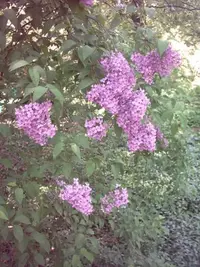
Recognize Amur honeysuckle by its opposite, oval leaves with pointed tips, arching multi-stem shrub form, and paired tubular white flowers borne from the leaf axils.

Most plants reach about 6 to 15 feet (1.8 to 4.6 m) tall, often with several trunks rising from the base.

Lonicera maackii Identification

Is This Amur honeysuckle?

Upload a clear image to check whether your plant ID is correct.

Clear images work best. Avoid photos taken too close or too far away

Check the shrub’s leaf pairs, branching, flowers, and berries.

  • A large, upright, many-stemmed shrub, often about 6-15 feet (1.8-4.6 m) tall, with arching outer branches.
  • Leaves grow in opposite pairs on the stem; each blade is simple, oval to egg-shaped, and about 2-3 inches (5-8 cm) long.
  • Pale white flowers occur in pairs where leaves meet the stem; each flower is tubular with five spreading lobes.
  • Berries are bright red, round, and usually borne in pairs at the leaf axils.

Split, hollow-looking tan bark on older stems can provide one more visual clue.

Lonicera maackii shows clear visual shifts from early shrub growth to flowering and fruiting.

  • Young plant: Usually a slender, upright shrub with paired oval leaves and green to tan stems; branching is sparse compared with mature plants.
  • Mature plant: Forms a dense, many-stemmed shrub or small tree, often 6-15 feet (1.8-4.6 m) tall, with arching outer branches and a broader crown.
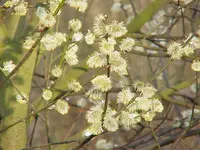
  • Flowering stage: Paired tubular white flowers line the leaf axils along young twigs, making the branch structure easier to see than in nonflowering plants.
  • Fruiting stage: Leaf pairs remain, but branches carry paired, glossy red berries at the leaf axils, a strong visual change from the flowering stage.

In spring, Lonicera maackii leafs out early and shows paired white flowers that soon turn creamy yellow, making shrubs stand out before many neighbors fully leaf out. By late summer into fall, red berries become obvious along the stems. After leaf drop, the shrub’s dense branching and pale, hollow-centered twigs are easier to see.

Several shrubs are regularly mistaken for Amur honeysuckle.

Morrow's honeysuckle(Lonicera morrowii)

Often confused because both are opposite-leaved shrubs with paired white flowers and red berries. Morrow's honeysuckle usually has densely hairy leaves, especially beneath, while Lonicera maackii leaves are mostly smooth or only lightly hairy.

Tatarian honeysuckle(Lonicera tatarica)

Similar size and branching can cause confusion. Tatarian honeysuckle typically has pink to rose flowers, while Lonicera maackii usually has white flowers that age yellow.

Bell's honeysuckle(Lonicera × bella)

This hybrid often overlaps in shape, leaves, and flower color. A practical clue is flower color: Bell's honeysuckle is commonly pink-flushed, while Lonicera maackii is usually white, then yellowish.

Lonicera maackii is native to northeastern Asia, including parts of China, Korea, Japan, and the Russian Far East. In its native range, it occurs in open woodlands, forest edges, thickets, valleys, and streamside habitats. That setting helps with identification because this species is most often encountered as a shrub of disturbed woodland margins and riparian corridors rather than deep shade or open prairie. Habitat alone is not diagnostic, but it helps narrow the field.

Check Your Plant ID

Use Botan to identify or confirm a plant from a photo, which helps avoid mix-ups with similar species.

FAQ

A quick Amur honeysuckle identification clue is the opposite leaves paired along the twig, together with white tubular flowers aging yellow and then bright red berries on a large, many-stemmed shrub.

More Plant Identification Guides

Identify Your Plant and Learn More

Use Botan to identify a plant from a photo, then see plant details, care information, and common problems for that species.

Botan app identifying a plant from a photo
How to Bottom Water Plants: Complete Guide

6 min read · 13 Jul 2026

How to Bottom Water Plants: Complete Guide

Bottom watering helps soil absorb moisture evenly and keeps foliage dry, reducing the risk of missed dry spots or root problems. Place the pot in a tray of water for a short time, then let it drain well.

Plant Care
How to Bottom Water Plants: Complete Guide
How Often to Water Fruit Trees

7 min read · 11 Aug 2026

How Often to Water Fruit Trees

Irrigation needs change as roots establish and weather shifts. This guide gives practical starting intervals, explains how soil and tree type change them, and shows how to recognize both excess moisture and drought stress.

Plant Care
How Often to Water Fruit Trees
12 Best Landscaping Trees for Your Garden

8 min read · 6 Oct 2026

12 Best Landscaping Trees for Your Garden

Choosing the landscape tree depends on what your garden needs most. These 12 options include compact flowering specimens, colorful deciduous trees, shade varieties, and evergreens suitable for screening and year-round structure.

Plant Recommendations
12 Best Landscaping Trees for Your Garden