Shallow Substrate Trays
Use wide, shallow trays with 1–2 cm of fine, sterile substrate so the thallus can spread laterally without drying edges or piling on itself.

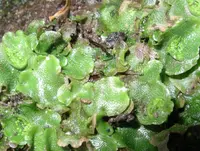
Crescent-cup liverwort (Lunularia cruciata) is a small, non-vascular plant that forms flat, overlapping green mats on soil or damp hard surfaces. It spreads by creeping growth rather than upright stems. Distinctive crescent-shaped cup structures on the surface hold tiny reproductive bodies that help it colonize new areas quickly. This species naturally occurs in mild, humid regions, often near streams, in greenhouses, and in shaded gardens. It thrives in constant moisture, low to medium light, and fine, compacted substrates, which can make it a persistent greenhouse or pot weed. For those who want to care for Crescent-cup liverwort intentionally, stable moisture and shelter from strong sun are the main priorities.

Care Difficulty
Moderate Care

Light Preference
Partial Shade

Water Requirements
Keep Soil Moist

Temperature Preference
Cool Climate

Hardiness Zone
7–11

Soil Texture
Loamy, Silty, Organic-rich

Soil pH
Acidic (5.5–6.5), Slightly acidic (6.5–7.0)

Soil Drainage
Waterlogged tolerant

Fertilization
Minimal (feed rarely)
Scan your plant to receive care tips personalized for your specific plant
Available on iOS and Android
Lunularia cruciata grows best in cool, shaded to lightly dappled sites that avoid harsh direct sun.
This liverwort needs constantly moist conditions and is sensitive to both drying out and stagnant water.
This species prefers cool, mild conditions and declines in sustained heat or hard frost.
This species needs constant high humidity to form healthy, flat thalli.
This liverwort favors consistently moist, organic-rich, fine-textured substrates.
This species is well suited to shallow container culture and terrarium trays.
This small non-vascular liverwort needs only minimal feeding under cultivation.
Pruning needs for Lunularia cruciata are light and mainly hygienic.
This liverwort is usually moved by transplanting patches rather than true repotting.
Lunularia cruciata is commonly propagated vegetatively and from its specialized structures.
In mild, frost-free to light-frost climates, this liverwort usually needs little special winter care.

Plant Health Check
Not sure what's wrong with your plant? Check your plant's health inside the app.
This liverwort produces shallow, crescent-shaped gemmae cups that hold tiny clonal propagules. Rain splashes these propagules out of the cups, allowing the plant to spread asexually across moist surfaces without producing spores.
Male and female sex organs grow on separate Lunularia cruciata plants, a condition called dioicy. Male plants form low, disk-like antheridial pads, while female plants develop stalked, umbrella-like archegoniophores that lift the developing sporophytes above the thallus.
This species thrives in human-modified habitats such as greenhouse benches, nursery containers, and shaded patios. Its ability to tolerate mild soil disturbance and regular watering makes it one of the most common liverworts encountered in horticultural settings, leading many growers to search for Lunularia cruciata care guidance.

Lunularia cruciata is believed to be native to western Europe and parts of North Africa but has spread accidentally with horticultural trade to many temperate regions worldwide, becoming a characteristic greenhouse and nursery liverwort in countries far from its original range.
This species spreads rapidly by gemmae, which are tiny clonal propagules, and by fragments of the thallus. In damp, shaded sites such as greenhouses or pots, it can quickly carpet surfaces and behave as a persistent weed.
Keep your plants happy and healthy with plant identification, disease detection, and easy care guidance.