Layering Propagation
Encourage new plants by pegging healthy trailing stems onto a shallow tray of moist, sterile mix until roots form, then sever and pot up the new sections once they resist gentle tugging.

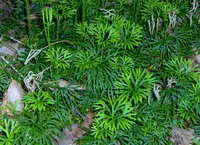
Groundcedar, Lycopodium digitatum, is a North American clubmoss related to ferns rather than true conifers. It forms low, creeping mats of evergreen, scale-like foliage that resemble tiny cedar branches. In forests it often carpets dry, open woodlands and sandy slopes, thriving in undisturbed, well-drained, acidic soil. The plant grows slowly and dislikes frequent disturbance, which can make how to care for groundcedar more demanding than typical houseplants. It prefers stable moisture, good air circulation, and dappled shade, so it suits cool, naturally humid environments better than hot, dry indoor spaces.

Care Difficulty
Hard Care

Light Preference
Partial Shade

Water Requirements
Keep Soil Moist

Temperature Preference
Cool Climate

Hardiness Zone
4–9

Soil Texture
Loamy, Peaty, Organic-rich

Soil pH
Strongly acidic (4.5–5.5), Acidic (5.5–6.5)

Soil Drainage
Moist but well-drained

Fertilization
Minimal (feed rarely)
Scan your plant to receive care tips personalized for your specific plant
Available on iOS and Android
This woodland clubmoss prefers cool, shaded conditions that mimic an understory forest floor.
This species needs consistently moist, never saturated, soil similar to its natural forest habitat.
This forest groundcover prefers cool to mild conditions and does poorly in temperature extremes.
This species needs consistently moist air and declines in dry indoor conditions.
Lycopodium digitatum prefers loose, organic-rich, evenly moist substrates that mimic woodland soil.
This species can be grown in containers if the pot is chosen to support its creeping, shallow-rooted habit.
This native woodland clubmoss needs only light feeding, as many established clumps of groundcedar grow well in low‑nutrient soils.
Lycopodium digitatum needs minimal pruning and is usually managed with light grooming rather than structural cutting.
This species is usually grown in the ground, so transplanting young clumps is more common than repotting mature plants.
Lycopodium digitatum is slow and specialized in nature, so practical home propagation focuses on careful division of small clumps.
This North American clubmoss is broadly cold hardy in much of its native range and usually needs only minimal winter care outdoors.

Plant Health Check
Not sure what's wrong with your plant? Check your plant's health inside the app.
This groundcedar is native only to eastern North America, where it forms creeping colonies on dry, acidic, usually sandy or rocky forest soils, especially in pine and oak woods.
The plant forms long, shallow underground stems called rhizomes that can extend well beyond the visible shoots, allowing a single clone to occupy a surprisingly wide patch of forest floor over time.
Unlike some related clubmosses that bear cone-like strobili on separate, much-branched fertile shoots, this species typically produces 1–3 simple, upright stalks from each leafy stem tip, each topped by a single spore cone.

Groundcedar spores were once collected from several North American Lycopodium species, including this one, and used in early photography and stage effects because the extremely fine, water-repellent spores burn in a quick, bright flash when dispersed through air.
This species spreads slowly by creeping stems and spores, usually forming low, patchy colonies rather than dense mats. It is not typically aggressive but may gradually expand in stable, undisturbed woodland-style plantings.
Keep your plants happy and healthy with plant identification, disease detection, and easy care guidance.