Flexuose Climbing Fern Care (Lygodium flexuosum)

Flexuose Climbing Fern

About Flexuose Climbing Fern

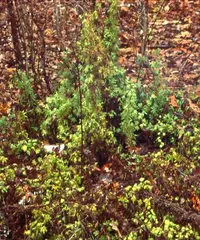
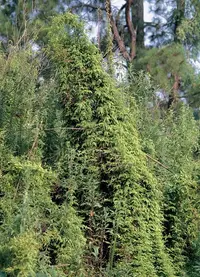
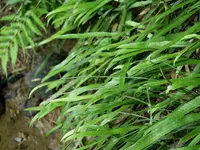
Flexuose climbing fern, Lygodium flexuosum, is a twining, vining fern that climbs using long, flexible fronds instead of typical woody stems. It forms delicate, lacy foliage that can scramble over shrubs, trellises, or rocky banks, giving a light, airy appearance.

This species is native to tropical and subtropical regions of Asia and Africa, where it grows in warm, humid habitats, often along forest edges and disturbed sites. Its vigorous growth and scrambling habit can make it somewhat challenging to control in suitable climates.

For those learning how to care for Flexuose Climbing Fern, it generally prefers bright filtered light, consistently moist but not waterlogged soil, and good humidity, which help maintain healthy, attractive fronds.

Main Plant Requirements

Care Difficulty

Moderate Care

Light Preference

Partial Shade

Water Requirements

Keep Soil Moist

Temperature Preference

Tropical / Frost Sensitive

Hardiness Zone

10–12

Soil Texture

Loamy, Silty, Organic-rich

Soil pH

Acidic (5.5–6.5), Slightly acidic (6.5–7.0)

Soil Drainage

Moist but well-drained

Fertilization

Minimal (feed rarely)

Get Personalized Care Plan

Scan your plant to receive care tips personalized for your specific plant

Available on iOS and Android

How to Care for the Flexuose Climbing Fern

This climbing fern prefers bright, indirect light similar to a lightly shaded forest edge.

  • Provide 3–5 hours of soft morning sun with filtered or dappled light for the rest of the day; avoid harsh midday and late-afternoon sun to prevent frond scorch.
  • Tolerates partial shade, but if grown in deep shade the fronds become sparse, pale, and elongated, and the vine climbs weakly in search of brighter conditions.
  • In hot summers, increase shade or use overhead filtering; in cooler seasons allow a bit more direct morning sun to support healthy growth of Flexuose Climbing Fern.

This fern needs consistently moist but not waterlogged soil around its shallow root system.

  • Water when the top 2–3 cm of soil feel just moist but not soggy; avoid letting the soil fully dry, as fronds wilt and crisp at the tips when underwatered.
  • Use freely draining, humus-rich soil so excess water can drain away; standing water around the roots causes yellowing fronds, blackened bases, and rot.
  • In warm growing seasons increase watering frequency, while in cooler months reduce slightly, still maintaining steady moisture rather than strict wet–dry cycles for Lygodium flexuosum.

This species thrives in warm, humid climates and is sensitive to cold and frost.

  • Optimal growth occurs at 70–85°F (21–29°C); growth slows below 65°F (18°C), especially if soil is wet and air humidity is low.
  • Protect from temperatures below 45°F (7°C); light frost damages fronds, and repeated freezing can kill the crown and underground rhizomes.
  • Tolerates brief heat up to 95°F (35°C) if soil stays evenly moist and shade is adequate, but extended hot, dry periods cause leaf scorch and stunted new growth.

This fern prefers consistently high humidity to support healthy, flexible fronds.

  • Aim for 60–80% humidity; it tolerates brief dips but reacts poorly to very dry indoor air.
  • Watch for crisping leaflet tips, slowed unfurling of new fronds, and brown edges as signs of low humidity stress.
  • Increase humidity with a room humidifier, grouped plants, and a water-filled pebble tray placed directly under the pot base.

Lygodium flexuosum thrives in moist, airy, organic-rich soil that stays evenly damp but never stagnant.

  • Use a loose, humus-rich mix such as 2 parts peat or coco coir, 1 part compost, and 1 part perlite or fine bark.
  • Aim for slightly acidic to neutral pH, roughly 5.5–7.0, to keep nutrient availability stable for steady fern growth.
  • Ensure rapid drainage by choosing a mix that drains within minutes yet feels lightly moist when squeezed, not muddy or compacted.
  • Avoid heavy clay, dense garden soil, or mixes that crust on top, which limit aeration and encourage root rot.

This species is suitable for container growing when the pot supports its climbing habit and moisture needs.

  • Select a wide, stable container that resists tipping as the vine-like fronds climb or sprawl over supports.
  • Choose slightly porous materials such as unglazed terracotta only if you can compensate for faster drying with more frequent watering.
  • Provide a vertical support structure anchored in the pot so twining fronds have secure attachment points and do not pull the container over.

This fern grows in naturally low-nutrient habitats and needs only light feeding in cultivation.

  • Use a balanced diluted liquid fertilizer (around 10-10-10) at 1/4–1/2 strength during the warm growing season.
  • Apply every 4–6 weeks in spring and summer, always on moist soil to prevent root burn.
  • Reduce feeding to 1 light application in late autumn or stop entirely in winter dormancy.
  • Alternatively, top-dress with a thin layer of mature compost once per year for gentle nutrition.

Thoughtful pruning keeps Lygodium flexuosum manageable and encourages healthy new fronds.

  • Best time is late winter to early spring, before strong new growth starts.
  • Cut back dead, damaged, or tangled fronds at the base using clean, sharp scissors or hand pruners.
  • Thin out overly crowded climbing stems to improve air movement and reduce fungal issues.
  • Guide remaining stems onto supports to control spread and maintain an orderly climbing form.

This twining fern is usually grown in the ground or large outdoor containers and dislikes frequent disturbance.

  • Consider transplanting when growth slows, roots circle the pot, or the plant dries out very quickly after watering.
  • Carry out repotting or transplanting in spring, every 2–3 years, when temperatures are mild and growth is starting.
  • Move into a container 2–5 cm wider, using a loose, organic-rich mix that drains well but stays evenly moist.
  • Handle roots gently, keep the original soil ball intact, then water thoroughly and shade for 5–7 days to reduce stress.

Lygodium flexuosum is usually propagated by spores or division under controlled, warm conditions.

  • For spores, collect mature brown sori on fronds, dry them, then sow on sterile, constantly moist peat-based medium in warm shade.
  • Maintain high humidity (70–90%) and 70–80°F for germination, using a covered tray or propagator.
  • Alternatively, divide established clumps in early spring, keeping several healthy fronds and rhizome pieces per division.
  • Replant divisions at the same depth, water well, and keep in bright shade until new growth shows stable establishment.

This subtropical fern has low frost tolerance and needs protection in regions with cold winters.

  • In climates below about 30°F, grow Lygodium flexuosum in containers and move indoors or into a frost-free greenhouse.
  • Outdoors in mild areas, apply a 5–8 cm mulch around the root zone to buffer soil temperature.
  • If light frost is possible, provide temporary fabric covering over foliage on the coldest nights.

Care Tips

Provide climbing mesh

Install a vertical mesh, netting, or thin trellis with 5–10 cm gaps so the fronds can twine naturally, and periodically guide young tendrils onto the support to prevent tangling and breakage.

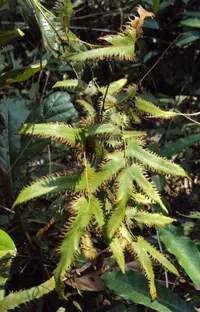
Rotate and redirect

Every 2–3 weeks, gently rotate the pot and redirect wandering fronds back toward the support structure to keep growth compact, reduce shading of lower fronds, and maintain even coverage.

Frond hygiene check

Once a month, inspect both sides of the fronds and the rachis (central stem) for mites, scale, and mealybugs, then wipe with a damp cloth or rinse under a gentle shower to remove dust and early pest colonies.

Surface root protection

If shallow roots or rhizomes become exposed at the soil surface, cover them with 1–2 cm of fine composted bark or fern-safe mulch to reduce moisture loss and mechanical damage.

Seasonal growth reset

At the end of the main growing season, remove old, brown, or overly tangled fronds and lightly thin crowded areas to improve air movement and light penetration, which supports healthier new growth when caring for Flexuose Climbing Fern.

Common Pests and Diseases

Lygodium microleaf gall mite

This pest induces small, swollen, bead-like galls along the leaflets and thin twining fronds, often causing twisting or distortion. Symptoms include clusters of tiny, pale, thickened segments that do not unroll normally.

Solution

Prune and destroy heavily galled fronds to reduce the mite population and prevent spread. For persistent infestations, apply a horticultural oil or sulfur-based miticide labeled for ferns, coating both sides of the fronds and repeating as directed while also removing nearby volunteer Lygodium vines that can act as reservoirs.

Leaf spot

This disease causes small, tan to dark brown spots on the thin leaf segments, which may merge into larger blotches under humid conditions. Symptoms include premature yellowing and shredding of the delicate leaflet margins.

Solution

Remove and discard affected fronds to lower the amount of fungal spores, and avoid wetting foliage when watering. Improve air movement around the vine and, if spread continues, use a broad-spectrum fern-safe fungicide according to label directions, treating both upper and lower frond surfaces.

Rust

This disease appears as orange to brown powdery pustules on the undersides of the leaf segments, often aligned along the veins. Symptoms include yellowing fronds and reduced vigor when infections are severe.

Solution

Cut and destroy infected fronds as soon as rust pustules are seen, and keep the vine less crowded on its support to improve airflow. In situations with recurring rust, apply a systemic fungicide labeled for rust on ferns at the first signs of infection, rotating products if treatments are needed over an extended period.

Scale insects

These insects form small, oval, tan to brown bumps on the slender stems and rachis, sucking sap and causing yellowing and decline of affected fronds. This pest often produces sticky honeydew that can lead to sooty mold on nearby foliage.

Solution

Wipe stems and accessible fronds with a cotton pad dipped in diluted alcohol or insecticidal soap, then rinse gently with water. For larger vines, use a horticultural oil spray targeting all stem surfaces and repeat at 7–14 day intervals until new growth appears clean, taking care to test on a small area first to confirm fern sensitivity.

Aphids

These insects feed on tender young fronds and coiled fiddleheads, causing curling, distortion, and slowed elongation of the climbing stems. This pest may also leave sticky honeydew that attracts ants and supports black sooty mold growth.

Solution

Rinse infested fronds with a firm stream of water to dislodge aphids, focusing on shoot tips and coiled fronds. If populations persist, apply insecticidal soap or a light horticultural oil to the growing tips and undersides of fronds, repeating as needed and avoiding treatment during high heat to prevent phytotoxicity.

Interesting Facts

Climbing with frond tips

This fern climbs by the continuous growth of its frond tips, which twine around nearby supports like a vine instead of relying on specialized tendrils or modified stems.

Extremely long fronds

Individual fronds can become many meters long in the wild, forming rope‑like strands that scramble over shrubs and small trees in warm, humid habitats.

Fire‑linked regeneration

In some parts of its range, this species regenerates vigorously from surviving rhizomes after disturbance such as cutting or fire, allowing it to reoccupy open ground quickly.

Botan icon

Did you know?

This species is one of only a few ferns with truly indeterminate frond growth, meaning a single frond can keep extending and branching for years as long as conditions allow, giving it an unusually vine‑like life form among ferns.

FAQs about Flexuose Climbing Fern

This species produces long, twining fronds that climb over nearby shrubs, trees, or supports using leaflet pairs as tendrils. Without vertical support it sprawls and forms dense, ground-hugging mats that can cover surrounding vegetation.

Grow Healthy Plants with Botan Care

Keep your plants happy and healthy with plant identification, disease detection, and easy care guidance.

Botan plant care app — identify plants on mobile

Explore More Plants