Rhizome Containment
Install a root barrier or sink bottomless pots into the ground to confine the spreading rhizomes and keep the clump from invading nearby beds over several seasons.

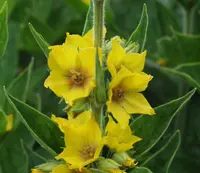
Dotted loosestrife (Lysimachia punctata) is a hardy, clump-forming perennial grown mainly for its tall spikes of bright yellow, star-shaped summer flowers. It typically forms dense colonies of upright stems with opposite, softly hairy leaves that create a full, informal look in borders or naturalistic plantings.
This species is native to parts of central and southeastern Europe, where it grows in moist meadows, woodland edges, and along streams. It is valued in gardens for its resilience, ability to cope with a range of soils, and tendency to spread steadily once established.
Gardeners who want to care for Dotted Loosestrife should note that it prefers moist, well-drained soil and enjoys full sun in cooler regions or light shade in warmer areas.

Care Difficulty
Easy Care

Light Preference
Full Sun

Water Requirements
Regular Water

Temperature Preference
Cold Hardy

Hardiness Zone
4–8

Soil Texture
Loamy, Clay, Organic-rich

Soil pH
Acidic (5.5–6.5), Slightly acidic (6.5–7.0)

Soil Drainage
Moist but well-drained

Fertilization
Minimal (feed rarely)
Scan your plant to receive care tips personalized for your specific plant
Available on iOS and Android
This hardy perennial prefers bright outdoor conditions with several hours of direct sun for strong flowering.
This moisture-loving perennial prefers consistently damp but not waterlogged soil.
This cold-hardy perennial tolerates a wide temperature range and survives typical outdoor winters in many regions.
Humidity is rarely a concern for Lysimachia punctata in typical outdoor conditions.
Lysimachia punctata prefers consistently moist, nutrient-rich, loamy soil that does not stay waterlogged.
This species can be grown in containers outdoors if the pot supports its moisture needs and spreading habit.
Lysimachia punctata grows well in average soil and usually needs only light feeding to maintain healthy flowering clumps.
Pruning maintains shape, controls spread, and supports flowering in Lysimachia punctata.
This species is mainly grown in the ground, so focus on dividing and transplanting to manage spread and vigor rather than frequent repotting.
Lysimachia punctata is commonly propagated by division and, to a lesser extent, by cuttings or seed.
This hardy perennial normally tolerates typical temperate winters with minimal intervention once established.

Plant Health Check
Not sure what's wrong with your plant? Check your plant's health inside the app.
This species spreads by short underground rhizomes that form dense clumps, allowing it to create long-lived, almost monocultural patches in moist, open habitats.
Its yellow, star-shaped flowers produce accessible nectar and pollen and are visited by a wide range of bees, hoverflies, and other insects, especially in early to mid-summer when floral resources may be limited locally.
In nature, this plant is often found along stream banks, damp meadows, and woodland edges, showing a notable tolerance for fluctuating soil moisture as long as conditions do not stay waterlogged for long periods.

Lysimachia punctata is native to central and southeastern Europe but has naturalized in parts of northern and western Europe and some regions of North America, where its ability to form persistent stands has led to localized concerns about it outcompeting native wetland plants.
This species spreads strongly by rhizomes and can become aggressive in open beds. Contain it with deep edging, root barriers, or by planting in large containers, and divide clumps every few years to control size when growing Dotted Loosestrife.
Keep your plants happy and healthy with plant identification, disease detection, and easy care guidance.