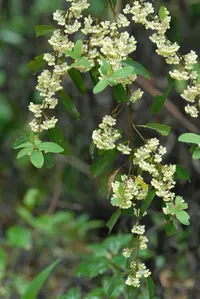
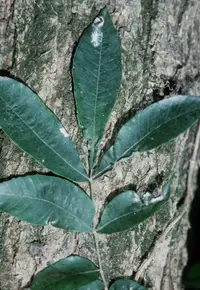
Osage-orange Care (Maclura pomifera)

Also known as: Horse-apple, Bois d'Arc, hedge apple, Monkey Brain, Bodark, Monkey Ball, Bow-wood, Yellow-wood, Mock Orange
Osage-orange

About Osage-orange

Osage-orange, Maclura pomifera, is a hardy deciduous tree known for its dense, thorny branches and large, wrinkled, yellow-green fruits. It often grows as a windbreak or hedge because of its strong, interlocking limbs.

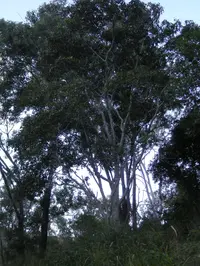
This species is native to the south-central United States, especially the Red River region of Texas, Oklahoma, and Arkansas, but it has been widely planted elsewhere. Mature trees develop a stout trunk and a broad, rounded crown.

It tolerates poor, dry soils and urban conditions, which makes it relatively easy to establish in tough sites. Those who care for Osage-orange should note that its thorns and fruit drop can make it less suitable for small, high-traffic gardens.

Main Plant Requirements

Care Difficulty

Easy Care

Light Preference

Full Sun

Water Requirements

Low Water

Temperature Preference

Cold Hardy

Hardiness Zone

4–9

Soil Texture

Sandy, Loamy, Clay

Soil pH

Slightly acidic (6.5–7.0), Slightly alkaline (7.0–7.5)

Soil Drainage

Well-drained

Fertilization

Minimal (feed rarely)

Get Personalized Care Plan

Scan your plant to receive care tips personalized for your specific plant

Available on iOS and Android

How to Care for the Osage-orange

Maclura pomifera is a sun-loving tree that develops best in open, unobstructed sites.

  • Provide 6–8 hours of direct sun daily; full sun all day promotes dense branching and heavy fruiting in Osage-orange hedges.
  • Tolerates light partial shade, especially with morning sun and light afternoon shade, but too much shade causes sparse growth and fewer fruits.
  • Newly planted trees benefit from some protection from extreme afternoon sun in very hot summers to reduce leaf scorch and transplant stress.

Maclura pomifera is drought-tolerant once established but still benefits from thoughtful watering in the first years.

  • For young trees, water deeply when the top 5–8 cm of soil feels dry, allowing water to soak 20–30 cm deep, then let the soil partly dry again.
  • Use well-drained soil; standing water, soggy soil, or algae growth around the base indicate poor drainage and risk of root rot.
  • In hot, dry summers, watch for drooping, dull leaves as a sign to water; in cool or rainy seasons, reduce watering to avoid saturated soil.

This hardy tree tolerates a wide temperature range but grows most actively under moderate warmth.

  • Optimal growth occurs around 70–85°F (21–29°C), with good shoot extension and leaf development in late spring and summer.
  • Mature trees survive winter lows near -30°F (-34°C); young trees benefit from mulch to buffer rapid freeze–thaw cycles around the root zone.
  • Handles summer heat above 95°F (35°C) if soil moisture is sufficient; prolonged extreme heat with drought can cause leaf scorch and early leaf drop.

Humidity is not a major factor for Maclura pomifera, which adapts well to typical outdoor air conditions.

Maclura pomifera prefers moderately fertile, well-drained mineral soils and tolerates a range of textures.

  • Use loamy or sandy-loam soil with some organic matter to support root development and moisture retention without waterlogging.
  • Aim for a slightly acidic to neutral pH around 6.0–7.5, avoiding strongly acidic or saline sites that restrict growth.
  • Improve drainage and aeration by incorporating coarse sand or fine gravel into heavier clay soils before planting.
  • Avoid compacted, poorly drained areas where water sits after rain, as prolonged saturation encourages root decline.

This species can be grown in containers only on a temporary or dwarfing basis due to its eventual tree size and strong roots.

  • Select a deep, heavy pot that resists tipping, as the woody trunk and branches become top-heavy over time.
  • Use a coarse, fast-draining mix and elevate the container slightly so drainage holes are never blocked by the ground surface.
  • Position large containers where strong winds are buffered by walls or railings to reduce stress on the developing root system.

This hardy North American tree usually needs minimal feeding once established, especially in fertile ground.

  • For young or container-grown Osage-orange, use a balanced slow-release fertilizer (e.g., 10-10-10) in early spring.
  • Apply a light top-dressing of compost around the root zone once per year during the growing season.
  • Reduce or skip feeding in fall and winter when growth is dormant.
  • Use fertilizers at 1/2–3/4 label strength to avoid excessive, weak growth.

Pruning Maclura pomifera focuses on structure, clearance, and safety rather than frequent shaping.

  • Schedule main pruning in late winter to very early spring before bud break.
  • Remove dead, damaged, rubbing, or crossing branches to improve airflow and tree health.
  • Thin crowded interior shoots to maintain a strong, open framework and desired height or spread.
  • Use clean, sharp bypass pruners or a pruning saw, making smooth cuts just outside the branch collar.

This tree is usually field-grown, so guidance centers on transplanting young specimens from pots or nursery rows.

  • Transplant in late fall or early spring when dormant; avoid hot, dry weather to reduce stress.
  • Look for circling roots, root-bound containers, or stalled growth as signs a young tree needs a larger space.
  • Move up 1–2 pot sizes or into the ground, gently loosening outer roots and planting at the same depth.
  • Water deeply after planting, then keep soil evenly moist for the first season and mulch 5–8 cm to protect roots.

Propagation is typically done from seed, with cuttings used less often due to variable success in home conditions.

  • Collect ripe fruits in fall, separate and clean seeds, then cold-stratify for 60–90 days at 34–41°F.
  • Sow stratified seeds in spring in a free-draining mix, keep lightly moist, and provide bright light.
  • For semi-hardwood cuttings in summer, use rooting hormone and high humidity in a warm, shaded propagator.
  • Space seedlings well and pot up once roots fill the starter cell or small pot to avoid early root binding.

This species is cold hardy in much of the US and usually needs little dedicated winter care once established.

  • Young trees benefit from 5–8 cm of mulch over the root zone, kept away from the trunk to prevent rot.
  • In very exposed sites, use a breathable trunk wrap on the first 1–3 winters to limit sunscald and cracking.
  • Container-grown trees in cold climates should be moved to an unheated, sheltered space above 20°F.

Care Tips

Early structural training

Select a single straight leader in the first 3–5 years and remove competing upright shoots during late winter to create a strong central trunk that will better support the heavy, spiny branches as the tree matures.

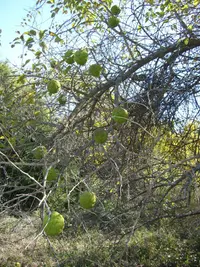
Managing thorns safely

When pruning or working near branches, use thick leather gloves, long sleeves, and eye protection, then collect and dispose of cut thorny material immediately so it does not injure people, pets, or puncture tires.

Fruit drop planning

If fruit litter is a concern, site trees away from driveways and walkways or plant only male (non-fruiting) selections so the large, heavy fruits do not create slipping hazards or extra cleanup work.

Windbreak and hedge use

For an effective windbreak or barrier hedge, plant in staggered double rows 1.5–3 m apart and tip-prune young shoots to encourage dense, thorny branching near the base.

Long-term space management

Allow generous spacing from fences, power lines, and buildings, since caring for Osage-orange becomes difficult once the tree reaches full size and its extremely hard wood and thorns make corrective pruning labor-intensive.

Common Pests and Diseases

Leaf spot

This disease causes small dark spots on leaves that may merge into larger blotches, sometimes leading to early leaf drop. Symptoms include more damage on stressed or crowded trees with poor air circulation.

Solution

Prune to open the canopy and remove heavily infected twigs and fallen leaves to reduce fungal spore levels. If defoliation is severe for several seasons, a copper or chlorothalonil-based fungicide labeled for ornamental trees can be applied in early spring and repeated as directed, focusing on thorough coverage of young foliage.

Powdery mildew

This disease produces a white or gray powdery coating on leaves, especially in shaded, humid sites. Symptoms include distorted new growth and reduced vigor when infections are heavy.

Solution

Improve air movement by thinning branches and avoiding dense hedging, and water at the soil level rather than overhead. In cases of repeated infection, apply a sulfur or potassium bicarbonate fungicide labeled for powdery mildew on ornamental trees at the first sign of symptoms, repeating as the label recommends.

Galls (Cecidomyiidae midges)

These insects cause small blister-like or pouchy swellings on leaves or twigs where larvae feed inside plant tissue. This pest usually creates cosmetic damage but can be heavy on some trees.

Solution

Rake and discard fallen, infested leaves in autumn to reduce overwintering stages, and avoid high-nitrogen fertilization that promotes tender, susceptible growth. In most cases, chemical control is unnecessary; for severe, repeated infestations, consult a local arborist about targeted systemic treatments timed to adult emergence.

Scale insects

These insects appear as small, immobile bumps on stems and branches, feeding on sap and sometimes producing sticky honeydew that can lead to sooty mold. This pest can cause twig dieback and general decline when populations are high.

Solution

Prune out heavily infested twigs and dispose of them, then scrub remaining colonies gently with a soft brush and soapy water on reachable branches. For larger trees or severe infestations, a horticultural oil spray during the dormant season or a labeled systemic insecticide in early spring can help reduce populations while minimizing impact on beneficial insects.

Borers

These insects tunnel into trunks and larger branches, creating small entry holes, frass (sawdust-like material), and sometimes dieback in affected limbs. Symptoms include weakened structure and higher risk of branch failure under wind or load.

Solution

Maintain tree vigor with proper watering during drought and avoid trunk injuries, since stressed trees are more attractive to borers. Remove and destroy severely infested branches, and where borer pressure is documented locally, consider a preventive trunk or soil-applied systemic insecticide timed to adult flight, following local extension guidance for Maclura pomifera care instructions.

Interesting Facts

Legacy of extinct megafauna

The large, wrinkled fruits of this species are often cited as classic examples of evolutionary anachronisms, thought to have been dispersed in the past by now-extinct North American megafauna such as giant ground sloths and mammoths, rather than by any modern native animal.

Unusually decay‑resistant wood

Its dense, fine-grained heartwood is naturally rich in rot-resistant compounds and was historically prized for fence posts and wagon wheels, often outlasting metal hardware in outdoor use.

Natural living fence

Before the invention of barbed wire in the 19th century, this species was widely planted across the central United States as closely spaced, heavily pruned hedgerows whose thorny branches formed an almost impenetrable livestock barrier.

Botan icon

Did you know?

The bright yellow heartwood of this tree yields one of North America’s strongest natural dye sources, historically used to produce yellow and yellow‑green colors for textiles and occasionally to enhance the color of other wood products.

FAQs about Osage-orange

This species typically grows 30–60 cm per year under good conditions, faster in fertile, well-drained soil. Growth slows in compacted, dry, or waterlogged sites. Young trees establish quickly, then moderate as the root system matures.

Grow Healthy Plants with Botan Care

Keep your plants happy and healthy with plant identification, disease detection, and easy care guidance.

Botan plant care app — identify plants on mobile

Explore More Plants