bigleaf magnolia Care (Magnolia macrophylla)

Also known as: Large-leaved Cucumber Tree, silverleaf magnolia, white cucumbertree
bigleaf magnolia

About bigleaf magnolia

Bigleaf magnolia (Magnolia macrophylla) is a deciduous tree known for having some of the largest simple leaves of any North American tree. It forms a rounded to irregular crown and produces very large, creamy white, fragrant flowers followed by cone-like fruiting structures.

This species is native to the southeastern United States, typically found in rich, sheltered woodlands and ravines. It can be somewhat demanding, as it dislikes exposed, windy sites and cramped urban spaces.

Gardeners who want to care for bigleaf magnolia should provide a protected location with evenly moist, well-drained, slightly acidic soil and space for its broad canopy and foliage spread.

Main Plant Requirements

Care Difficulty

Moderate Care

Light Preference

Partial Sun

Water Requirements

Regular Water

Temperature Preference

Cold Hardy

Hardiness Zone

5–8

Soil Texture

Loamy, Clay, Organic-rich

Soil pH

Strongly acidic (4.5–5.5), Acidic (5.5–6.5)

Soil Drainage

Moist but well-drained

Fertilization

Minimal (feed rarely)

Get Personalized Care Plan

Scan your plant to receive care tips personalized for your specific plant

Available on iOS and Android

How to Care for the bigleaf magnolia

This species needs bright outdoor conditions with some protection from harsh afternoon sun.

  • Provide 4–6 hours of morning sun with light shade or dappled light after midday, especially in hotter climates.
  • Allow partial shade (under high, open trees) to prevent leaf scorch on bigleaf magnolia, particularly where summer sun is intense.
  • Watch seasonal changes: in spring and fall, more direct sun is usually safe, but in mid-summer add shade from about 1–4 p.m. to reduce stress.

Magnolia macrophylla prefers consistently moist but not waterlogged soil.

  • Before watering, check that the top 3–5 cm of soil has just started to dry, then irrigate slowly so moisture reaches the deeper root zone.
  • Use deep, infrequent watering rather than light sprinkling, and plant in well-drained, slightly acidic soil to reduce root rot risk.
  • In hot, dry periods, look for drooping newer leaves and dry soil as cues to water; yellowing leaves and soggy soil indicate overwatering.

This deciduous tree is hardy but grows best within moderate temperature ranges.

  • Optimal growing temperatures are about 65–80°F (18–27°C) during the active season, with cool winters needed for normal dormancy.
  • Established trees tolerate winter lows near -10°F (-23°C) in suitable hardiness zones, but young plants benefit from protection from severe freezes and drying winds.
  • In summer, it copes with short heat spells up to about 90°F (32°C) if soil moisture is adequate; prolonged hotter periods increase scorch and stress risk.

Magnolia macrophylla prefers moderate outdoor humidity but usually adapts well in most temperate climates.

  • Aim for ambient humidity around 40–60% to support healthy foliage and flower development.
  • It tolerates short dry spells, but prolonged very dry air can cause marginal leaf browning and tip dieback.
  • Increase humidity around young trees by mulching the root zone and grouping nearby plantings to reduce drying winds.

Magnolia macrophylla grows best in deep, evenly moist, well-aerated soil that never stays waterlogged.

  • Use a loamy structure with plenty of organic matter, such as composted bark and leaf mold, to hold moisture while staying friable.
  • Ensure drainage is reliable; avoid compacted clay or low spots where water pools after rain.
  • Target a slightly acidic to neutral pH around 5.5–7.0; incorporate peat-free compost or pine fines to gently acidify if needed.
  • Improve aeration and drainage by mixing in coarse sand or fine bark chips, and avoid heavy amendments that create dense, sticky soil.

This species is only moderately suitable for container growing and is usually best kept in pots for temporary or juvenile stages.

  • Choose a very large, deep, and heavy container to accommodate the long taproot and reduce tipping from top-heavy growth.
  • Use a stable, wind-sheltered placement because large leaves act like sails and can stress roots in loose containers.
  • Select a thick-walled pot material, such as heavy ceramic, to buffer rapid moisture loss and temperature swings in exposed locations.

Magnolia macrophylla benefits from light, thoughtful feeding but tolerates lean, well-prepared soil.

  • Use a slow-release, balanced NPK fertilizer or a 2–5 cm layer of compost in early spring as growth begins.
  • Feed once in spring and, if growth is weak, once in midsummer; avoid late-season feeding that encourages tender growth.
  • Apply at half the label strength for young or newly planted bigleaf magnolia to limit root burn risk.
  • Water thoroughly before and after fertilizing to help distribute nutrients evenly and protect roots.

Magnolia macrophylla needs only minimal pruning to maintain health and structure.

  • Prune in late winter or immediately after flowering to avoid cutting off next year’s flower buds.
  • Remove dead, diseased, or storm-damaged wood first, then any crossing or rubbing branches.
  • Limit cuts to light thinning; avoid heavy structural changes that can stress the tree and reduce flowering.
  • Use clean, sharp bypass pruners or loppers and make smooth cuts just outside the branch collar.

This magnolia is usually grown in the ground, so focus on careful transplanting rather than frequent repotting.

  • Transplant young trees in late fall or early spring when soil is workable and the plant is dormant.
  • Look for circling roots in containers or stalled growth as signs a nursery plant needs a larger, wider hole.
  • Dig a broad planting hole, loosen outer roots gently, and set the tree at the same soil depth as in its pot.
  • Water deeply after planting, mulch 5–8 cm over the root zone, and keep soil evenly moist to reduce transplant shock.

Magnolia macrophylla is slow to propagate and most home gardeners rely on nursery-grown plants.

  • Sow fresh seeds in fall after removing the fleshy coat; provide cold stratification in moist medium at 35–40°F for several months.
  • Use semi-ripe cuttings in mid to late summer, with a rooting hormone and high humidity under bright, indirect light.
  • Layering low branches in spring, by wounding and burying a section, can root over 1–2 years with consistent moisture.

This magnolia is moderately cold hardy but young trees benefit from some winter preparation.

  • In USDA zones near the cold limit, apply a 5–8 cm mulch layer over the root zone, keeping it off the trunk.
  • Avoid late-summer nitrogen that promotes tender shoots vulnerable to freeze damage.
  • For container-grown plants, move pots into an unheated garage or sheltered area where temperatures stay above about 20°F.

Care Tips

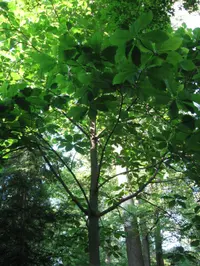
Stake young trunks

Install a sturdy, flexible stake on the windward side of young trees and secure the trunk with soft, adjustable ties to prevent wind rock and root loosening while the root system establishes.

Protect surface roots

Avoid cultivating or walking heavily under the canopy because this species forms shallow, sensitive roots; use a light organic mulch layer instead of digging to control weeds.

Manage heavy branches

As lower branches thicken and extend, selectively reduce or remove those that sag or are prone to breakage under leaf weight or snow load to prevent structural damage.

Shelter from strong winds

Position the tree where buildings or larger trees break prevailing winds, or create a windbreak with shrubs or fencing, since the oversized leaves tear easily and lose vigor in exposed sites when growing bigleaf magnolia.

Plan for leaf drop

Allow the very large fallen leaves to dry and then shred or chop them before composting or using as mulch, since whole leaves can mat, shed water, and slow soil aeration around the root zone.

Common Pests and Diseases

Scale insects

This pest attaches firmly to young stems and leaf undersides, sucking sap and causing yellowing, reduced vigor, and sticky honeydew that can lead to sooty mold. Symptoms include rough, bump-like coverings on stems and midribs that do not brush off easily.

Solution

Prune and dispose of heavily infested twigs, then wipe reachable areas with a cloth dipped in mild soapy water or horticultural oil. For larger trees, apply a horticultural oil spray during the dormant or early growing season, ensuring thorough coverage of branches and undersides of leaves, and repeat as needed according to label directions.

Magnolia leaf spot

This disease causes tan to brown spots on the large leaves, often with darker borders and sometimes small holes where dead tissue drops out. Symptoms include premature leaf yellowing and drop, especially in damp, shaded sites with limited air movement.

Solution

Remove and discard fallen and heavily spotted leaves to reduce fungal spores, and avoid overhead watering that keeps foliage wet. Improve air circulation by spacing plants properly and thinning nearby vegetation, and in severe, recurring cases consider a labeled fungicide applied at leaf-out and during prolonged wet periods.

Magnolia scale

This pest is a large soft scale specific to magnolias that feeds on sap and produces heavy honeydew, which often develops black sooty mold on leaves and nearby surfaces. Symptoms include dieback of smaller branches, leaf yellowing, and reduced flowering over time.

Solution

In late summer, inspect for the crawler stage on stems and treat with an appropriate insecticidal soap or horticultural oil, repeating as needed to cover new hatchlings. During winter dormancy, apply a horticultural oil spray to trunks and branches to smother overwintering scales and prune out severely infested limbs to limit population size.

Leaf scorch

This disorder is common because of the very large leaves, with symptoms including browning and crisping along edges and between veins, often appearing during hot, dry, or windy weather. Symptoms include leaves that look burned while veins remain green, especially on exposed upper branches.

Solution

Maintain even soil moisture with deep, infrequent watering and a 5–8 cm layer of organic mulch over the root zone, kept away from the trunk. Provide shelter from strong winds and intense afternoon sun where possible, and avoid high-salt or high-nitrogen fertilizers that can increase scorch sensitivity.

Verticillium wilt

This disease is a soil-borne fungus that invades the water-conducting tissues, leading to sudden wilting, branch dieback, and sparse foliage, often appearing first on one side of the tree. Symptoms include discolored streaks in the sapwood when affected branches are cut open.

Solution

Prune and destroy affected branches well back into healthy wood, disinfecting tools between cuts, and reduce plant stress with regular watering and mulch over the root area. Avoid replanting other susceptible species in the same location, and if decline is advanced, consider gradual replacement with a more resistant tree species while improving soil health with organic matter.

Interesting Facts

Largest simple leaves

This species holds the record for having the largest simple leaves of any tree native to North America, commonly reaching 30–90 cm long under natural conditions.

Gigantic fragrant flowers

Its creamy white flowers can span 20–30 cm across, are strongly fragrant, and open in late spring to early summer, making them among the largest flowers of any temperate-zone tree.

Disjunct native range

Bigleaf magnolia has a patchy, disjunct distribution in the southeastern United States, typically occurring as scattered populations in sheltered ravines and rich, moist forests rather than forming continuous stands.
Botan icon

Did you know?

Fossil and morphological evidence suggest that bigleaf magnolia retains several primitive magnolia features, such as large, spirally arranged floral parts, which makes it useful in studies of the early evolution of flowering plants.

FAQs about bigleaf magnolia

Lack of flowering often comes from insufficient maturity, late spring frosts damaging buds, or too much shade. Avoid heavy pruning, protect from frost where possible, and allow several years for reliable blooming to develop.

Grow Healthy Plants with Botan Care

Keep your plants happy and healthy with plant identification, disease detection, and easy care guidance.


Botan plant care app — identify plants on mobile

Explore More Plants