


Controlled substrate depth
Maintain a very shallow, level substrate layer (0.5–1 cm of fine, clean sand or sandy loam) so the thalli can spread as a flat mat without being buried or shaded by raised ridges.

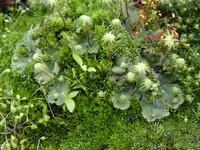
Common liverwort (Marchantia polymorpha) is a primitive non-vascular plant, more closely related to mosses than to flowering plants. It forms flat, green, overlapping mats that hug the soil surface, rocks, or damp cracks.
In nature it usually grows in cool, moist, shaded places such as stream banks, greenhouse benches, potting areas, and compacted garden soil. It spreads quickly by tiny spores and small plant fragments, so it can become a persistent ground cover or even a minor weed in nurseries.
Because it prefers constant moisture, low air movement, and low light, it often appears where conditions stay wet. Understanding these traits is the key to how to care for Common Liverwort in containers or terrariums.

Care Difficulty
Moderate Care

Light Preference
Partial Shade

Water Requirements
Keep Soil Moist

Temperature Preference
Cool Climate

Hardiness Zone
3–9

Soil Texture
Loamy, Silty, Organic-rich

Soil pH
Acidic (5.5–6.5), Slightly acidic (6.5–7.0)

Soil Drainage
Waterlogged tolerant

Fertilization
Minimal (feed rarely)
Scan your plant to receive care tips personalized for your specific plant
Available on iOS and Android
This shade-loving liverwort prefers soft, indirect light that mimics a forest floor or stream bank.
This non-vascular plant requires consistently moist conditions that do not stay stagnant or waterlogged.
This species thrives in cool, temperate conditions and declines in prolonged heat or hard frost.
This species needs very high humidity to thrive and declines quickly in dry air.
Marchantia polymorpha prefers constantly moist, organic-rich, shallow substrates rather than typical potting soil.
This species can grow in shallow containers when moisture and stability are tightly controlled.
Marchantia polymorpha grows in low‑nutrient habitats and usually needs no additional feeding in cultivation.
Pruning for Marchantia polymorpha is minimal and mainly about hygiene and colony control.
This liverwort is more often transplanted than repotted, since it typically grows as a ground or surface cover.
Common Liverwort is straightforward to multiply and is well suited to small‑scale propagation in shallow trays or terraria.
This liverwort is cold tolerant in many temperate climates and usually needs no special winter care outdoors.

Plant Health Check
Not sure what's wrong with your plant? Check your plant's health inside the app.
This liverwort is considered one of the earliest land plant lineages and is often used as a model organism to study how plants first adapted from aquatic to terrestrial environments, including tolerance to desiccation and high light.
It produces tiny lens-shaped gemmae in cup-like structures on the thallus surface; raindrops splash these gemmae away, creating genetically identical clones and allowing very rapid colonization of bare, moist substrates.
The species is dioicous, meaning individual plants are either male or female, and it forms distinctive umbrella-like male structures (antheridiophores) and star-like female structures (archegoniophores) on stalks that rise above the main thallus.

Marchantia polymorpha has one of the simplest and most compact genomes among land plants that can be easily grown in laboratories, which has made it a key reference species for studying fundamental plant processes such as hormone signaling, organ development, and responses to environmental stress.
This species spreads very quickly by tiny spores and vegetative fragments. In moist, compact, or poorly drained areas it can form dense mats and behave aggressively, often outcompeting mosses, seedlings, and small ground covers if unmanaged.
Keep your plants happy and healthy with plant identification, disease detection, and easy care guidance.

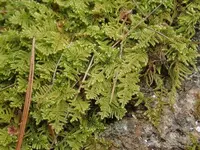
brocade moss
Callicladium imponens
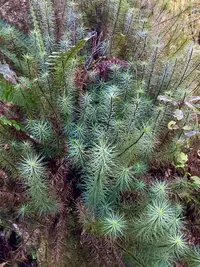
Dawsonia superba
Dawsonia superba
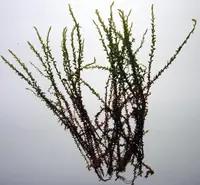
calliergon moss
Calliergon cordifolium
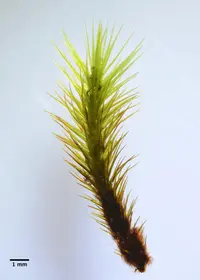
Menzies' anacolia moss
Anacolia menziesii
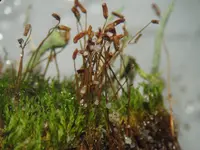
ceratodon moss
Ceratodon purpureus
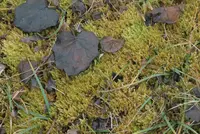
Lindberg's Hypnum Moss
Calliergonella lindbergii
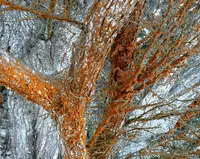
Orange Rock Hair
Trentepohlia aurea
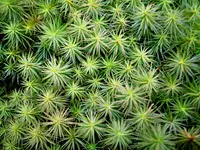
juniper polytrichum moss
Polytrichum juniperinum