


Host timing awareness
Plan any observational work around known periodical cicada emergence years in your region, since the fungus appears only when its cicada hosts are present above ground.

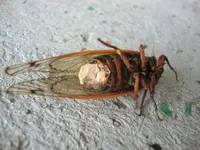
Massospora cicadina is not a typical ornamental plant but a specialized fungal pathogen that infects periodical cicadas. It belongs to a group of fungi that live and reproduce on living insects rather than in soil or pots.
This fungus forms a white to yellowish, powdery mass that replaces the rear segments of infected cicadas, releasing spores as the insects move and fly. It naturally occurs in areas where 13- and 17-year periodical cicadas emerge in large numbers, mainly in eastern North America.
Because it depends on cicada hosts and complex life cycles, it is not suitable or practical to grow or care for Massospora cicadina like a normal houseplant or garden species.

Care Difficulty
Moderate Care

Light Preference
Partial Shade

Water Requirements
Moderate Water

Temperature Preference
Warm Climate

Hardiness Zone
Unknown

Soil Texture
Loamy

Soil pH
Slightly acidic (6.5–7.0)

Soil Drainage
Well-drained

Fertilization
Minimal (feed rarely)
Scan your plant to receive care tips personalized for your specific plant
Available on iOS and Android
This fungus develops in soil and on periodical cicadas rather than as a typical light-dependent plant.
Moisture conditions for this cicada-associated fungus are tied to natural forest soil and rainfall patterns, not to plant-style irrigation.
This periodical cicada pathogen tracks the long, underground life cycle of its hosts rather than typical plant temperature needs.
Humidity is not a meaningful care factor for Massospora cicadina, which is a pathogenic fungus specialized on cicadas rather than a cultivated plant.
Soil preparation is not applicable, as Massospora cicadina is an obligate pathogen of cicadas and is not managed through horticultural soil mixes.
This species is not suitable for container growing, as it is a cicada-infecting fungus and not a container-grown plant.
This guide treats Massospora cicadina as if managed like a soil-grown organism, although in nature it does not need horticultural fertilization.
Pruning is not applicable to Massospora cicadina because it is a cicada-infecting fungus rather than a cultivated garden plant.
Repotting or transplanting does not apply to Massospora cicadina, which behaves as a pathogen in insect hosts rather than a container-grown plant.
Intentional propagation of Massospora cicadina is not recommended outside controlled research settings due to its pathogenic lifecycle in cicadas.
Specific winter care is not relevant for Massospora cicadina, which overwinters naturally in soil and cicada hosts rather than as a horticultural specimen.

Plant Health Check
Not sure what's wrong with your plant? Check your plant's health inside the app.
This fungus infects only periodical cicadas in the genus Magicicada, synchronizing its life cycle with their 13- or 17-year emergence patterns so it can reappear when new hosts emerge from the soil.
Infected cicadas often remain able to fly and show altered mating behavior, which increases contact with healthy cicadas and helps spread the fungal spores despite severe damage to the abdomen.
The fungus produces an initial stage with a large plug of infectious spores that spread between living cicadas, followed by a second stage that generates resting spores designed to persist in soil until the next periodical cicada generation emerges.

Massospora cicadina produces psychoactive compounds, including alkaloids similar to those in some hallucinogenic mushrooms and plant-derived stimulants, which are thought to help keep infected cicadas active and mobile long enough to disperse the fungus over wider areas.
This species is a pathogenic fungus of periodical cicadas, not a garden plant. It spreads only through infected insects and spores in the environment, not via roots or shoots in soil or containers.
Keep your plants happy and healthy with plant identification, disease detection, and easy care guidance.

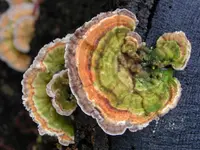
turkey tail mushroom
Trametes versicolor
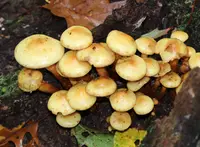
alder scalycap
Flammula alnicola
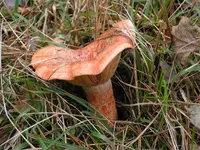
saffron milkcap
Lactarius deliciosus
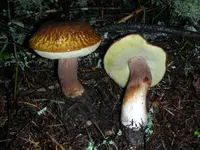
Boletus fibrillosus
Boletus fibrillosus
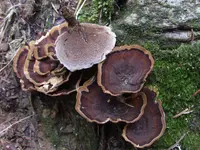
Brown Funnel Polypore
Coltricia perennis
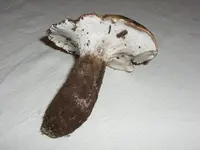
Boletopsis leucomelaena
Boletopsis leucomelaena
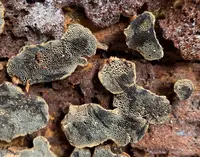
Coltriciella dependens
Coltriciella dependens
snow fungus
Tremella fuciformis