Mounting On Slabs
Mount the plant on cork or hardwood bark with a thin pad of long-fiber sphagnum to mimic its epiphytic habit, then mist roots lightly once or twice daily so the mount never dries to a crisp between regular soakings.

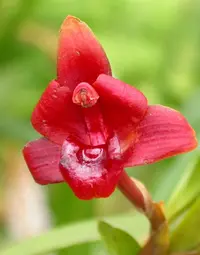
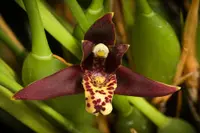
Flame orchid, Maxillaria coccinea, is a compact epiphytic orchid known for its vivid red, waxy flowers that stand out against dense, grass-like foliage. It usually grows in clumps, forming a neat, tufted appearance suitable for small spaces and mounted displays.
This species is native to cool, misty cloud forests of the Andes in South America, where it grows on trees in humid, shaded conditions. It can be moderately challenging, as it prefers stable moisture, good air movement, and cooler temperatures, so learning how to care for Flame Orchid requires attention to its natural habitat.
In cultivation it performs best in bright, filtered light, high humidity, and a very airy orchid mix that drains quickly but does not dry out completely.

Care Difficulty
Hard Care

Light Preference
Bright Indirect Light

Water Requirements
Keep Soil Moist

Temperature Preference
Tropical / Frost Sensitive

Hardiness Zone
11–12

Soil Texture
Peaty, Organic-rich, Loamy

Soil pH
Acidic (5.5–6.5)

Soil Drainage
Moist but well-drained

Fertilization
Moderate (every 2–4 weeks)
Scan your plant to receive care tips personalized for your specific plant
Available on iOS and Android
This orchid prefers bright but gentle light similar to a lightly shaded forest edge.
This species prefers evenly moist conditions with brief drying at the surface between waterings.
This orchid grows best in cool- to intermediate-temperature conditions with mild seasonal shifts.
This orchid prefers consistently high humidity to stay healthy and flower reliably.
This epiphytic orchid needs a very open, airy medium rather than regular potting soil.
This species is well-suited to container growing when the pot and medium prevent water from lingering around the roots.
This orchid benefits from light, consistent feeding during active growth but reacts poorly to heavy fertilizer.
Pruning needs for Maxillaria coccinea are minimal and focus on hygiene rather than shaping.
This species prefers a stable root environment and only occasional repotting when the medium breaks down or the pot is crowded.
Division is the standard method for multiplying Maxillaria coccinea in home collections.
This orchid is not frost hardy and requires sheltered, cool to mild winter conditions.

Plant Health Check
Not sure what's wrong with your plant? Check your plant's health inside the app.
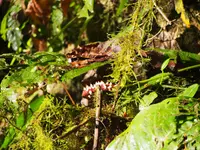
This orchid is native to cool, misty cloud forests of the Andes in Colombia, Ecuador, and Peru, where it often grows on mossy tree branches in very high humidity and constant air movement.
The plant produces thick, waxy, typically scarlet flowers that can release a sweet, spicy fragrance, especially in brighter conditions and cooler air.
Each slender growth usually carries only one flower emerging from the base, a trait that helps distinguish it from many other orchids that form showy multi-flowered spikes.

This species often hosts specific epiphytic mosses and liverworts on its roots and surrounding substrate in the wild, creating miniature, layered plant communities on a single tree branch.
Lack of blooms often comes from insufficient light, temperature that is too even year-round, or depleted nutrients. Slightly cooler, drier rest after flowering, stable humidity, and light feeding usually restore flowering over the next season.
Keep your plants happy and healthy with plant identification, disease detection, and easy care guidance.